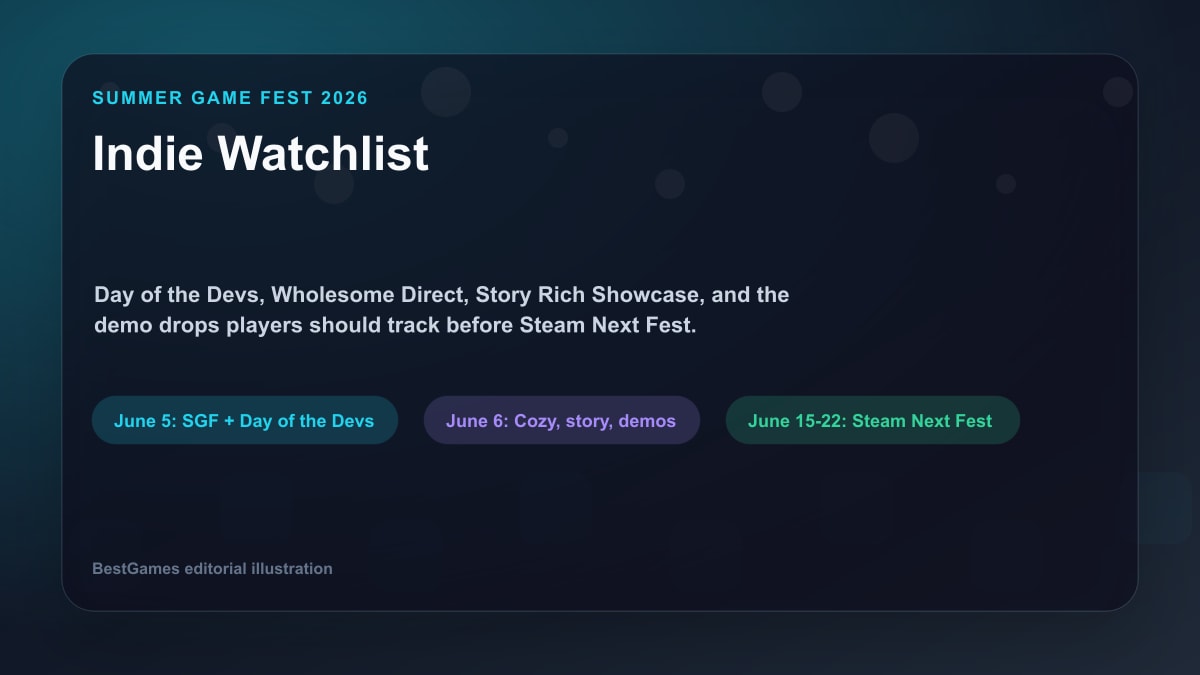
Summer Game Fest 2026 Indie Watchlist is the practical filter players need before the June showcase week becomes too noisy to follow. The main Summer Game Fest broadcast is set for Friday, June 5 at 2 p.m. Pacific time, live from the Dolby Theatre in Los Angeles. Day of the Devs follows at 4 p.m. Pacific time. On June 6, Wholesome Direct, Story Rich Showcase, Green Games Showcase, Pride Parade, and other community or partner streams stack up within a few hours. Then, on June 15, Steam Next Fest opens and turns many of the most interesting games from trailers into playable demos.
That calendar creates a familiar problem. Players say they want more original independent games, but the week that surfaces them is built like a firehose. A brilliant two-minute trailer can vanish between a publisher sizzle reel, a hardware reveal, and a surprise date announcement for a much bigger franchise. Demo drops are even easier to miss, because they often arrive in three places at once: a show segment, a Steam page, and a developer post on social media.
The answer is not to watch every minute live. The answer is to treat showcase week as a scouting window. A good player watchlist should record which show gave a game credibility, what the game actually asks you to do, whether a demo exists now, and whether the game should be revisited during Steam Next Fest June 2026. That approach makes Summer Game Fest less like a news marathon and more like a playable discovery map.
This piece is written for players first, but it also helps small teams understand how players will sort them. If a game appears in Day of the Devs, players will expect curation and a clear creative identity. If it appears in Wholesome Direct, players will look for comfort, craft, and emotional tone, not just pastel colors. If it arrives as a stealth demo drop, players will decide quickly whether the download earns a spot in their finite evening queue. The player is not hostile. The player is overloaded.
Summer Game Fest 2026 Indie Watchlist Starts With the Schedule
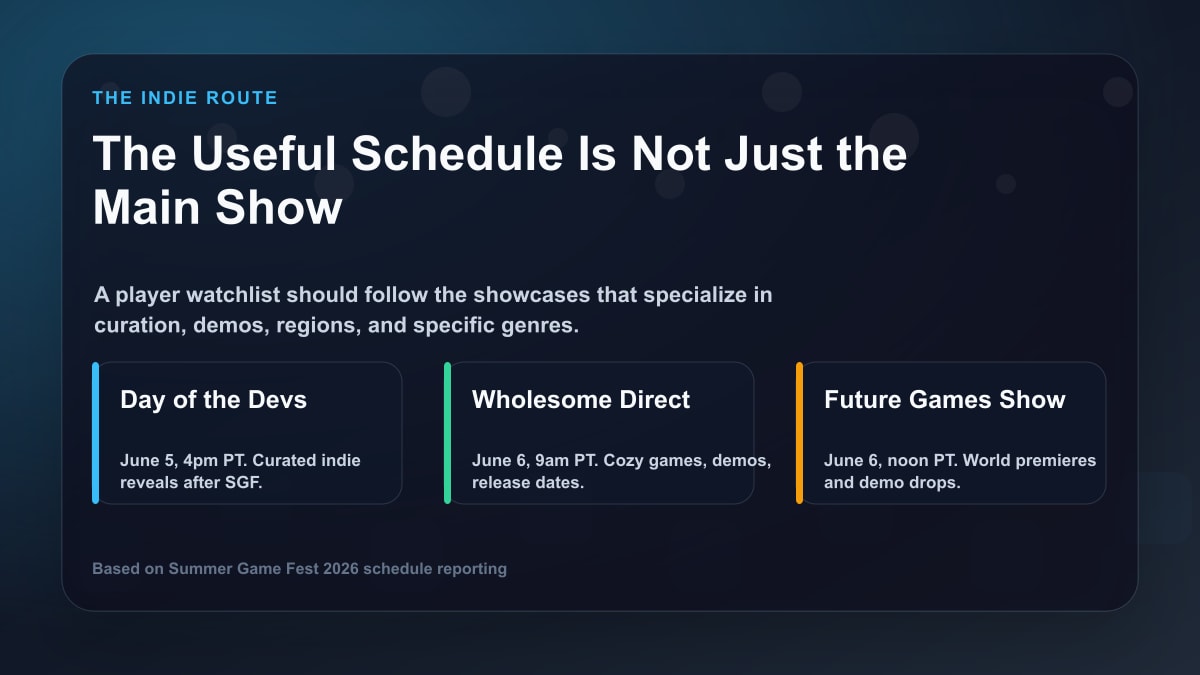
The official Summer Game Fest schedule matters because it shows where indie games are likely to appear. The main showcase is the biggest room, but it is not always the cleanest place to understand a small game. The official page describes the main June 5 stream as a look at what is next in video games across platforms, while Day of the Devs is positioned as a look at upcoming indie games from the non-profit organization. That distinction should guide how players take notes.
For a player who cares about independent games, the core watch window is compact. Watch the main Summer Game Fest stream for surprise reveals, publisher-backed indies, Game Pass or platform deals, and big release date positioning. Watch Day of the Devs for games where the creative hook is likely to matter more than production scale. Watch Wholesome Direct for cozy, uplifting, and emotionally hopeful titles. Watch Story Rich Showcase for games where writing, pacing, branching structure, or character work may need more time than a normal trailer slot can provide.
| Show | When to Track | Why It Matters for Indie Players |
|---|---|---|
| Summer Game Fest Showcase | June 5, 2 p.m. PT | The broadest reveal stage, useful for surprise indie announcements and high-visibility publishing deals. |
| Day of the Devs | June 5, 4 p.m. PT | The strongest curation signal for players looking beyond franchise updates and platform marketing. |
| Wholesome Direct | June 6, 9 a.m. PT | The key showcase for cozy, gentle, social, craft, farming, exploration, and comfort-first games. |
| Story Rich Showcase | June 6, 10 a.m. PT | A new narrative-focused stream that gives story-driven games more room to explain tone and structure. |
| Future Games Show | June 6, 12 p.m. PT | A likely place for trailer premieres, exclusive looks, and stealth demo drops that need immediate follow-up. |
| Steam Next Fest | June 15-22 | The week when players can turn the watchlist into actual downloads, wishlists, feedback, and favorites. |
For players in Asia and Europe, calendar dates can slide across midnight. The important anchor is Pacific time because the official listings and Steam's festival timing use it. Day of the Devs is June 5 in Pacific and Eastern time, but it lands on June 6 for the UK, Europe, Japan, and China. Wholesome Direct is June 6 in Pacific time and June 7 in Japan and China. If you are using a notes app or calendar, include the local time so you do not accidentally mark the wrong day.
The second rule is to separate announcement value from play value. A trailer can be beautiful and still tell you almost nothing about how the game feels. A demo can be rough and still reveal a strong loop. A wishlist can be useful even if you are not ready to buy. The Summer Game Fest 2026 Indie Watchlist should have columns for all three: announcement, playable demo, and revisit date.
The best indie watchlist is not a ranking. It is a promise to revisit the games that would otherwise be buried by the next trailer.
Day of the Devs 2026: The Curated Indie Signal
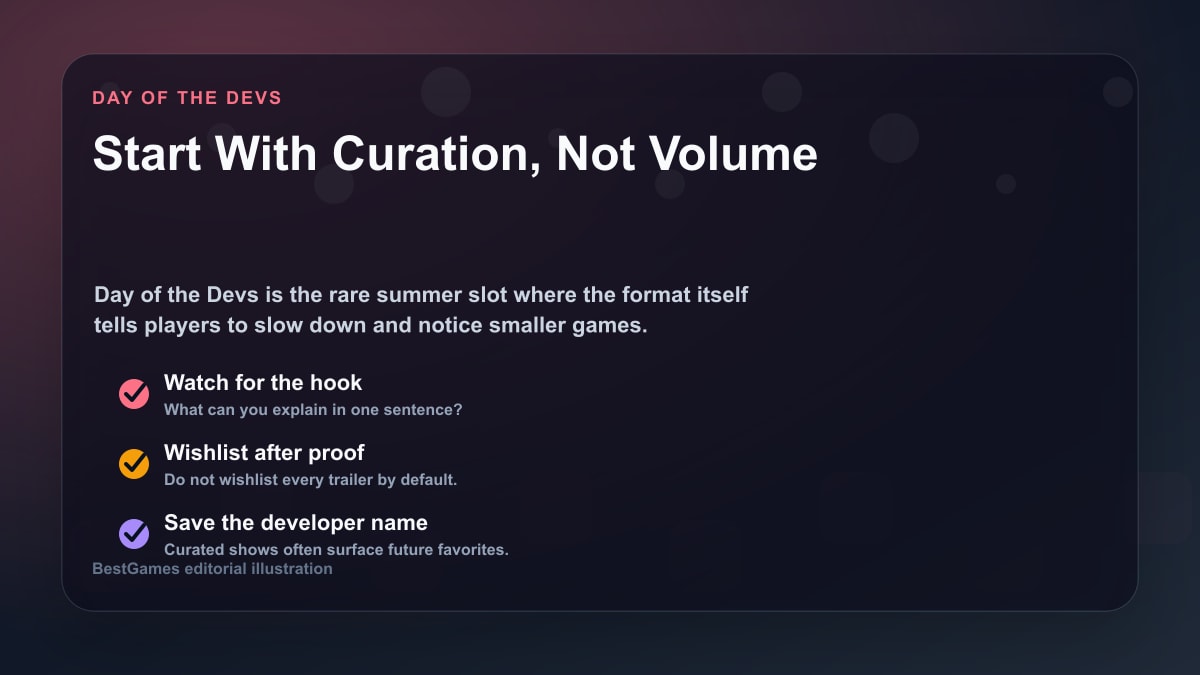
Day of the Devs is the first show players should treat as a quality filter. The organization describes itself as a non-profit with a mission to celebrate the creativity, diversity, and magic of video games while connecting players with developers. Its 2026 Summer Game Fest Edition is listed as the next showcase, and the official Summer Game Fest page frames it as upcoming indie games from the non-profit Day of the Devs.
That matters because a Day of the Devs slot is not just another trailer placement. It tells players that someone has made a curatorial decision. The game may be strange, intimate, mechanically unusual, small in scope, or difficult to summarize in a store capsule, but it has been selected because it does something worth noticing. For players tired of algorithmic browsing, that human curation is the point.
The right way to watch Day of the Devs is to write down the verbs. Do not stop at genre labels. "Adventure game" is too vague. "Walk through an abandoned town while solving memory puzzles" is better. "Build a train network by listening to ghosts" would be better still. Independent games often compete on verbs, tone, and constraints, not on feature count. If your watchlist records only title and release window, you will forget why the game stood out.
Players should also track whether a game's trailer answers three basic questions. What does the player do moment to moment? What is the emotional promise? What is the reason to play this instead of the five similar games already in a backlog? Day of the Devs games often have strong answers to at least one of those questions, but the player still has to capture the answer before the next segment arrives.
This is where a watchlist beats a social feed. A feed rewards the flashiest screenshot. A watchlist rewards the most useful memory. If a Day of the Devs game makes you think, "I need to see if the controls feel as good as the idea," mark it as a demo priority. If it makes you think, "I want to follow the developer because the design point of view is unusual," mark it as a social follow. If it makes you think, "This will be better with reviews later," mark it as a release-window watch rather than a day-one wishlist.
For context, our previous look at AI game dev workflows on X argued that small teams are producing more visible prototypes than ever. Day of the Devs is a useful counterweight to that volume. It does not prove a game will be great, but it helps players find games that have survived at least one layer of editorial attention.
What to note during Day of the Devs
- The game's main verb, not just its genre.
- Whether the trailer shows real interface, combat, building, dialogue, movement, or puzzle solving.
- Whether a demo is live, dated, or likely to appear during Steam Next Fest.
- Whether the developer name is memorable enough to follow directly.
- Whether the game feels like a solo-play evening, a co-op plan, a Steam Deck candidate, or a wishlist-only curiosity.
Wholesome Direct 2026: Cozy Games Need a Different Lens
Wholesome Direct is scheduled for June 6 at 9 a.m. Pacific time, and the official Summer Game Fest listing describes it as world premieres and surprises from uplifting, joyful, and hopeful games. Coverage ahead of the event points to more than 50 emotionally resonant titles. That density is both the charm and the challenge. Cozy and wholesome games can blur together when players watch them as a single mood board.
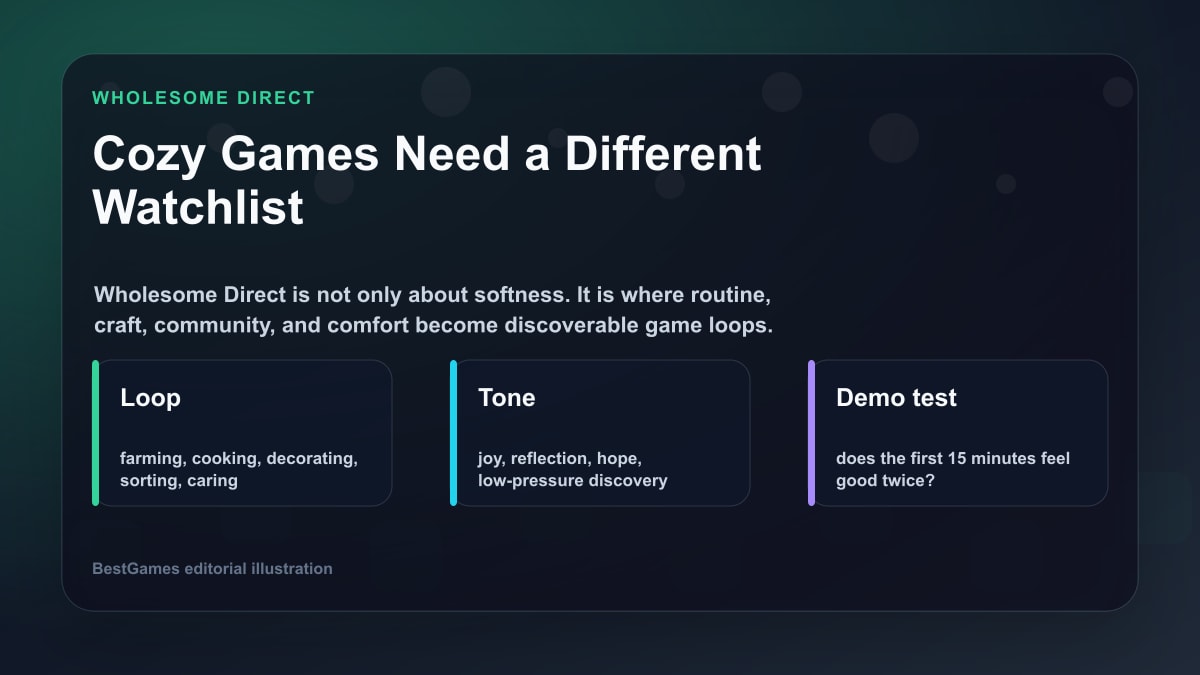
A better approach is to split cozy games by player routine. Some are daily ritual games built around farming, cooking, fishing, decorating, or tending a small space. Some are narrative comfort games where the appeal is character contact, gentle dialogue, and the absence of pressure. Some are social or management games where the loop is about caring for a community. Some are puzzle or exploration games that use softness as an entry point, not as the entire design.
That distinction matters because "cozy" is not a mechanic. It is a promise about friction, tone, and emotional temperature. A game can look cozy and still be stressful if its economy is demanding. Another can look quiet and still have a deep systems loop. Players should therefore ask a different set of questions during Wholesome Direct than they ask during the main Summer Game Fest show.
The most useful question is: would this feel good twice? The first 15 minutes of a cozy demo can be carried by art direction and music. The second session reveals whether the routine has a reason to continue. If a trailer shows a farm, ask what changes after day three. If it shows a cafe, ask whether serving customers is a puzzle, a rhythm, a decoration layer, or just an animation. If it shows animals, ask whether interaction is mechanical, narrative, cosmetic, or collectible.
Wholesome Direct also deserves attention because it catches players who do not always identify as "indie game" players. They may arrive for cozy aesthetics, relationship systems, low-pressure goals, or family-friendly tone rather than developer culture. For BestGames readers who use browser games as short breaks, the connection is obvious: our article on browser games and 30-minute sessions found that play length often grows when the loop is clear, kind, and friction-light. Many Wholesome Direct games compete on that same rhythm.
In a watchlist, do not mark every cute game as a must-play. Use categories. Mark "routine" for games that look like habit builders. Mark "story" for games where the character premise is the hook. Mark "craft" for games where making, decorating, or arranging seems central. Mark "shared" for games you might want to play with a friend or family member. Those labels are more useful than ranking 50 games by trailer charm.
Player filter: For Wholesome Direct, track loop, tone, session length, and demo availability. A beautiful trailer is nice; a repeatable comfort loop is what decides whether the game stays installed.
Story Rich Showcase and Regional Shows: Why Smaller Streams Matter
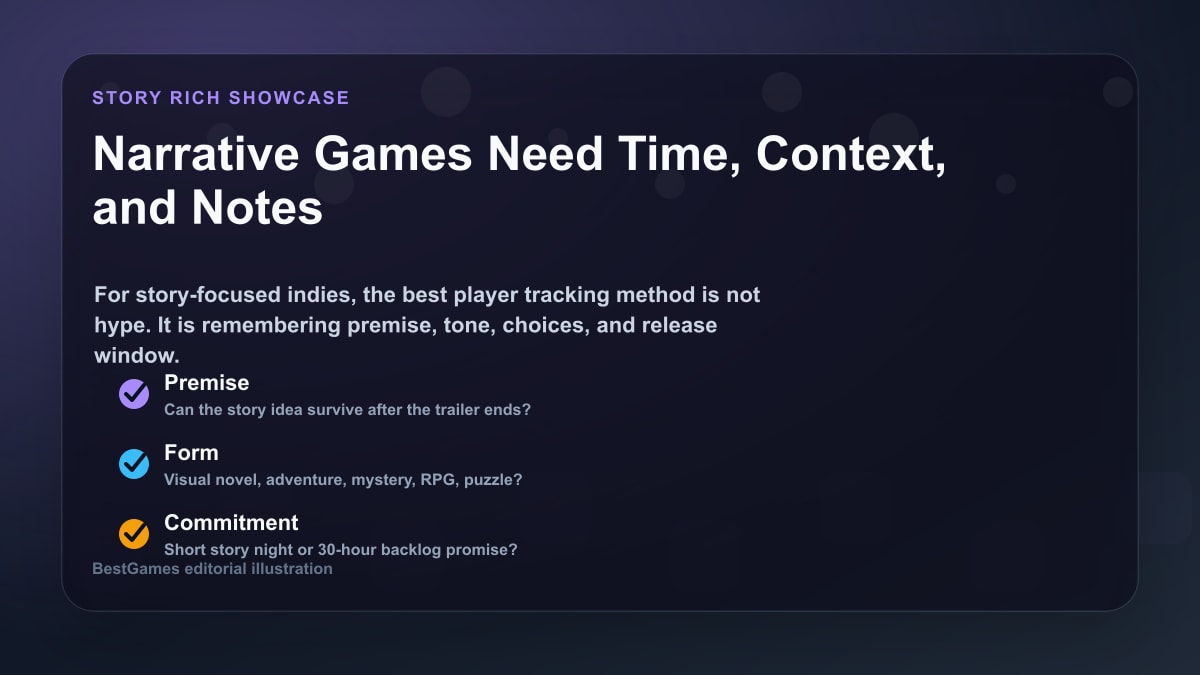
The debut Story Rich Showcase is one of the most important indie signals around Summer Game Fest 2026 because it points to a problem narrative games often face. They need context. The official Summer Game Fest listing says the show seeks to give narrative-driven titles the time, care, and visibility they often miss during one of the busiest moments in the games calendar. That is exactly the gap a player watchlist can solve.
Story-driven games are hard to judge from a single montage. A combat game can show hit reactions. A city builder can show growth. A roguelite can show upgrade choices. A story game has to communicate voice, premise, pacing, agency, and structure without spoiling the reason to play. That is why players should write slightly longer notes here. "Looks interesting" will not survive the week. "Time-loop mystery about a failing space colony, choice-heavy conversations, demo maybe during Next Fest" has a chance.
Regional and community showcases also deserve more attention than they usually get. The Summer Game Fest schedule includes streams such as the Southeast Asian Games Showcase, Latin American Games Showcase, Women-Led Games, Deutsche Indie Showcase, India Games Showcase, Pride Parade, Green Games Showcase, and Frosty Games Fest. Some players skip these because they do not expect major reveals. That is backwards. These are exactly the shows where a small game may have enough room to be understood.
Discovery is not evenly distributed. A game from a small studio in a region with less Western press coverage may not get a giant trailer reaction, but it can still be one of the most interesting playable discoveries of the month. A game from a marginalized creator may not fit neatly into a platform holder's marketing beat, but it may have a voice players have not seen elsewhere. A climate-focused or pride-focused showcase may include games whose subject matter makes them more memorable, not less commercial.
The point is not charity watching. It is better scouting. When every major outlet is chasing the same biggest reveals, smaller streams offer a competitive advantage for curious players. You find the games your friends did not see. You find the demos that are not instantly buried on a trending page. You find the developers whose next project you will want to follow even if this one is not for you.
For the Summer Game Fest 2026 Indie Watchlist, smaller streams should get three note fields: region or community context, main gameplay loop, and availability. If a trailer gives only a title and release year, do not discard it. Add the developer site or Steam page and revisit after the show recap lands. Many indie teams update store pages after a showcase, not before it.
Demo Drops, Steam Pages, and the June 15 Next Fest Bridge
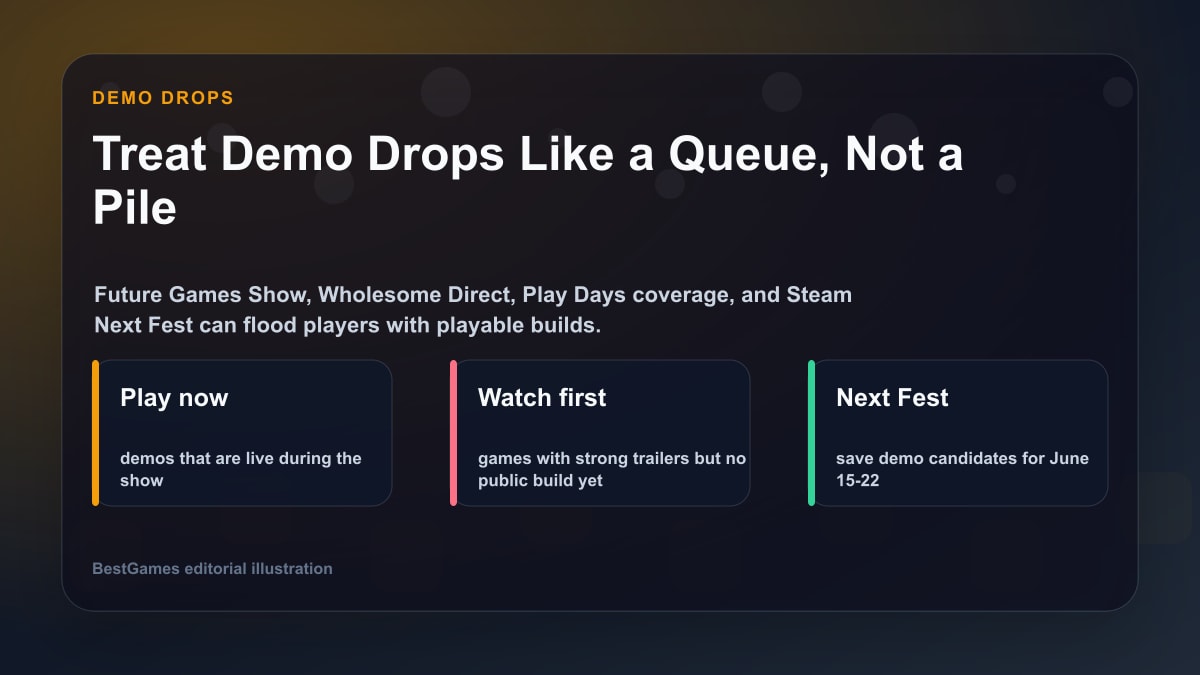
Demo drops are the most actionable part of showcase week. Future's summer programming has already positioned the Future Games Show Summer Showcase around world premieres, exclusive trailers, and stealth demo drops, while Steam Next Fest June 2026 runs from June 15 to June 22 according to Valve's Steamworks documentation. That gives players a clean bridge: discover on June 5-7, test a few immediately, then use Steam Next Fest to finish the queue.
The mistake is treating every demo as urgent. Some demo drops are time-limited, but many remain available into Next Fest or beyond. The better move is to sort demos into three groups. First, play now: demos from games you were already interested in, demos tied to limited showcase windows, or demos whose hook depends on immediate conversation. Second, wishlist and schedule: games that look strong but require more attention than you can give during the weekend. Third, monitor only: games with compelling trailers but unclear controls, release windows, or store pages.
Steam pages are part of the watchlist, not a separate step. A good Steam page tells you the release window, demo status, developer, supported languages, controller details, and tags. It may show whether the game is Steam Deck friendly, whether co-op is online or local, whether the demo has saved progress, and whether the full game is planned for early access. A trailer can create interest, but the page helps decide what kind of attention the game deserves.
For players, the most useful Steam behavior is simple. Wishlist games you genuinely want to revisit. Follow games where you want updates but are not ready to signal purchase intent. Download only the demos you can actually play within 48 hours. Delete demos that did not land. Leave thoughtful feedback when a demo surprises you, because small teams often treat festival feedback as a real design signal, not just a marketing metric.
For developers, this is the same lesson from the other side. Our Steam Next Fest June 2026 demo checklist focused on store pages, wishlists, streams, and post-festival follow-up. Players are performing a version of that checklist too. If the demo is hard to find, if the opening does not explain itself, if the Steam capsule does not match the trailer, or if the call to wishlist feels detached from the actual experience, players will move on.
The June 15 start date matters because it gives players permission to be patient. You do not need to finish every demo during Summer Game Fest weekend. You need to identify which ones deserve time. The watchlist should therefore include a "Next Fest action" column: play demo, compare with similar game, watch developer stream, wait for impressions, or ignore unless updated.
A simple demo queue rule
- Download no more than three demos at once.
- Give each demo 15 minutes unless it clearly asks for a slower start.
- Write one sentence after playing: what stayed with you?
- Wishlist only if you want a reminder later, not because the show told you to.
- Keep one wildcard slot for a game from a smaller stream you did not expect to like.
A Summer Game Fest 2026 Indie Watchlist Player Checklist
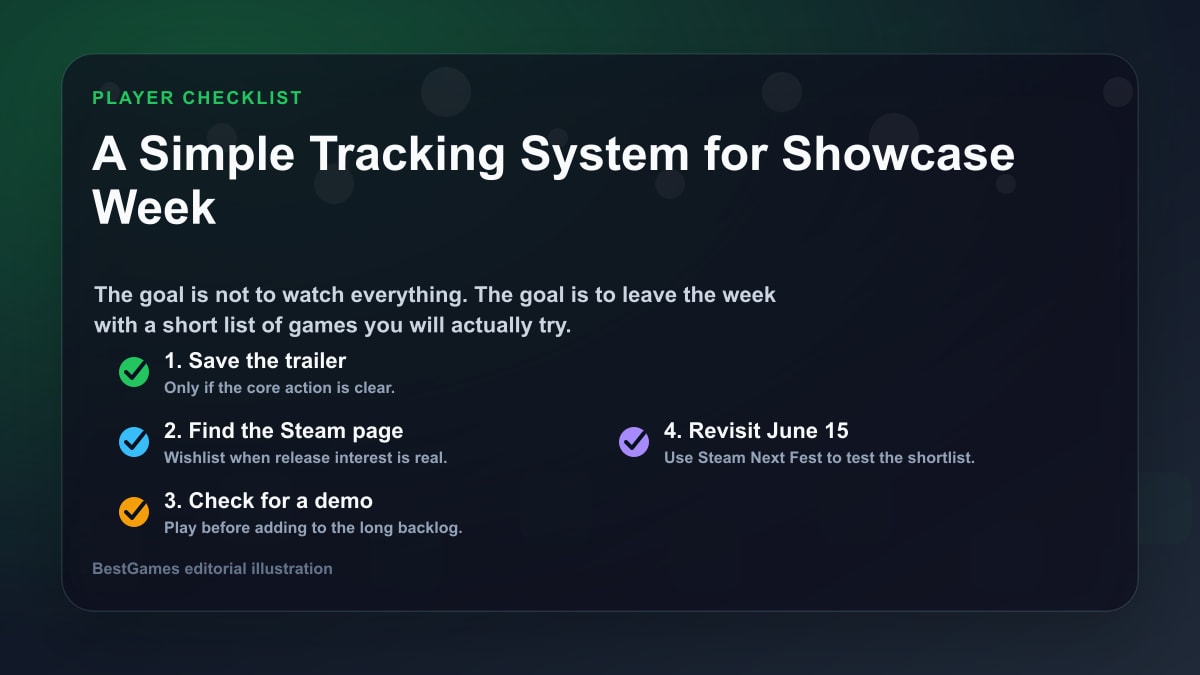
The best player checklist is boring enough to use while watching live. It should not require a spreadsheet unless you enjoy spreadsheets. A notes app, bookmark folder, or Steam collection is fine. The purpose is to keep the indie games from collapsing into one vague memory of colorful trailers.
Use this structure for every game that catches your attention:
- Title: The exact name, copied from the show or Steam page.
- Show: Summer Game Fest, Day of the Devs, Wholesome Direct, Story Rich Showcase, Future Games Show, or another stream.
- Hook: One sentence describing what made you stop scrolling.
- Verb: What the player actually does.
- Demo: Live now, coming during Next Fest, unclear, or no demo announced.
- Action: Wishlist, follow, download, watch later, or ignore.
That last field is the most important. A watchlist without an action becomes a graveyard. If a game has a demo, decide when to play it. If it has no demo, decide whether to wishlist or follow. If it has only a trailer, decide whether the trailer is strong enough to survive a week of new announcements. If the answer is no, let it go. Discovery improves when players are willing to remove things.
Also make room for taste changes. Summer showcases can make certain genres feel overrepresented. After the third farming game or fifth deckbuilder, a player may become unfairly impatient. That is why the hook field matters. It lets you compare games by what they actually promise, not by the fatigue created by nearby trailers. A cozy game about grief and a cozy game about furniture arrangement may share a visual temperature while offering completely different play reasons.
Players should be especially careful with "coming soon" language. A game can be worth tracking even without a release date, but it belongs in a different category from a demo you can play tonight. Use release timing to protect your attention. 2026 games with demos go near the top. 2027 games with strong premises go in a follow folder. Undated games need a developer follow only if the creative voice is strong enough.
Finally, do not outsource the entire watchlist to influencers or recap articles. Recaps are useful, including ours on the BestGames blog, but your own taste should decide the final queue. Showcase week is one of the few moments when players can step outside recommendation algorithms and build a more personal discovery path.
What to Watch First If You Have Limited Time
If you can watch only one indie-focused stream live, make it Day of the Devs. It comes directly after the main Summer Game Fest showcase, it has a long history of surfacing distinctive independent games, and it gives you the strongest early curation signal. If you can watch two, add Wholesome Direct because it has enough volume and genre identity to produce several games that may not appear elsewhere. If you can watch three, add Story Rich Showcase because narrative-focused games need more context and are easy to underrate in normal trailer blocks.
If you cannot watch live at all, the order changes. Start with official show recaps and Steam pages, not reaction clips. Reaction clips are good for measuring hype, but they often flatten the detail that helps you choose a demo. Look for timestamps, store links, developer names, and demo notes. Then search Steam by the exact titles that interested you. If the store page exists, capture it in your watchlist. If it does not, follow the developer or publisher directly.
The Future Games Show deserves special attention after the fact because stealth demo drops can be easy to miss while watching live. A stealth demo is only useful if players find it while their interest is fresh. After the show, scan the official article, Steam event page, and game pages for the phrase "demo available" or "play now." Those are the items most likely to turn a passive watchlist into a playable weekend.
When Steam Next Fest begins on June 15, resist the urge to start from the front page alone. Start with the games you already marked during Summer Game Fest weekend. Then use Steam's categories to add surprises. This gives you both intentional follow-through and algorithmic discovery. Without the first half, Next Fest becomes random browsing. Without the second half, your list becomes too narrow.
The deeper pattern is that indie discovery in 2026 is no longer one event. It is a chain: showcase, trailer, Steam page, demo, wishlist, follow-up, release. Summer Game Fest supplies the first links. Day of the Devs, Wholesome Direct, and Story Rich Showcase add curation. Future Games Show and Steam pages add playability. Steam Next Fest turns attention into testing. The player who understands that chain will find better games than the player who waits for a top-ten list after everything is over.
The Bottom Line
Summer Game Fest 2026 will be loud, but the best indie discoveries will not necessarily be the loudest announcements. Day of the Devs should be treated as the curation anchor. Wholesome Direct should be filtered by routine, tone, and repeat play rather than cuteness alone. Story Rich Showcase should be watched with slower notes because narrative games need context. Future Games Show and other streams should be checked for demo drops. Steam Next Fest should be treated as the second half of the same discovery cycle, not as a separate event.
The practical goal is simple. By the end of the weekend, you should have a short list of games to play, a longer list of games to follow, and a few names you would have missed if you only watched the biggest trailer reactions. That is what a good Summer Game Fest 2026 Indie Watchlist is for: not to capture everything, but to keep the right games from disappearing.
Frequently Asked Questions
When is Summer Game Fest 2026?
The main Summer Game Fest 2026 showcase streams on Friday, June 5, 2026 at 2 p.m. Pacific time, live from the Dolby Theatre in Los Angeles.
When are Day of the Devs and Wholesome Direct?
Day of the Devs follows the main Summer Game Fest showcase on June 5 at 4 p.m. Pacific time. Wholesome Direct streams on June 6 at 9 a.m. Pacific time.
Why should players track demo drops before Steam Next Fest?
Demo drops help players identify games worth testing before Steam Next Fest begins on June 15. They also prevent the best small games from being lost in the full festival list.
Which indie showcase should I watch first?
If you have limited time, start with Day of the Devs, then Wholesome Direct, then Story Rich Showcase. Those three give the clearest indie discovery signals.