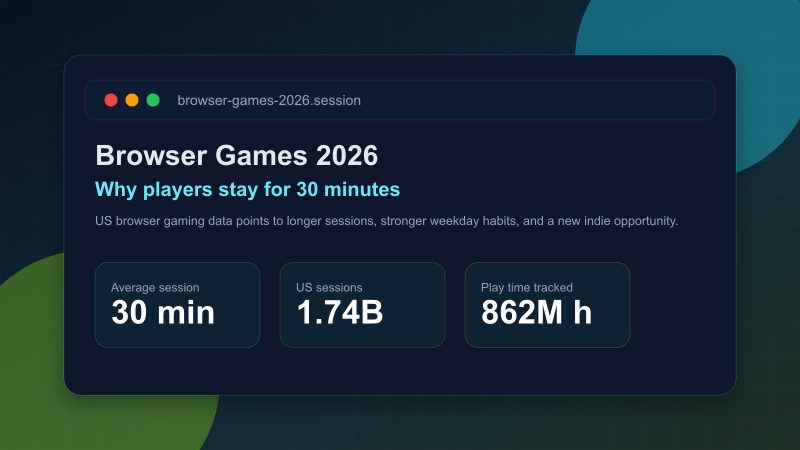
Browser games 2026 no longer look like a nostalgia category. The strongest evidence is not a viral remake, a single portal success story, or a new graphics demo. It is time. PocketGamer.biz reported on May 21, 2026 that a CrazyGames study found the average US browser gaming session now lasts 30 minutes, based on 1.74 billion browser game sessions and 862 million hours of gameplay recorded between May 2025 and May 2026 (PocketGamer.biz, 2026). For a format still dismissed as a quick tab, a school-break distraction, or a Flash-era leftover, that number changes the conversation.
Thirty minutes means players are not just clicking, bouncing, and forgetting. They are staying long enough for progression systems, daily hooks, multiplayer rounds, puzzle arcs, and ad-supported loops to matter. It also means Web Games should be judged less like disposable embeds and more like lightweight live products. That shift matters for players looking for instant-play arcade games, for developers testing ideas before a Steam launch, and for sites like BestGames that sit directly in the middle of discovery, play, and curation.
This article argues that browser games are being re-priced by three forces at once: player behavior is proving deeper than the old stereotype, portals are measuring engagement like modern product teams, and browser technology is catching up to the ambitions of Indie Game Development. The opportunity is real, but it is not automatic. A web build still has to load fast, explain itself instantly, keep a tight loop, and respect the player's time.
Browser Games 2026 Are Measured by Time, Not Nostalgia

The old way to talk about browser games was historical. Flash games were popular, Flash died, HTML5 replaced it, mobile apps absorbed casual play, and browser games became a smaller niche. That story is partly true, but it misses the present. The new story is behavioral. Players are not only arriving at browser games; they are giving them meaningful time. PocketGamer.biz summarized the headline as "average browser gaming session now lasts 30 minutes," and WN Hub repeated the same CrazyGames dataset with added genre detail (PocketGamer.biz, 2026; WN Hub, 2026).
The numbers are specific enough to be useful. CrazyGames tracked 1.74 billion US sessions over a 12-month period, with weekday traffic 22% higher than weekends. Thursday delivered the highest overall session volume. Friday produced the longest average sessions as players moved toward the weekend. Hypercasual games led for most of the year, while puzzle games dominated morning windows. WN Hub broke the genre share down as 78.8% hypercasual, 20.6% puzzle, and the rest split across other tracked categories (WN Hub, 2026).
That does not mean every web game is suddenly deep. It means the format has learned how to fit daily life. The browser is open during work breaks, lunch hours, school downtime, second-screen moments, and late-night idle sessions. A player does not need to install anything, create an account, or commit to a full platform. The tab is the invitation. The game still has to earn attention after that, but the first barrier is almost gone.
The 30-minute number changes the design brief
A 30-second game can survive on novelty. A three-minute game needs a satisfying first loop. A 30-minute session needs pacing. It needs a reason to continue after the first clear, crash, match, merge, or upgrade. For HTML5 Games, that pushes design away from pure one-tap gimmicks and toward readable goals, meaningful escalation, better save states, and more generous early feedback. The best online puzzle games already understand this: they teach quickly, then create just enough friction to make the next move feel earned.
There is also a commercial implication. Browser games do not usually sell like premium PC games, and many developers still see ads as a fragile business model. But a longer session gives portals more chances to place ads without destroying the experience, gives developers more room to introduce rewarded moments, and gives players enough time to form a preference. Time is not revenue by itself. It is the condition that makes revenue experiments possible.
Browser Games 2026 Need Platform-Grade Loops
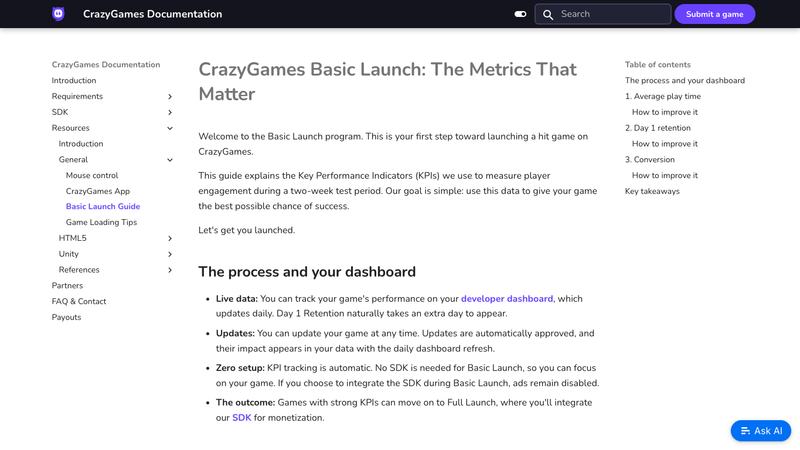
The second signal comes from the way portals talk to developers. CrazyGames' Basic Launch documentation does not describe browser games as throwaway content. It describes a two-week test period, a dashboard, daily KPI updates, average play time, day-one retention, and conversion. The documentation defines average play time as "the average time a player spends in your game in a single session" and says, "Longer sessions mean players are hooked on your core loop" (CrazyGames, 2026). That sounds less like an old portal submission page and more like a product analytics funnel.
Those metrics are useful because they are blunt. A developer may love a mechanic, but if players do not survive the first minute, the mechanic is irrelevant. CrazyGames says top-performing titles typically convert more than 80% of players, load in under 10 seconds, and have a build size below 20 MB during the relevant early path (CrazyGames, 2026). Its separate technical requirements enforce an initial download size of 50 MB or less, with 20 MB needed for mobile homepage eligibility, and they explicitly connect file size to how quickly a user can start playing (CrazyGames Technical Requirements, 2026).
That is the practical standard for browser games in 2026. A great idea is not enough. A beautiful export from Unity or Godot is not enough. A game has to survive the first click, the first loading screen, the first input, and the first decision. Web players are generous because they can start instantly; they are ruthless because they can leave instantly.
A useful checklist for developers
For indie teams considering a browser build, the CrazyGames metrics suggest a simple hierarchy:
- Reach playable state before the player starts wondering why they clicked.
- Make the first goal visible without a tutorial wall.
- Keep the first loop short, but make the second loop more interesting.
- Save progress or state whenever the game asks for more than a quick attempt.
- Design ad breaks around natural pauses, not interruption for its own sake.
That hierarchy explains why hypercasual and puzzle games dominate the data. They are not necessarily the only formats that can work in the browser. They are the formats that best satisfy the first-click contract. The player understands what to do, can see progress, can fail quickly, and can restart without feeling punished. A deeper browser game can still succeed, but it has to respect that same contract before asking for more commitment.
This is where browser games differ from premium PC launches. A Steam player has already installed a build, accepted a store page pitch, and often paid money. A browser player has given you a tab. That is less commitment, but also less friction. The design challenge is to turn that low-friction entry into enough trust for a longer session.
WebGPU Makes Browser Games 2026 More Ambitious

The third signal is technical. Browser games have always competed with a credibility problem: players remember simple 2D games, ads, school portals, and laggy embeds. Developers remember memory ceilings, mobile performance issues, file size pain, and the awkwardness of exporting large engine projects to web. Some of those constraints remain. But the browser's ceiling is much higher than it was during the late Flash and early HTML5 transition.
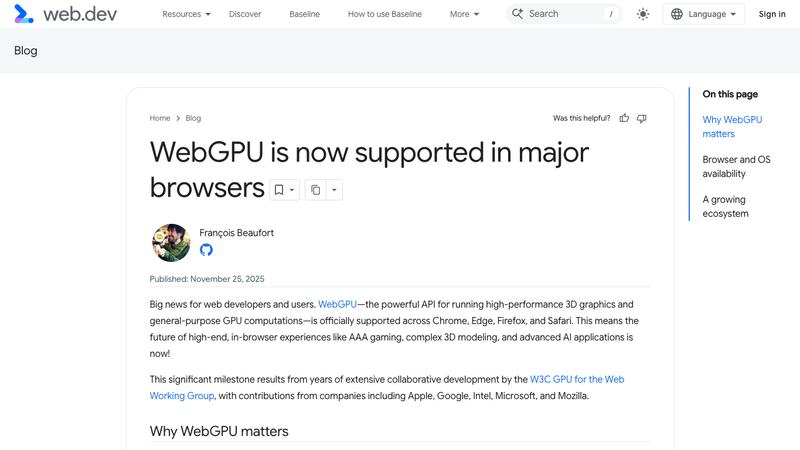
WebGPU is the clearest marker. On November 25, 2025, web.dev announced that WebGPU was supported across Chrome, Edge, Firefox, and Safari, describing it as a path for high-performance 3D graphics and general-purpose GPU computation. The post says WebGPU points toward "high-end, in-browser experiences like AAA gaming" and notes that modern graphics, physics simulation, video processing, and local AI workloads benefit from more direct GPU access (web.dev, 2025). That does not mean every web game should chase AAA visuals. It means the browser is no longer defined only by what it cannot do.
PlayCanvas shows the same shift from the engine side. Its public site positions the platform as an open-source WebGL and WebGPU creation environment, with full WebGPU support, compute shaders, and WebGL2 compatibility. It also claims "lightning fast load times, 60 frames a second gameplay" for browser games (PlayCanvas, 2026). That phrase matters because it connects visual ambition to the same first-click requirement discussed earlier. A technically impressive web game that loads too slowly loses the player before the GPU matters.
Open-source engines are moving too. Godot 4.5 added features such as screen reader support, improved diagnostics, rendering work, and mobile-relevant fixes, while the Godot blog in late May 2026 showed a fast cadence of 4.7 beta snapshots, Asset Store work, and ecosystem updates (Godot Engine, 2026). Godot's web story is still not as effortless as native desktop deployment, but the direction is clear: indie tools are treating web export as a serious platform path, not merely a novelty.
The interesting frontier is not just prettier browser games. It is faster experimentation. The arXiv paper WebGameBench, submitted on May 17 and revised on May 21, 2026, frames browser-native games as a useful evaluation target for coding agents because they turn requirements into delivered applications that can actually be played in a browser (WebGameBench, 2026). In plain terms, web games are convenient laboratories. They are easy to host, easy to test, easy to share, and easy to judge because the result is interactive.
That makes the browser valuable even for developers who do not plan to monetize there first. A small team can use a web build as a demo, a feedback surface, a jam entry, a publisher pitch, or a public prototype. As we covered in our AI game dev workflow analysis, the fastest modern indie workflows are often about making ideas playable earlier, not replacing the judgment required to finish a game.
Indie Developers Are Asking a Better Question
The community question has shifted from "Are browser games dead?" to "What job should the browser version do?" A May 2026 r/gamedev thread asked whether HTML5 games were worth making and how developers should monetize them. The replies were divided, which is exactly why the thread is useful. Some developers argued that Poki and CrazyGames can still be profitable if a game fits the audience. Others warned that mobile and Steam remain stronger commercial paths for many projects. One hobby developer gave the simplest defense of the format: moving to browser solved the friction of asking friends to download and trust a native executable (Reddit r/gamedev, 2026).
That debate is healthier than hype. Browser games are not a universal replacement for Steam, mobile, console, or native PC. They are a different distribution shape. Their strengths are instant access, shareability, low test friction, school and work-break availability, and low commitment. Their weaknesses are monetization pressure, file size limits, cache uncertainty, performance variance, platform competition, and a player base that may not want complexity before trust is earned.
For Indie Game Development, the web path becomes attractive when those strengths match the project. A puzzle game, idle game, arcade challenge, short roguelite prototype, tactics demo, or lightweight multiplayer experiment can all benefit from instant access. A cinematic open-world game with heavy assets and long onboarding probably should not treat the browser as its primary home. But it might still use a browser slice as a marketing sample or interactive press kit.
Unity's 2026 report supports that strategic reading from a different angle. Unity says 52% of developers now prioritize smaller-scale projects to reduce risk, and 67% of polled developers spend three months or less in prototyping. The same report emphasizes online events and social media as major discovery strategies, with 62% of respondents using online events and 60% using social media (Unity, 2026). Put those facts beside the CrazyGames data and a clear pattern appears: smaller games, faster prototypes, online discovery, and instant-play builds are all moving in the same direction.
The browser is a discovery surface before it is a business model
That distinction matters. Many developers get stuck asking whether browser games make enough money. The better first question is whether a web build can reduce the cost of discovery. Can it let a streamer play instantly? Can it let a Reddit user test without installing? Can it let a player share a link in a chat? Can it let a developer see whether the first loop works before committing to months of production? If the answer is yes, the browser has value even before monetization is proven.
This is also why CrazyGames, Poki, itch.io, Newgrounds, Kongregate, YouTube Playables, and smaller portals occupy different roles. Some are commercial distribution partners. Some are community testing grounds. Some are archives of niche play. Some are social traffic surfaces. A browser strategy in 2026 should not begin with "put it everywhere." It should begin with what kind of player behavior the developer needs to learn.
Browser Games 2026 Have a Showcase Moment
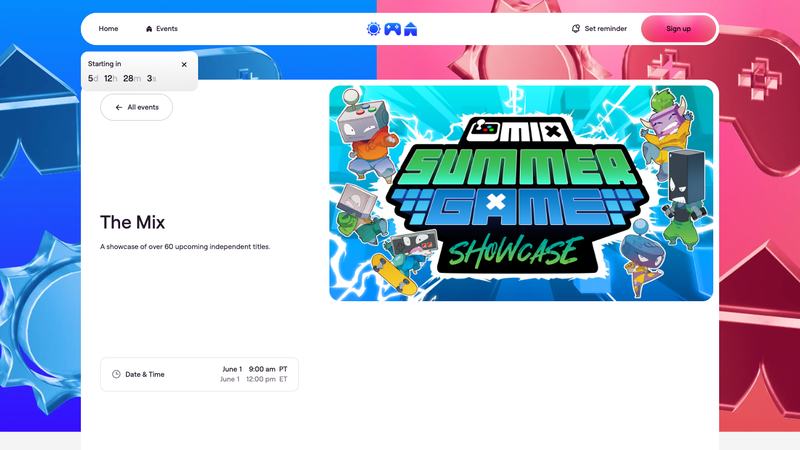
The timing is useful. On June 1, 2026, The MIX Summer Game Showcase is scheduled as part of Summer Game Fest programming, describing itself as "a showcase of over 60 upcoming independent titles" (Summer Game Fest, 2026). Steam Next Fest follows from June 15 to June 22, 2026, giving players a week of demos and developers a high-pressure discovery window (Steam, 2026). These events do not focus only on browser games, but they show why instant access matters. Discovery windows are crowded. Demos compete for attention. Anything that lets a player try a game faster has strategic value.
That does not mean every Steam Next Fest demo should be mirrored as a browser build. It does mean developers should think about the browser as part of the funnel. A web build can introduce a mechanic before the Steam demo. A lightweight browser version can support a mailing list campaign. A playable web slice can make a press pitch more memorable. A game jam version can prove a hook before the full project starts. The browser's job is not always to be the final product. Sometimes its job is to make the first impression playable.
For BestGames readers, this is why the category deserves attention. The best browser games in 2026 are not merely convenient; they are built around a sharper understanding of attention. They know that the player arrives casually but may stay seriously. They respect the first minute, then build toward the 30-minute session. They may look simple from the outside, but their best versions are highly tuned products.
What to watch next
The next stage will likely split into two lanes. The first lane is high-performance web games using WebGPU, WebAssembly, better engine exports, and smarter asset streaming. These games will try to prove that the browser can support richer visuals and deeper systems. The second lane is product-optimized casual design: puzzle, arcade, idle, merge, parking, racing, and lightweight simulation games that use data to improve session length and retention. Both lanes matter, but the second is likely to generate more reliable traffic in the near term.
That is why Browser Games are in a better position than their reputation suggests. The format does not need to defeat Steam or mobile. It needs to own the space where instant access, short onboarding, and repeat sessions overlap. The CrazyGames data suggests that space is larger and stickier than many developers assumed.
Conclusion: The Browser Is a Serious First Screen Again
The 2026 browser games story is not a simple comeback. It is a correction. The browser never stopped being useful; the industry stopped taking it seriously because mobile stores, Steam, and console ecosystems dominated the conversation. Now the data is harder to ignore. A 30-minute average US session, 1.74 billion tracked sessions, weekday traffic strength, and platform-grade launch metrics all point to a format that deserves a more serious editorial and developer conversation.
For players, the result is straightforward: better instant games, more polished loops, and less reason to treat browser play as disposable. For developers, the lesson is sharper. A browser build can be a product, a prototype, a demo, a feedback tool, or a marketing surface, but it cannot be an afterthought. It has to load quickly, teach quickly, and make the next minute feel worthwhile.
Browser games 2026 are not winning because they are nostalgic. They are winning where they respect how people actually play now: in tabs, in breaks, across devices, with low commitment at the start and surprising commitment when the loop works.
Browser Games 2026 FAQ
Are browser games still popular in 2026?
Yes. CrazyGames data reported by PocketGamer.biz shows 1.74 billion US browser game sessions from May 2025 to May 2026, with an average session length of 30 minutes. That suggests browser games remain a meaningful part of casual and instant-play gaming.
Why are players spending longer in browser games?
Better loops, faster loading, puzzle and hypercasual dominance, and stronger progression systems all help. The browser removes the install barrier, but the game still needs clear goals, fair pacing, and enough reward to keep players moving.
Are HTML5 Games a good path for indie developers?
HTML5 Games can be useful for prototypes, demos, instant sharing, and portal distribution. They are not a universal replacement for Steam or mobile, but they can reduce discovery friction and help developers test a core loop faster.
Does WebGPU change browser game development?
WebGPU raises the technical ceiling for web games by bringing more modern GPU access to major browsers. It will not fix weak design, but it gives ambitious developers more room for richer visuals, simulations, and performance-sensitive experiences.