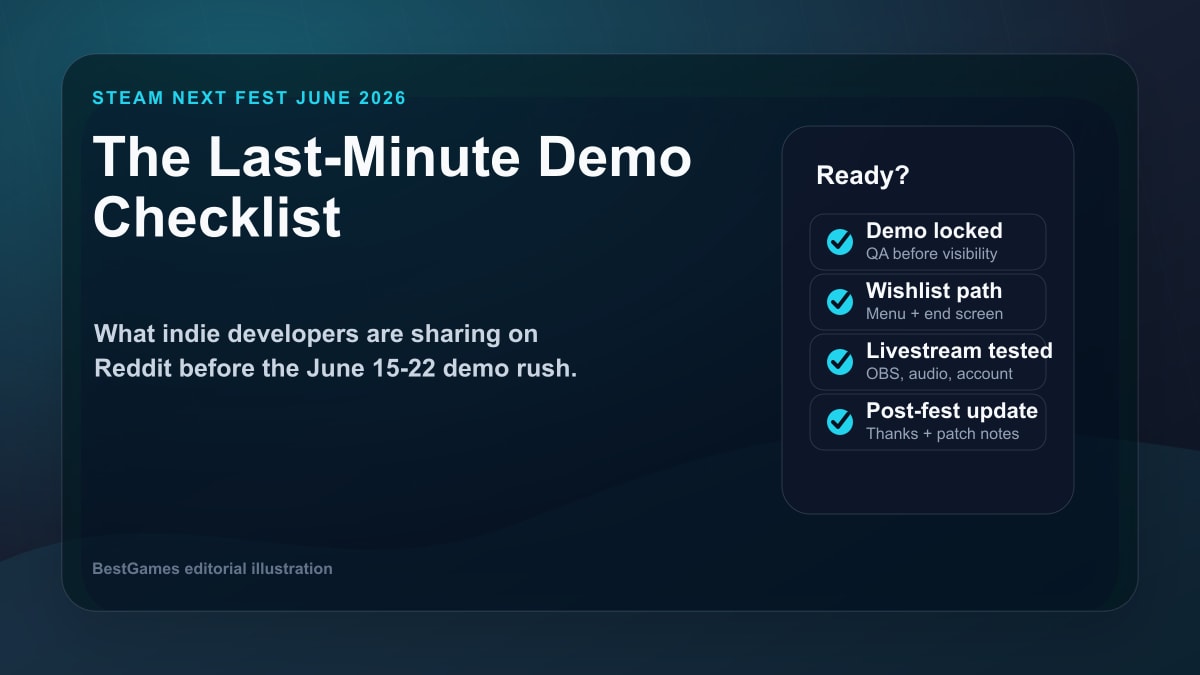
Steam Next Fest June 2026 is close enough that the useful advice is no longer inspirational. Valve's public Steamworks page puts the festival itself on June 15-22, 2026, with a press preview opening on June 4 and required demo-review materials due by June 3 at 11:59 p.m. Pacific time for eligible games. For a solo developer or a small team, that means the comfortable planning window is gone. What remains is prioritization.
The interesting part is where many indie developers are doing that prioritization: Reddit. Threads on r/IndieDev and r/gamedev in the days before the event are full of plain, practical questions. Is the demo stable enough? Should the livestream be scheduled now? Is the store page understandable without context? Does the demo push players toward wishlisting the full game without feeling desperate? What should be done after the festival ends, when the download spike has already passed?
This article turns those conversations into a working indie game demo checklist. It is not a guarantee of visibility, because Steam Next Fest is too crowded for guarantees. It is a way to avoid the preventable mistakes that make a good demo look unfinished, or make a promising game disappear before players understand why they should care.
BestGames usually writes for players, but this piece is intentionally developer-facing. It also matters for players because a better festival checklist produces better demos: shorter dead starts, clearer hooks, smoother controls, fewer broken builds, and less confusion about what the full game is supposed to become. A festival full of reliable demos is better for everyone.
Steam Next Fest June 2026 Starts Before the Festival
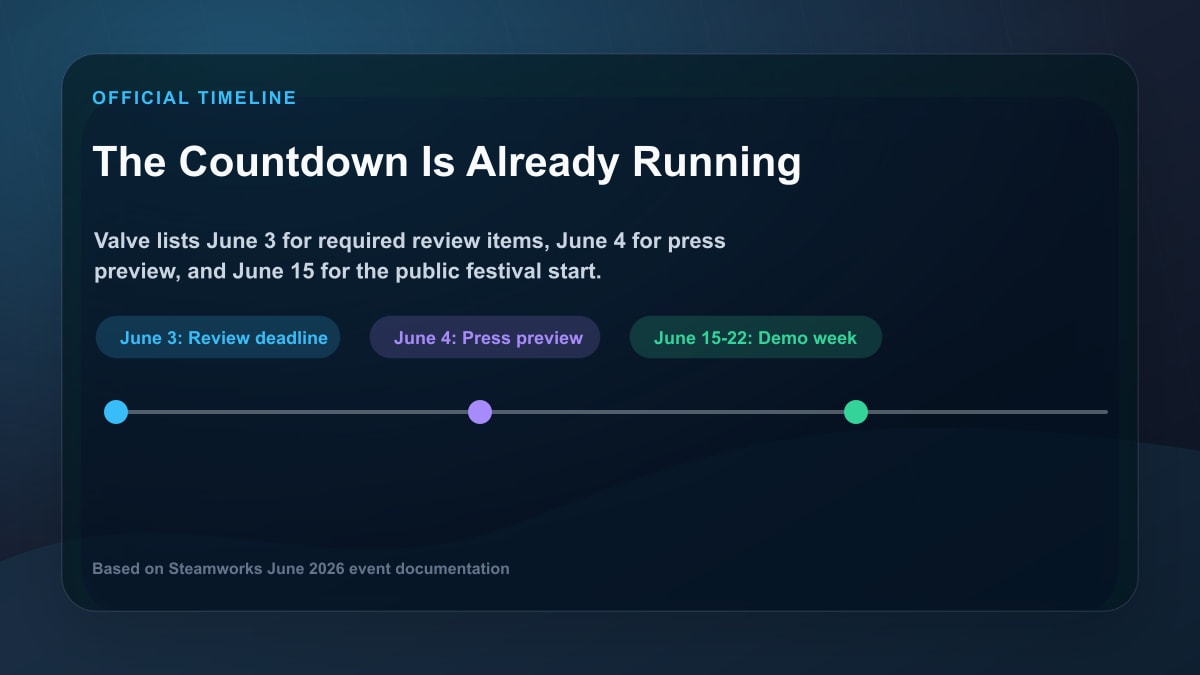
The biggest misunderstanding around Steam Next Fest June 2026 is that the festival begins when the public sale page goes live. Operationally, it begins earlier. Valve's June 2026 page lists June 3 as the deadline for demo availability, store assets, trailers, tags, and broadcast setup that need review. It also lists June 4 as the start of the press preview, when registered press can access eligible games before the public event.
That timeline changes the last-minute checklist. A developer cannot wait until June 14 to learn that the demo build is stuck behind the wrong Steam branch, the broadcast account is not configured, the store page is missing an approved trailer, or the demo points players to a wishlist button that is not visible. The public week is the performance. The review and preview window is the technical rehearsal.
For teams still polishing, the right question is not "What else can we add?" It is "What can fail in front of a player, a creator, or a press contact, and how do we remove that failure today?" This is why Reddit advice around the event tends to be blunt. Developers are comparing launch notes, not dreaming about ideal scope. The comments that keep repeating are about boring things that matter: build stability, save behavior, input clarity, store-page copy, livestream checks, and follow-up posts.
The best practical framing is to separate the work into three buckets. The first bucket is eligibility and access: the demo must be uploaded, visible, reviewed, and attached to the right base game. The second bucket is conversion: the store page, screenshots, trailer, capsule, and demo flow must make the full game understandable. The third bucket is communication: livestream schedule, press notes, creator messages, Steam event posts, Discord or mailing-list updates, and post-festival follow-up.
Those buckets also keep a small team from wasting the final week. Adding one more level may feel satisfying, but if the first level has unclear controls, a long loading pause, or a confusing end screen, the extra content is unlikely to help. Steam Next Fest June 2026 rewards clarity before volume.
The last useful week before Next Fest is not for adding everything. It is for removing the reasons players leave before the hook lands.
The Reddit Checklist: Stable Beats Bigger
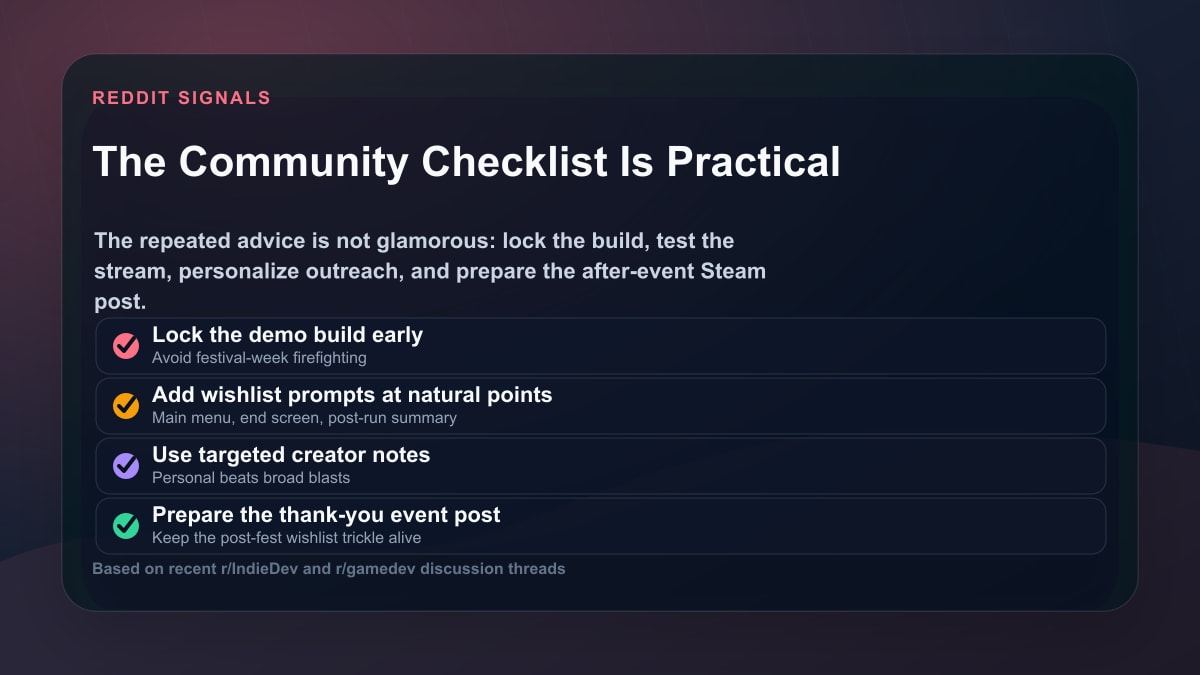
The clearest Reddit pattern is that developers are not asking for one secret trick. They are sharing a defensive checklist. Lock the demo. Test every obvious input path. Confirm the store page link from inside the demo. Do not send creators a generic email. Make the end of the demo feel intentional. Schedule a livestream only if it will not create a new point of failure. Prepare the post-festival message before the festival ends.
That advice sounds small because it is aimed at a specific risk: festival players have low patience. They are not booting one demo in isolation. They are sampling many demos in a short week, often from a queue, a discovery carousel, a creator recommendation, or a screenshot that looked promising. The moment a demo asks them to troubleshoot, guess, wait, or forgive, another demo is one click away.
The Reddit version of the checklist starts with the build. Does the demo install cleanly from Steam? Does it launch from a fresh machine, not only from the developer's setup? Does the first playable state arrive quickly? Are controller and keyboard prompts correct? Does the quit path work? Does the demo recover from alt-tabbing, resolution changes, and common display modes? These are not glamorous tasks, but they decide whether the player ever reaches the interesting part.
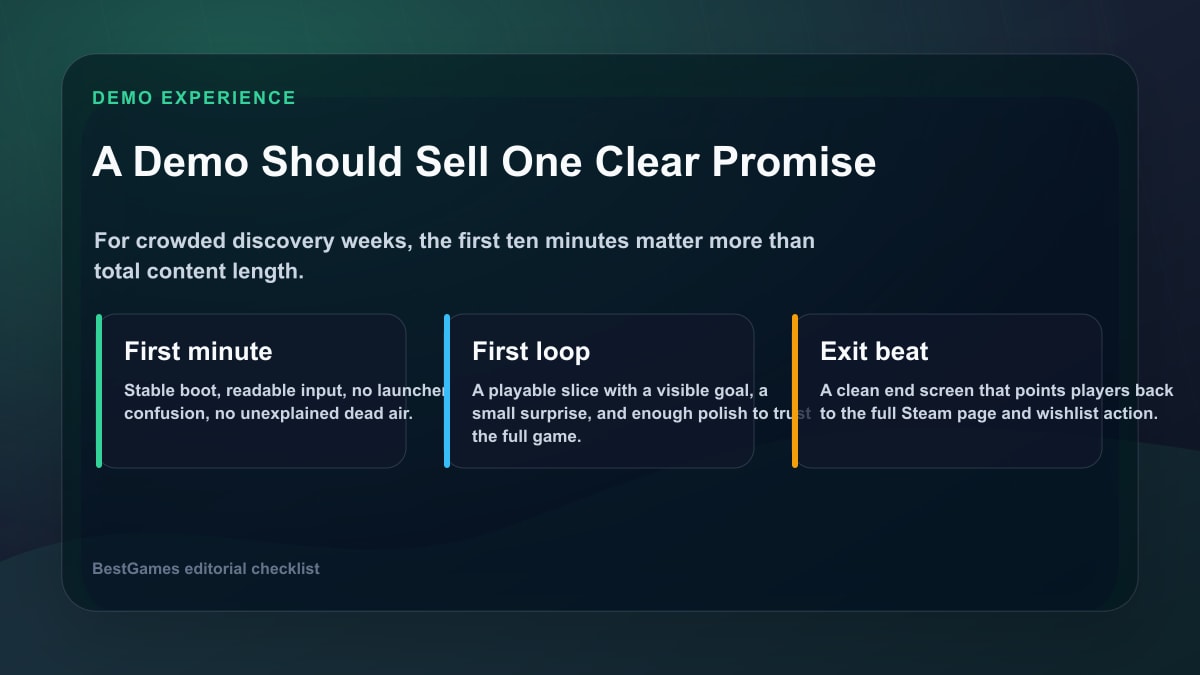
The next check is scope. A Next Fest demo does not need to prove the entire game. It needs to prove the reason the full game should exist. A polished 15-minute slice with a strong ending usually beats a messy 90-minute slice that exposes every unfinished edge. Developers on Reddit often return to this point because the temptation to over-show is real. When a team has been building for months or years, it wants players to see all the work. Players, however, are looking for a reason to keep caring.
The practical demo rule is simple: the first ten minutes should contain the core promise, not just the setup for the promise. A puzzle game should let players solve the kind of puzzle that defines the game. A roguelite should show the decision texture, not only a tutorial combat room. A cozy sim should show the loop that makes organization, farming, decorating, or crafting satisfying. A horror game should deliver tension, not only corridor walking before the scare arrives.
That rule also applies to browser-game-adjacent developers watching Steam from the outside. As we argued in our browser games 2026 analysis, low-friction play only works if the first loop is readable. Steam demos have more friction than browser games, but the same attention logic applies: players need to understand what they are being asked to enjoy before they invest more time.
A last-minute demo QA pass
- Install and launch the public demo build from a clean Steam account or clean test environment.
- Play the first 12 minutes without developer knowledge. Write down every moment that requires guessing.
- Test keyboard, mouse, controller, ultrawide, windowed, fullscreen, audio sliders, save behavior, and quit behavior.
- Remove unfinished menu items, placeholder text, debug labels, old build numbers, and misleading "coming soon" buttons.
- Put the wishlist or full-game store-page path in the main menu, pause menu, and end screen without interrupting play.
- Make the end of the demo clear: thank the player, show what the full game expands, and invite feedback.
This is also where a small team should decide what not to fix. If a bug is rare but a tutorial confusion happens to every player, fix the tutorial. If a late-demo encounter needs balance work but the first two rooms feel slow, tighten the first two rooms. Next Fest visibility is front-loaded around discovery, so early friction costs more than late imperfection.
Store Page, Wishlists, and the First Ten Seconds
Steam Next Fest is a demo event, but the store page still does a large part of the work. Many players will never download the demo. They will see a capsule, hover over a tile, skim tags, watch part of a trailer, glance at screenshots, and decide whether the game belongs in their queue. That means the Steam demo checklist must include the page around the demo, not only the executable.
Valve's Steamworks documentation for demos emphasizes that the demo is attached to the base game and has its own configuration path. The store page, demo button, and base game relationship all need to be clear. In practice, this means the player should understand three things before downloading: what the game is, what the demo includes, and why wishlisting the full game is the next useful step.
Reddit postmortems often make the same point from a different angle. Developers can spend months tuning a demo, then lose click-through because the capsule art does not read at small sizes, the tags describe the developer's intent instead of the player's expectation, or the trailer waits too long to show the hook. Steam Next Fest June 2026 will be crowded enough that ambiguous positioning becomes expensive.
The first ten seconds of the page need to answer the genre and hook question. "Turn-based tactics with programmable spells" is clearer than "a deep strategy adventure about destiny." "Cozy shop management with physics-based sorting" is clearer than "a wholesome journey of discovery." A strong description does not need to be dry, but it does need to tell the player what they will do.
The demo itself should reinforce that message. If the page promises tactical decisions, the demo should not spend the opening stretch on walking, lore, and menu setup. If the page promises speed, the demo should not begin with five screens of exposition. If the page promises atmosphere, the demo should not bury the first mood-setting moment behind a long tutorial. Store page and demo should feel like two parts of one pitch.
Wishlists are the metric developers talk about most because they are visible, comparable, and tied to launch momentum. They are also easy to misunderstand. A wishlist is not a promise to buy. It is a signal that the player wants to be reminded later. Steam Next Fest can create a spike, but some of those wishlists may be deleted after the festival, especially if players used the wishlist as a temporary queue. That does not make the spike useless. It means developers should measure quality, not only volume.
A practical wishlist path has three parts. First, the page itself needs a strong reason to wishlist before the demo is downloaded. Second, the demo should include a natural call to action after the player has experienced the hook. Third, the developer should keep communicating after the festival so the wishlist does not become a stale bookmark. Steam event posts, devlogs, patch notes, and release-date clarity all help turn a festival signal into a launch relationship.
For teams that also use social clips, web prototypes, or AI-assisted indie workflows, the store page is where all those experiments must converge. A viral GIF, a Reddit thread, or a browser prototype can create curiosity. Steam has to convert that curiosity into a durable reminder.
Livestreams, Press Preview, and Creator Outreach
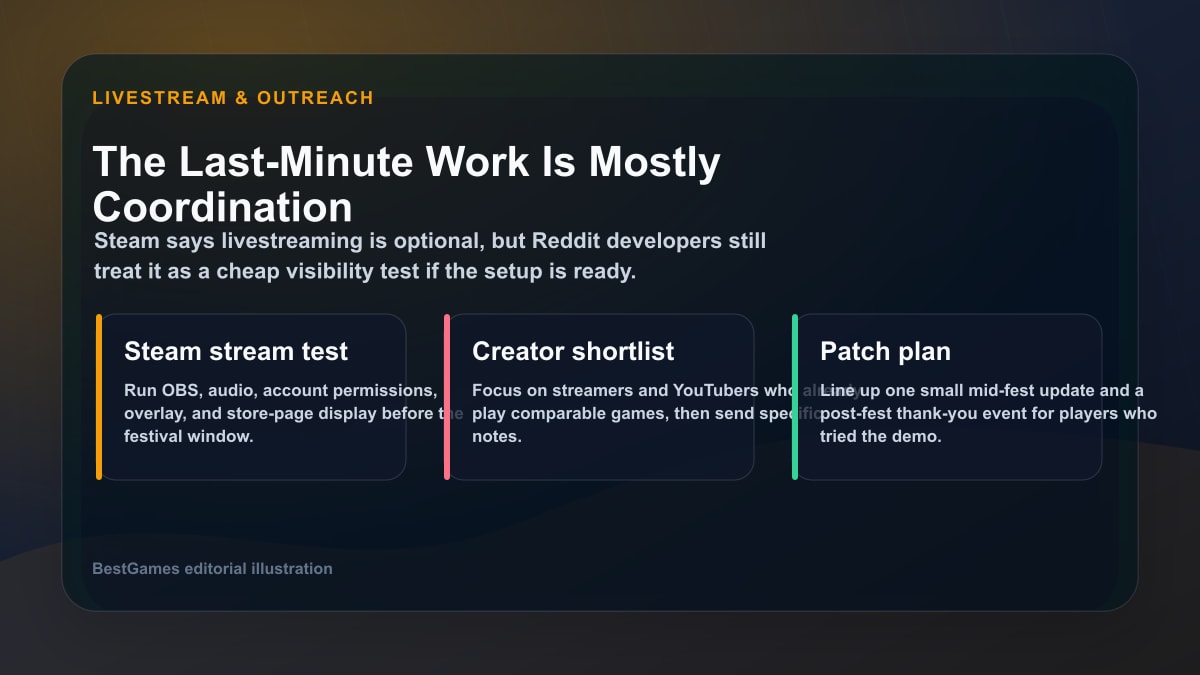
Valve lists livestreaming setup in the June 2026 timeline, but the documentation also treats it as optional. That distinction matters. A livestream can help a Steam page feel alive, give players a quick read on the game, and create scheduled activity during the festival. It can also waste time if the developer is still fighting the demo build, audio chain, OBS settings, or account permissions.
The Reddit advice here is pragmatic: do not add a livestream because other developers are doing one. Add it if the setup is already reliable and the stream has a purpose. A silent looped trailer may be less useful than a scheduled developer playthrough. A chaotic stream with poor audio may be worse than no stream at all. The goal is not to perform professionalism; it is to make the game easier to understand.
A last-minute livestream check should be concrete. Can the correct Steam account broadcast? Does the stream appear on the store page? Is the audio balanced? Are subtitles or text overlays readable at small sizes? Does the developer know which part of the demo to show first? Is there a short answer ready for "What is this game?" These details matter because a player watching for 30 seconds is making the same decision as a player skimming the store page.
The press preview on June 4 gives another reason to prepare early. Press and creators do not need a long essay; they need a clean pitch, a playable build, a press kit, direct contact information, and a reason the game fits their audience. The worst outreach is broad and generic. The better version names why the creator or writer might care: the game matches their coverage history, solves a genre itch, or contains a specific visual or mechanical hook that will make sense to their viewers.
For tiny teams, creator outreach should be narrow. Make a list of channels that already cover the genre. Check whether they cover demos, early access, roguelikes, cozy games, horror games, tactics games, or whatever category fits. Send a short message that respects their time. Include the Steam page, demo timing, press kit, one-sentence hook, and one sentence explaining why this particular game fits their audience. Ten thoughtful messages are usually better than 200 vague ones.
The same logic applies inside Reddit. A developer posting about a Next Fest demo should not treat the community as free advertising space. The better posts share something useful: a checklist, a postmortem, a mistake, a trailer critique request, or a concrete lesson from preparing the demo. The strongest Reddit threads around Next Fest tend to work because they are useful to other developers, not only promotional for the original poster.
After Steam Next Fest June 2026 Ends
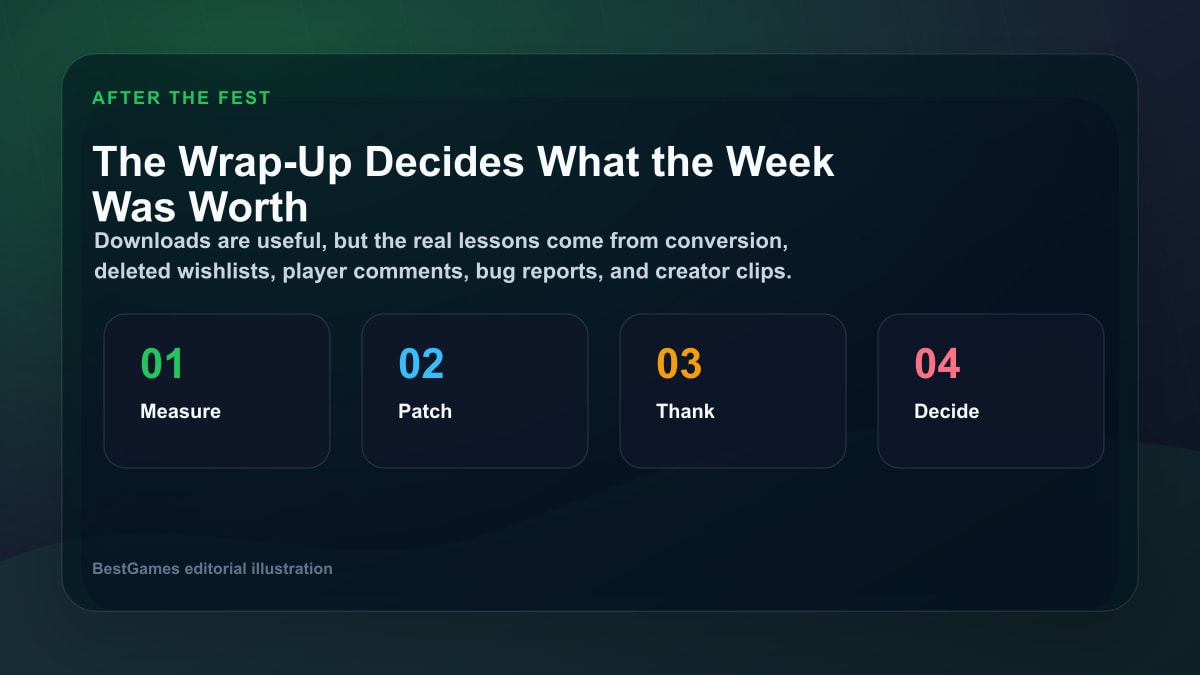
The most overlooked part of the Steam Next Fest June 2026 checklist is what happens after June 22. Developers often treat the festival like a finish line because the public pressure is intense. In reality, the festival is a diagnostic window. It tells a team what players understood, what they ignored, what they complained about, what they loved, and whether the store page turned attention into durable intent.
The first post-festival task is measurement. How many demo downloads came from the event? How many wishlists were added? How many wishlists were removed? Which store-page assets were visible when traffic arrived? Did players finish the demo? Where did they quit? Which bug reports repeated? Which clips or screenshots generated the most reaction? The goal is not to produce a vanity number. The goal is to learn which part of the launch funnel is weak.
The second task is communication. Players who tried the demo should not feel abandoned. A Steam event post can thank them, summarize the most common feedback, explain one or two planned changes, and invite them to keep the game wishlisted. This is not only polite. It tells players that the developer is listening and gives wishlists a reason to stay attached to the project.
The third task is deciding whether the demo should remain live, be patched, or be removed. Leaving a strong demo online can keep helping discovery. Leaving a broken or misleading demo online can hurt the full game. If the demo represents the project well, patch it and keep using it. If it needs major work, explain that the team is updating it. If the full game has changed direction, do not let an old festival build become the public's first impression forever.
This is where festival hype turns into launch planning. A team may discover that the game has a strong hook but weak onboarding. It may learn that the store page attracts the wrong genre audience. It may find that streamers love the game but players struggle with controls. Those are good problems to discover before launch, not after. Steam Next Fest is valuable because it compresses that learning into one visible week.
Conclusion: Treat Next Fest Like a Product Test, Not a Lottery Ticket
The best last-minute advice for Steam Next Fest June 2026 is sober. Do not assume the event will rescue an unclear game. Do not spend the final week adding new content if the first playable minutes still feel rough. Do not treat the store page as separate from the demo. Do not schedule a livestream that creates new technical risk. Do not let the festival end without a plan for feedback, patches, and player communication.
At the same time, do not undersell the opportunity. Next Fest remains one of the rare moments when players actively seek demos, creators look for interesting indie games, and developers can compare real behavior against expectations. Reddit's developer threads are useful because they cut through the fantasy version of that opportunity. They show that the difference between a forgettable demo and a useful festival showing is often ordinary preparation.
A good demo does not need to show everything. It needs to boot reliably, express the hook quickly, respect the player's time, make the full game easier to understand, and leave behind a reason to wishlist. That is the checklist worth finishing before June 15.
Steam Next Fest June 2026 FAQ
When is Steam Next Fest June 2026?
Steam Next Fest June 2026 runs from June 15 to June 22, 2026. Valve's June 2026 Steamworks page lists the event end time as 10 a.m. Pacific time on June 22.
What is the most important last-minute task for a Steam Next Fest demo?
The most important task is making the first playable minutes stable and clear. A larger demo does not help if players hit confusing controls, long dead time, broken settings, or an unclear hook before they see why the game matters.
Should indie developers livestream during Steam Next Fest?
Livestreaming is optional, but it can help if the setup is tested and the stream has a clear purpose. If the team is still struggling with build stability or audio setup, the livestream should not take priority over the demo itself.
How should developers use Reddit before Next Fest?
Reddit works best when developers share useful context, ask specific questions, or discuss lessons learned. Posts that only advertise a demo usually perform worse than posts that help other developers understand a real preparation problem.