Today's Summary
Unreal Engine 6 leads the report because Epic is explicitly expanding the engine into a connected development and distribution layer. Early Access is targeted for the end of 2027, with the full release 12–18 months later. Verse and Scene Graph, portable Fortnite cosmetics, open specifications, and optional integrations for Claude, Gemini, Codex, and other models form the core roadmap. A production Unreal plugin provides a useful reality check for AI-assisted work. Opposing accounts from current and former id Software staff expose the human cost of engine consolidation. SIGGRAPH's new Games Summit, Steam's estimated $11.1 billion half-year, gaming's $2.5 billion financing quarter, Netflix Minigolf, and next week's Xbox slate complete the wider ecosystem picture.
Editor's Viewpoint: The Next Engine War Is About Leverage
Unreal Engine 6 is not being pitched as a prettier renderer. Epic wants the engine to become the place where a team writes gameplay, operates a persistent world, connects AI assistants, moves assets between experiences, and participates in shared economies. Each piece can remove difficult work. Together, however, they also concentrate more of a studio's production life inside one ecosystem.
That trade becomes sharper beside the id Tech dispute. A specialist engine is not merely a pile of code; it is institutional knowledge carried by the people who understand why a renderer, toolchain, or workflow behaves as it does. Once those people are gone, a technically superior system can become strategically impossible to maintain. Standardizing on Unreal may then look efficient even when the conditions that created that choice were destructive.
Developers should welcome better portability, faster iteration, and more accessible tools, but ask one practical question at every layer: if this provider changes direction, what can we still take with us? Epic's commitment to glTF, USD, public specifications, visible source branches, and a choice of AI models is encouraging precisely because it acknowledges that fear. The healthiest version of UE6 will not be the engine that absorbs everything. It will be the one powerful enough to connect everything without turning every studio into a tenant.
Epic reveals Unreal Engine 6 and targets Early Access for the end of 2027
Epic Games revealed the road to Unreal Engine 6 during today's State of Unreal keynote at Unreal Fest Chicago. The company says UE6 will unify the two development streams it currently runs in parallel: Unreal Engine 5 for traditional high-end projects and Unreal Editor for Fortnite for live, persistent experiences. Epic is targeting an Early Access release at the end of 2027, followed by a full release 12 to 18 months later.
This is deliberately early disclosure rather than a product launch. A public UE6 development branch is now visible on GitHub, but Epic warns that it is not an alpha for production use. UE5 work will continue to merge forward, Fortnite development will attach to the UE6 stream, and studios on UE5 are promised a manageable transition rather than a hard break. Actors and Blueprints will survive in early UE6 versions before eventual deprecation, with conversion tools planned. For teams choosing technology today, the immediate message is clear: keep shipping on UE5, but begin treating UEFN's experiments as previews of Unreal's general future.
Roadmap at a Glance
- End of 2027 — Epic's current target for UE6 Early Access.
- 12–18 months later — The planned window for a full release.
- No hard break — Existing UE5 projects are meant to move forward gradually.
- Visible development — The UE6 source stream is public now, but not production-ready.
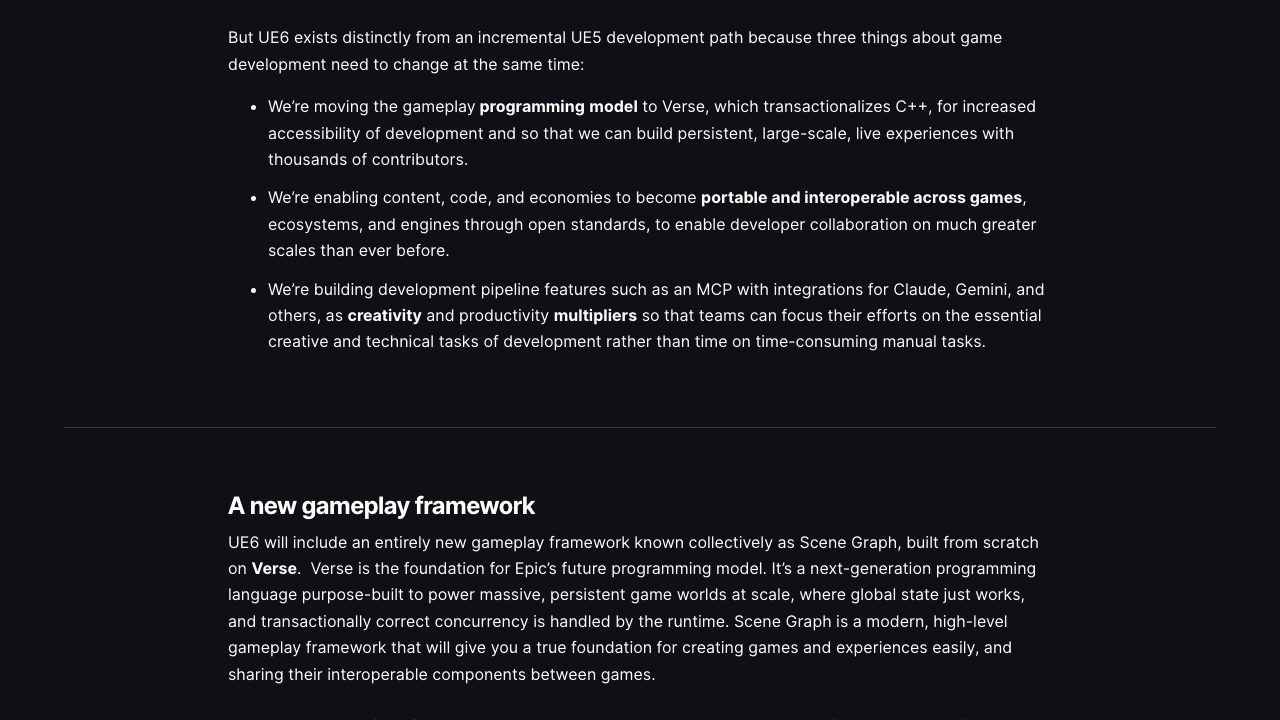
Verse and Scene Graph move from Fortnite experiment to Unreal's future gameplay model
UE6's largest technical change is a new gameplay framework called Scene Graph, built on Epic's Verse language. Epic describes Verse as the foundation of its future programming model for massive, persistent worlds. Its transactional approach lets operations roll back and run again safely, including C++ called from Verse. The current implementation is single-threaded, but Epic is researching how those transactions can scale across hardware and server clusters.
The long-term promise is unusually ambitious: developers could write game logic as though it were running on one machine while the runtime automatically moves work and objects between servers. Persistent global state could also make common tasks such as player saves less dependent on custom database plumbing. This is not ready for ordinary production, and Epic repeatedly frames it as work in progress. Still, the direction matters now. Blueprints made visual scripting central to Unreal; Verse aims to make large-scale live operation a native engine concern. Teams should watch how debugging, performance predictability, version control, and C++ interoperability develop before treating the architectural elegance as proven.
What Changes
- Scene Graph — A new high-level gameplay framework replaces assumptions built around Actors.
- Verse first — Epic is moving its future programming model beyond Blueprints and conventional C++ alone.
- Transactions — Game operations can be rolled back and resimulated.
- Distributed ambition — Epic wants one programming model to scale across multiple servers.
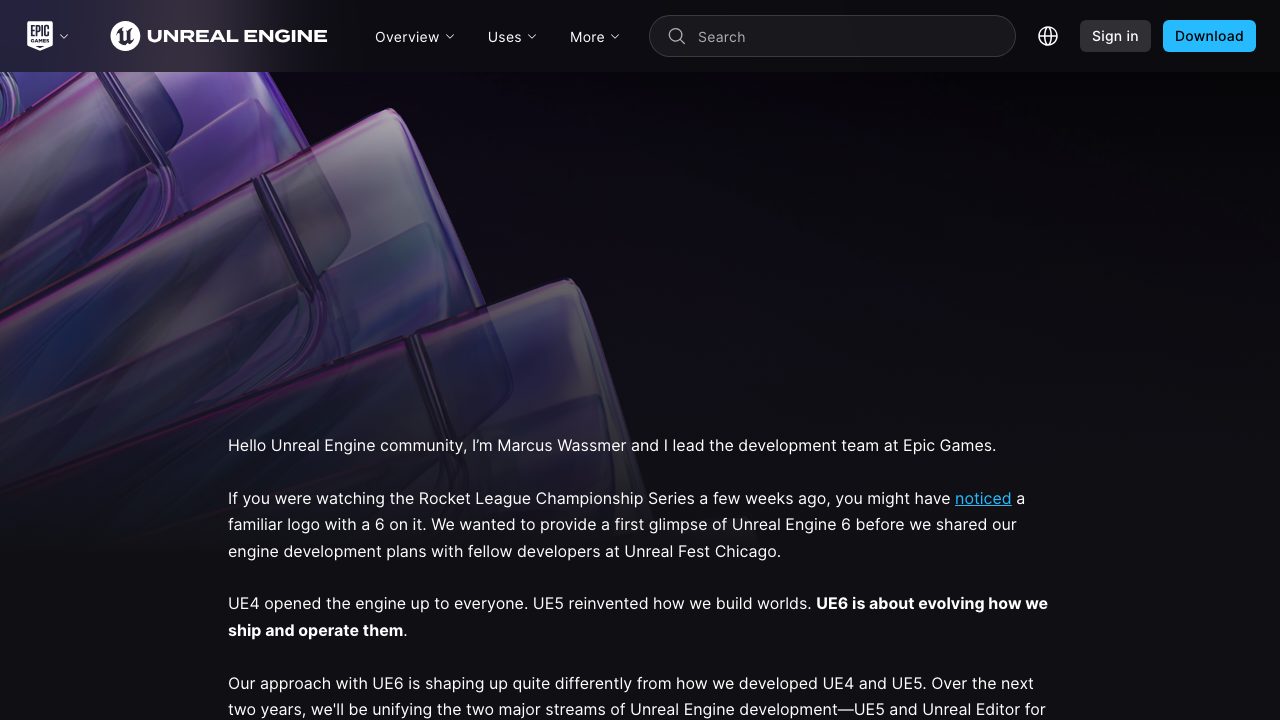
UE6 proposes portable content, code, and economies across games and engines
Epic's second UE6 pillar is portability. Where established standards such as glTF and USD can serve the engine, Epic says it will treat them as first-class formats. Where the industry lacks a standard, the company plans to publish Unreal systems as open specifications with Verse interfaces, asset conventions, and documentation that other engines and tools can implement. That is a broader promise than easier importing: it imagines functional assets carrying behavior and value between experiences.
Fortnite outfits will be the first large test. Epic plans to move the underlying system into an open UE6 module so eligible Fortnite cosmetics can appear in other games and outfits created elsewhere can work inside Fortnite. The company ultimately describes a shared economy of “smart assets” that retain logic as well as appearance. For developers, the opportunity is access to an existing social graph and player investment. The risk is designing around permissions, commercial rules, and technical contracts that may change. Open specifications will therefore matter as much as the headline interoperability. Portability is valuable only when a studio can understand, test, and leave the system without losing its own work.
The Portability Test
- glTF and USD — Existing open formats are promised first-class treatment.
- Open specifications — Epic says non-Unreal tools will be able to implement new systems.
- Fortnite outfits first — Cosmetics become the initial proof at meaningful scale.
- More than meshes — The goal includes behavior, ownership, and economic value.
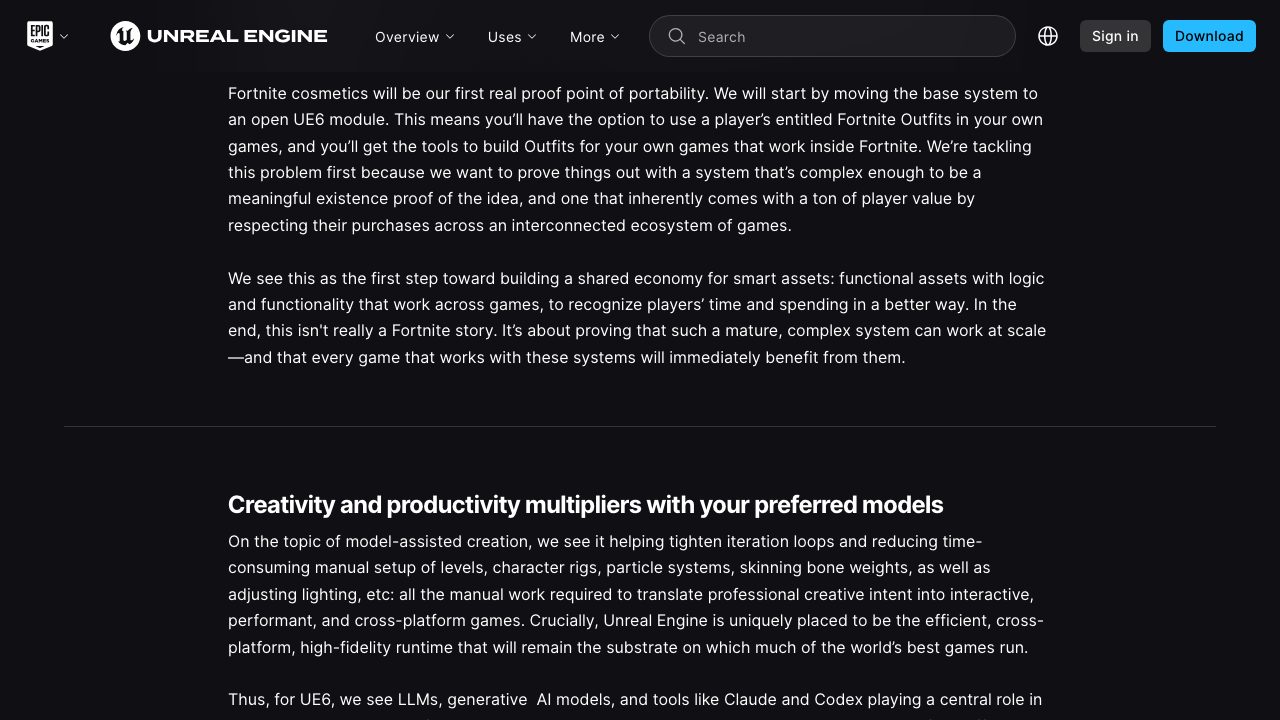
Epic plans an open model layer for UE6 instead of choosing one AI assistant
One day after Kimi K3 made playable 3D generation the industry's viral AI test, Epic has described how model assistance could enter a mainstream engine. UE6 is planned to expose engine capabilities through an open connection layer, with integrations for Claude, Gemini, and other models. Epic separately names Codex when describing tools that could help teams build content faster while preserving creative control. Its own Epic Developer Assistant will remain an optional default rather than the only path.
The intended work is less spectacular and potentially more useful than one-prompt game demos: level setup, rigs, particle systems, skin weights, lighting adjustments, code indexing, crash analysis, test generation, and internal tools. Epic says its strongest internal results so far often do not involve generating mainline engine code. That is a meaningful boundary. The company is prioritizing repetitive, inspectable work where an expert can verify the result. If the open layer works as advertised, studios could change models without rebuilding every engine integration. The practical questions will be pricing, data governance, permissions, reproducibility, and whether tools remain dependable across long production cycles.
AI Without a Single Gatekeeper
- Bring a preferred model — Epic names multiple providers rather than one exclusive assistant.
- Engine-level access — Models could operate tools, not merely suggest text.
- Structured work first — Testing, analysis, and setup lead the production examples.
- Creative control — Optional assistance is the stated design principle.

A three-month Unreal plugin test shows where AI assistance actually saves time
Online technical lead Olga Taranova has published a grounded production case that arrives at exactly the right moment for Epic's AI roadmap. A weekend experiment with Claude grew into a roughly 4,000-line Unreal plugin that transfers DataAsset properties to and from CSV files. It has now been used in an active game project for about three months, saving hours of repetitive work while still requiring roughly three person-days of maintenance per month.
The model performed best on documented, repeatable Unreal patterns: plugin setup, editor panels, reflection, metadata, and boilerplate. It struggled with project-specific context, subtle editor behavior, undo support, serialization defaults, and interactions between increasingly complex features. Round-trip tests became the real safety net. The lesson is not that AI failed; it is that value appeared when inputs, outputs, and verification were explicit. That aligns with Epic's emphasis on internal tools and automated analysis. It also warns against treating engine access as automatic competence. Models can accelerate established patterns, but undocumented design history and institutional knowledge remain difficult to reconstruct after people leave.
Production Evidence
- Three months in use — This is an operating tool, not a launch demo.
- Structured tasks win — Clear inputs and outputs made automation effective.
- Maintenance remains — The plugin still consumes expert time each month.
- Tests are decisive — Verification mattered more than raw code generation.
Former id staff say lost engine knowledge could make another id Tech game impossible
A laid-off id Software worker has challenged Microsoft's assurance that id Tech retains a healthy development base. In reporting relayed by PC Gamer from Game Developer, the former employee said the cuts removed people able to fix, maintain, or change the engine and described the lost institutional knowledge as immense. They also pointed to severe reductions across visual effects and technical art and design, concluding that they could not imagine another game being made in id Tech.
This account is not an official cancellation, and it conflicts directly with statements from Microsoft and current studio leadership. But it explains why engine strategy cannot be measured only by a headcount total. Mature proprietary technology depends on specialists who know its undocumented assumptions, workflows, and failure modes. Replacing that knowledge with a widely supported engine may reduce immediate risk, yet it also narrows the industry's technical diversity. On the day Epic presents Unreal as an increasingly comprehensive ecosystem, the id Tech story is the clearest warning that consolidation can arise from lost capability rather than a neutral comparison of tools.
What Is at Stake
- Institutional knowledge — Engine expertise is not evenly distributed across a studio.
- Conflicting accounts — Former staff and company leadership describe different realities.
- Technical diversity — Losing a specialist engine reduces alternatives for the wider industry.
- No confirmed cancellation — The engine's fate remains disputed, not settled.
Hugo Martin answers the reports: id Tech is “very much alive and well”
id Software studio head Hugo Martin addressed the post-layoff reports during an official Doom: The Dark Ages livestream. He rejected claims that the team had been reduced to roughly 50 people or “gutted,” saying the studio is approximately the size it was when it made Doom in 2016. Martin added that id Tech engineers remain in Frankfurt and at MachineGames and that the teams collaborate across locations.
The statement is the strongest public reassurance yet from current leadership, but it does not reconcile the detailed concerns raised by former staff about particular disciplines and lost knowledge. Both things can be true: a studio can retain enough people to build another game while becoming less capable of evolving its proprietary engine at the previous pace. The next evidence will be work, not rhetoric — what project id announces, which engine it uses, and whether the technology continues to advance. Until then, reporting should preserve the disagreement. For developers, the episode is also a reminder that engine continuity depends on people, budgets, and long-term organizational commitment, not only a repository that still exists.
The Official Counterpoint
- Studio continues — Martin says the Doom team remains capable of future work.
- Distributed expertise — Engine staff also sit outside the Texas studio.
- Doom 2016 comparison — Leadership uses a proven team size as reassurance.
- Proof still pending — The next project and engine choice will settle more than statements can.
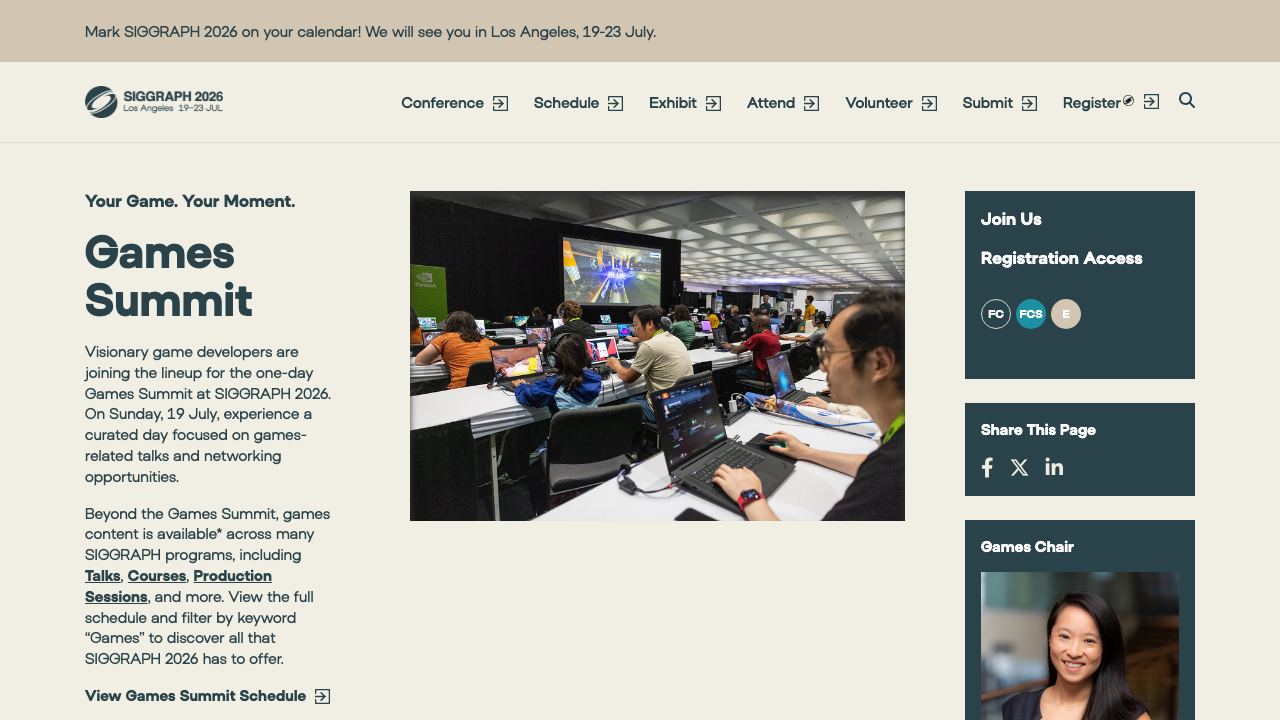
SIGGRAPH opens tomorrow with its first dedicated Games Summit
SIGGRAPH 2026 begins in Los Angeles tomorrow with a new one-day Games Summit. The program widens the conference beyond its traditional emphasis on graphics research and real-time rendering, adding sessions on accessibility, audio, performance capture, production, and the economics of modern development. Games-related talks will continue across the wider conference through July 23.
The timing makes the summit a useful counterpart to Unreal Fest. Epic's UE6 roadmap presents an integrated answer to large-scale game production, but the industry still advances through a network of specialist research, standards, studios, and independent tools. A gathering that puts engine programmers beside audio teams, accessibility practitioners, performers, and business leaders better reflects how games actually reach players. For smaller developers, the lesson is not to chase every technical frontier. It is to understand which production constraint is stopping the current project — performance, workflow, accessibility, funding, or audience — and learn from the specialists closest to that problem. Better engines expand possibility; multidisciplinary judgment turns possibility into a finished game.
A Broader SIGGRAPH
- New one-day summit — Games receive a dedicated opening-day program.
- Beyond rendering — Accessibility, audio, capture, and economics join technical sessions.
- Studios and indies — The lineup is designed to connect different production scales.
- Week-long presence — Games content continues throughout the conference.
Steam's estimated $11.1B half-year shows why platforms outlast launch cycles
Alinea Analytics estimates that games on Steam generated $11.1 billion in gross revenue during the first half of 2026, the platform's strongest six-month period. The estimate is 14.5% higher than the first half of 2025 and 8% above the holiday-heavy second half of last year. Higher prices, growth among Chinese players, viral cooperative hits, and publishers returning to Steam all contributed.
The most revealing number for today's ecosystem discussion is that only 21% of 2026 revenue came from games released this year, down from 29% for new releases in 2024. Steam's power is not merely launching hits; it is keeping old games purchasable, discoverable, reviewed, updated, and connected to communities. That durable catalog creates a compounding advantage no individual release can reproduce. Epic's plan for portable economies and connected experiences is partly an attempt to create another kind of compounding network. Independent teams should read both signals carefully: launch visibility remains scarce, but long-term support, community trust, and a game that continues to sell after its first season may be more valuable than a perfect opening week.
Platform Gravity
- $11.1B estimated gross — Steam posted its strongest half-year.
- 14.5% annual growth — The platform expanded despite industry turbulence.
- Only 21% from 2026 games — Back catalogs increasingly drive revenue.
- Trust compounds — Reviews, updates, and libraries reinforce the store over time.

Gaming financings pass $2.5B — but AI, advertising, and hardware take the lead
Gaming financings exceeded $2.5 billion across 96 disclosed private rounds in the second quarter of 2026, according to Drake Star's latest report. It was the strongest quarter of the past year and the second-highest disclosed value in three years. More than ten new gaming funds worth over $2 billion were also announced, while the quarter included 51 mergers and acquisitions.
The headline does not mean ordinary game studios suddenly have easy access to money. The largest rounds favored infrastructure around games: AppsFlyer raised more than $1 billion, followed by General Intuition, Decart, Tripo AI, and ModRetro. AI, advertising technology, and hardware drove the total. That distribution reinforces today's wider theme. Investors are backing the layers that many creators depend on, because platforms and tools can capture value across multiple games. New funds aimed at independent developers are encouraging, but teams still need a disciplined plan for production, ownership, marketing, and revenue. A powerful engine may lower some costs; it does not automatically move capital toward the people making the actual games.
Follow the Capital
- 96 rounds — Funding activity was broad, though value was concentrated.
- Infrastructure leads — AI, advertising, and hardware attracted the largest checks.
- 51 deals — Acquisition activity remained healthy.
- New indie funds — More financing routes exist, but access is not guaranteed.
Netflix Minigolf turns shows, phones, and the living-room screen into one game
Netflix Minigolf will launch for subscribers on July 28 as a four-player local party game. Developed by Netflix-owned Next Games, it combines minigolf with pinball across more than 60 courses themed around Stranger Things, Bridgerton, Squid Game, and other shows. Players use phones as controllers and can collect pranks that disrupt opponents.
The release is a compact example of ecosystem design. Netflix already owns the audience relationship, the screen, recognizable characters, mobile authentication, and a subscription that removes the purchase decision. The game turns those advantages into a low-friction social activity timed beside a new golf show. None of that guarantees strong play, but it changes the distribution problem dramatically. For independent developers, the useful observation is not “make branded minigolf.” It is that interface and context can be part of the design pitch: a device players already hold, a group already gathered, and a familiar subscription can make a simple mechanic accessible. As engines chase persistent shared worlds, Netflix is testing a smaller but immediate version of cross-media play.
The Netflix Loop
- 60+ courses — Multiple shows become one reusable party-game format.
- Phones as controllers — No dedicated gamepad is required.
- Four local players — The design targets a shared room, not solo streaming.
- Subscription access — Discovery starts inside an existing entertainment relationship.

Next week's crowded Xbox slate makes Play Anywhere the default visibility signal
Xbox Wire's July 20–24 schedule presents more than twenty releases competing inside a single week. The range runs from The Planet Crafter and Shift at Midnight to CULTIC, Tiny Witch, High Times, Dodo Duckie, and a long tail of compact puzzle and platform games. A striking share carry Xbox Play Anywhere, letting one purchase and save travel between console and Windows PC; several also arrive through Game Pass.
The list shows what engine democratization looks like at the storefront. More teams can ship competent games across devices, but the resulting volume makes identity and discovery harder. Platform badges become quick trust signals because players cannot investigate every release. The most legible games in the schedule explain themselves through one unusual rule: Dodo Duckie changes between 2D and 3D, Shift at Midnight hides lethal impostors among gas-station customers, and Bear Mage Honey Sage creates sticky platforms from honey. UE6 may reduce production friction even further. That only increases the value of a concept a player can understand in one sentence, a launch page that proves it immediately, and a platform feature that removes the next barrier to trying it.
Discovery Under Pressure
- More than twenty releases — One platform week already exceeds most players' attention.
- Play Anywhere spreads — Cross-device ownership becomes a standard advantage.
- Game Pass reduces friction — Subscription placement creates sampling opportunities.
- One-sentence hooks win — Distinct mechanics remain easier to remember than feature lists.