Today's Summary
Kimi K3 is the lead story because it reframes AI game creation around playable systems rather than static concept art. Moonshot's own 3D open-world case, independent social tests, a real user's storm-chaser experiment, and the model's July 27 open-weight promise reveal both the opportunity and the current cost. Around it, Roblox prepares prompt-to-game creation for phones, glTF moves toward portable interactive behavior, Hamburg offers non-repayable prototype grants, game financing posts its strongest quarter in a year, two titles arrive on Game Pass, July's indie slate expands, and graphics researchers gather in Los Angeles.
Editor's Viewpoint: The Demo Is No Longer the Finish Line
Kimi K3's most important game-development result is not that it can draw a handsome scene. The striking part is that it can assemble a world, wire movement and weather, inspect what it made, and keep revising through screenshots. That compresses the distance between an idea and the first playable test. For solo developers and tiny teams, this could make experimentation dramatically cheaper: a strange mechanic can be experienced before anyone commits a month to it.
But social media naturally rewards the first thirty seconds — the sweeping camera, the unexpected detail, the fact that a prompt produced anything playable at all. Games survive on the next thirty hours: controls, pacing, save states, accessibility, performance, original art direction, and the thousand judgment calls that turn a prototype into a coherent experience. The user who produced a good storm-chaser game and then hit a weeks-long quota wall is therefore as revealing as Moonshot's polished open world.
The near-term winner will not be the developer who generates the most impressive one-shot demo. It will be the team that uses this new speed to test more ideas while keeping authorship, verification, and player feedback firmly in the loop. AI can collapse prototype time. It cannot decide which game deserves to exist.
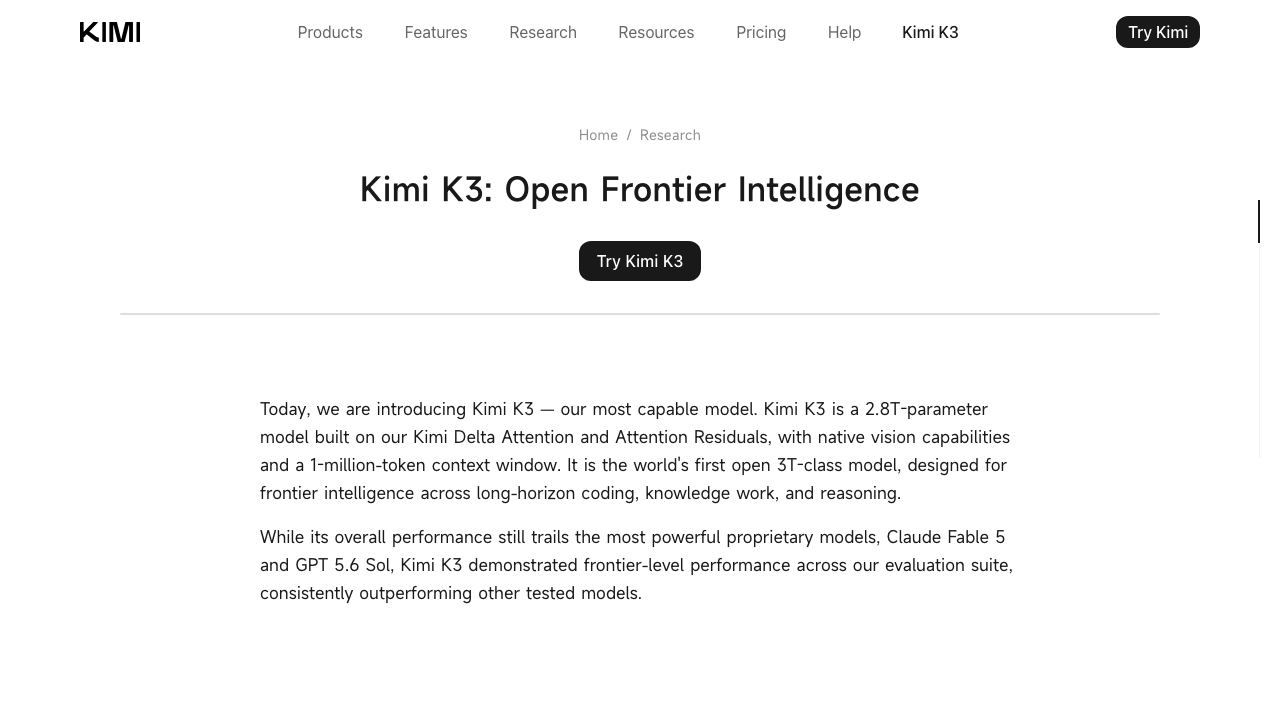
Kimi K3 launches as Moonshot's 2.8T open-frontier model with vision built in
Moonshot AI introduced Kimi K3 on July 16 as its most capable model, built with 2.8 trillion total parameters, native vision, and a one-million-token context window. The company positions it for long-running coding, reasoning, and knowledge work rather than short chat answers. At launch, K3 is available through Kimi's consumer product, desktop work app, coding tool, and API, with the highest reasoning setting used by default.
For game developers, the important capability is the combination rather than any single benchmark. K3 can navigate a large project, use development tools, interpret screenshots, and revise visible output. That loop is closer to how a developer actually works on a game than a model that only emits a code sample once. Moonshot is also unusually direct about the limit: it says K3 still trails the strongest proprietary models overall, even while posting competitive results across its own evaluation suite. That restraint matters because the model's most viral demos are already encouraging much larger claims.
What Developers Should Watch
- Native vision — The model can inspect game output instead of coding blind.
- Long sessions — A million-token context supports larger projects and longer feedback loops.
- Multiple access points — Web, desktop, coding tool, and API availability lowers trial friction.
- Claim boundary — Officially impressive does not mean proven on production games.
Kimi K3's procedural horseback world turns a model showcase into a playable 3D game
The launch's defining game-development case is a browser-based 3D exploration game built with Three.js, WebGPU, and GPU compute. Kimi K3 generated the environment procedurally and used a 3D asset tool for the rider and horse, producing forests, a cabin village, snowy mountains, and dynamic weather. Moonshot explicitly notes that animated character models and terrain data were external inputs, a useful disclosure that keeps the result from being misread as pure text-to-game magic.
The case matters because it connects several difficult tasks: world generation, asset integration, movement, rendering, and visual iteration. K3's advertised “vision in the loop” means the model can compare live screenshots with its intent and continue editing the build. That is a practical development pattern, not merely an image-generation trick. Still, the demo proves prototype assembly, not commercial readiness. It does not establish how the model handles long-term project architecture, collision edge cases, progression design, controller support, optimization across devices, or the creative consistency needed for a full release.
Why This Demo Spread
- It is playable — The output can be explored, not just watched.
- It joins the pipeline — Code, generated terrain, and external assets work together.
- It self-inspects — Screenshot feedback makes iteration visible.
- It has honest dependencies — External models and terrain are disclosed.
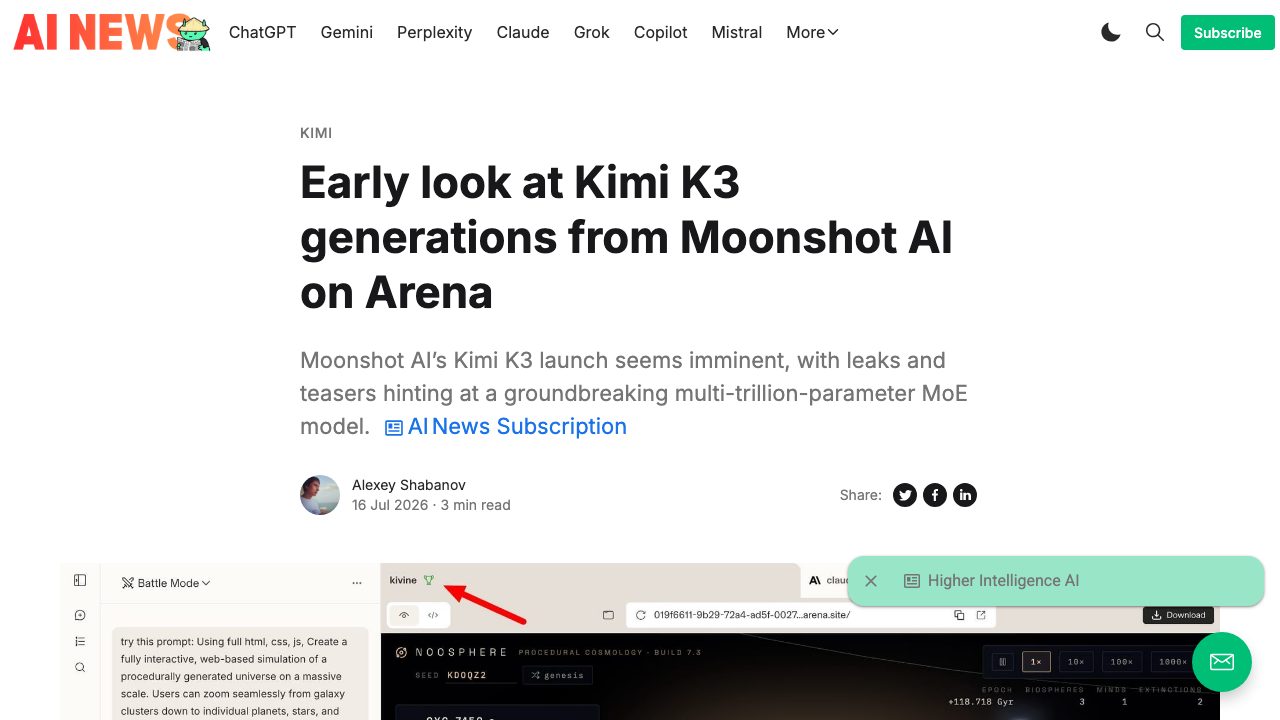
Social testers praise Kimi K3's 3D detail — while flagging 35-minute runs and weaker UX
Early Arena generations and social-media tests made interactive 3D Kimi K3's breakout narrative before the official launch page had time to settle. Testers shared universe simulations, voxel scenes, a Death Star trench run, and richly detailed interfaces. One creator called interactive 3D experiences a likely core strength; another said a frontend generation was among the best outputs they had seen from the prompt.
The same reports provide the necessary counterweight. A direct comparison found a rival model faster with sturdier interface components, while K3's result was more elaborate and visually ambitious. One impressive generation reportedly took 35 minutes. Those observations suggest K3 may currently trade speed and interface reliability for scope and visual taste. For game makers, that is not a minor footnote: iteration frequency determines how many design hypotheses a team can test in a day. Social clips establish that K3 can surprise. They do not yet establish whether it is the most dependable tool for repeated production work.
The Real Signal
- 3D is the viral wedge — Interactive scenes drew more attention than benchmark tables.
- Taste is visible — Testers repeatedly noticed composition and detail.
- Speed remains a cost — A 35-minute pass changes the economics of iteration.
- UX can lag spectacle — Rich visuals do not guarantee robust controls or interface behavior.
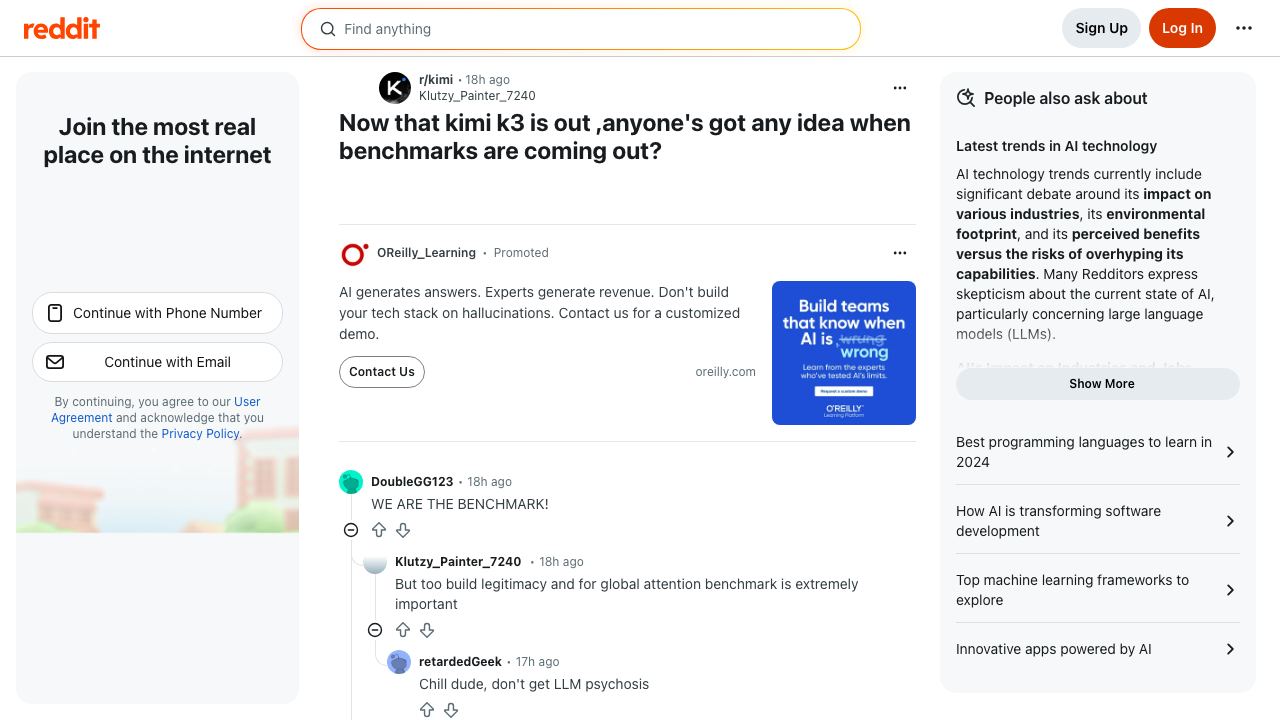
A user's 3D storm-chaser game exposes Kimi K3's most practical launch-day tension
In a launch-day discussion about benchmarks, one Kimi user offered something more useful than a score: they asked the model to make a 3D storm-chaser web game and described the completed result as good. The experiment is modest compared with Moonshot's polished horseback showcase, but it is stronger evidence of accessibility. An ordinary user chose a game idea, produced a playable version through the public product, and understood the result well enough to judge it.
Then the constraint arrived. The user said that single game consumed enough access that their quota would not return until August 11. Replies immediately reframed the achievement around cost: what does “one game” include, how expensive was it, and can this workflow support repeated experiments? That exchange is the launch in miniature. K3 can compress a concept into something playable, but creative iteration needs more than a spectacular first pass. If the next build is weeks away, the model behaves like a demo booth rather than a daily development partner.
Prototype Reality Check
- Low entry barrier — A user could describe a niche game and receive a playable result.
- Real-world validation — This was outside Moonshot's curated showcase.
- Quota shock — One game may consume a disproportionate share of public access.
- Iteration is the product — A prototype only matters if the creator can revise it.

Kimi K3's July 27 weight release could matter more to game tools than launch-day hype
Kimi K3 is available now through hosted products and an API, while Moonshot says the full model weights will arrive by July 27. Axios highlighted the release as a major open-model challenge, noting the model's scale, long context, native visual input, and strong early developer preference results. The open-weight promise is especially relevant to game technology, where studios often need custom pipelines, predictable data handling, and control over how a model interacts with proprietary projects.
There is an important distinction between open weights and easy local use. A model of this scale will not run on a typical developer workstation, and Moonshot recommends large multi-accelerator configurations for efficient deployment. Hosted access therefore remains the practical route for most small teams. The official API is priced at $0.30 per million cached input tokens, $3 per million uncached input tokens, and $15 per million output tokens. That structure rewards repeated work on a stable codebase, but output-heavy world generation can still become expensive. The July 27 release will expand experimentation; it will not erase infrastructure economics.
Access Questions
- Weights are coming — July 27 is the next real milestone.
- Self-hosting is specialized — Open does not mean laptop-sized.
- Caching helps projects — Stable code context can reduce recurring input cost.
- Output still costs — Large generated builds need budget discipline.
Roblox Build brings prompt-to-game creation to phones — and admits the slop risk
Roblox announced Build, a mobile-first creation surface that turns a text idea into a basic game inside the Roblox app. A public alpha begins in New Zealand on July 28. The tool can generate a starting experience, let creators playtest and refine it, then pass the same project and chat history into Roblox Studio. Roblox says its models can handle mechanics, environments, characters, visual style, sound, functional 3D objects, and eventually complete editable scenes.
The timing makes Build a direct companion story to Kimi K3. Both promise that playable 3D creation can begin from language, but Roblox controls the engine, asset conventions, publishing path, safety checks, and discovery system. That vertical integration may make its output less open but more immediately shippable. Roblox also confronts the obvious concern: a flood of disposable AI games. The company says retention-based discovery and extended review will prevent low-quality projects from dominating. That is a claim the July alpha will have to prove, especially when faster creation multiplies both good experiments and forgettable copies.
Platform Advantage
- Phone-first creation — The audience for building expands beyond desktop users.
- One publishing stack — Generation, testing, safety, discovery, and release share a platform.
- Studio handoff — Mobile ideas can continue in professional tools.
- Quality pressure — Retention ranking becomes Roblox's defense against mass-produced clutter.

glTF interactivity extension moves toward ratification as 3D assets learn behavior
The Khronos Group submitted the KHR_interactivity extension for glTF 2.0 for ratification. The proposal allows behavior graphs to travel inside a glTF asset, so an interactive object can carry logic rather than requiring every application to rebuild that behavior in platform-specific code. Support is already developing across tools and runtimes, moving glTF from a format for looking at 3D assets toward a portable building block for experiences.
This standards story sits directly under the Kimi K3 and Roblox Build headlines. Generative tools can create scenes quickly, but those scenes become more useful when behavior, assets, and meaning survive the trip between an editor, a browser, a game engine, and a publishing platform. Portable interactivity could reduce the amount of glue code required to turn generated prototypes into reusable components. Ratification is not instant universal support, and behavior graphs will not replace full game logic. Still, the extension addresses a less glamorous bottleneck that may determine whether AI-generated 3D work becomes a real ecosystem or a collection of isolated demos.
Why Standards Matter
- Behavior can travel — Logic moves with the 3D asset.
- Less platform glue — Creators avoid rewriting simple interactions for every runtime.
- AI output becomes reusable — Generated components gain a clearer exchange path.
- Ratification is the start — Tool and engine adoption will determine real value.

Gamecity Hamburg opens a second prototype-funding round worth up to €80,000 per project
Gamecity Hamburg announced its second 2026 prototype-funding round, with applications scheduled from September 4 through September 24. Founders, startups, and small or medium-sized companies can seek up to €80,000 in non-repayable support for prototypes with convincing market potential. The selection committee adds producer Nora Klutzny and Overhype Studios co-founder Paul Taaks alongside publishing, development-services, and Indie Arena Booth expertise.
Public prototype money is especially relevant on a day dominated by near-instant AI demos. Faster tools can lower the cost of answering “does this idea work?”, but teams still need cash for original art, design iteration, testing, accessibility, contracts, and the months required to make a prototype pitchable. Hamburg's program funds that middle zone between clever experiment and investable product. The non-repayable structure also lets developers test a distinct idea without immediately trading away ownership or accepting a publisher roadmap. AI may stretch €80,000 further than it once did, but the grant's real value is time for judgment rather than raw content volume.
Prototype Opportunity
- Up to €80,000 — A meaningful runway for a small team.
- Non-repayable — Developers retain more control over early decisions.
- September window — Applicants have time to prepare evidence and a focused pitch.
- Market potential required — A fast demo still needs a credible audience.

Game financings pass $2.5B in the strongest quarter of the past twelve months
New market reporting says gaming financings exceeded $2.5 billion in the strongest quarter of the past year. The total is lifted by very large disclosed rounds, including more than $1 billion raised by AppsFlyer, so it should not be mistaken for a universal recovery across studios. Even so, the quarter provides a more constructive capital signal after a period dominated by layoffs, closures, and risk avoidance.
For game developers, the distribution matters more than the headline total. Capital is flowing toward infrastructure, proven platforms, and businesses that can show scalable economics. A beautiful AI-generated 3D prototype may reduce the cost of a first meeting, but investors still evaluate acquisition, retention, team credibility, intellectual-property ownership, and a path to revenue. The likely effect of tools such as Kimi K3 is therefore not that every idea gets financed. It is that more teams can reach the evidence stage with less money, increasing both opportunity and competition. The best prototypes will need a sharper reason to exist when everyone can make the opening minute look expensive.
Capital Signal
- $2.5B-plus quarter — Financing activity improved materially.
- Large deals distort the average — Small studios should not read this as easy money.
- Evidence bar rises — Cheap prototypes increase the number of credible-looking pitches.
- Business fundamentals remain — Retention and distribution still decide outcomes.
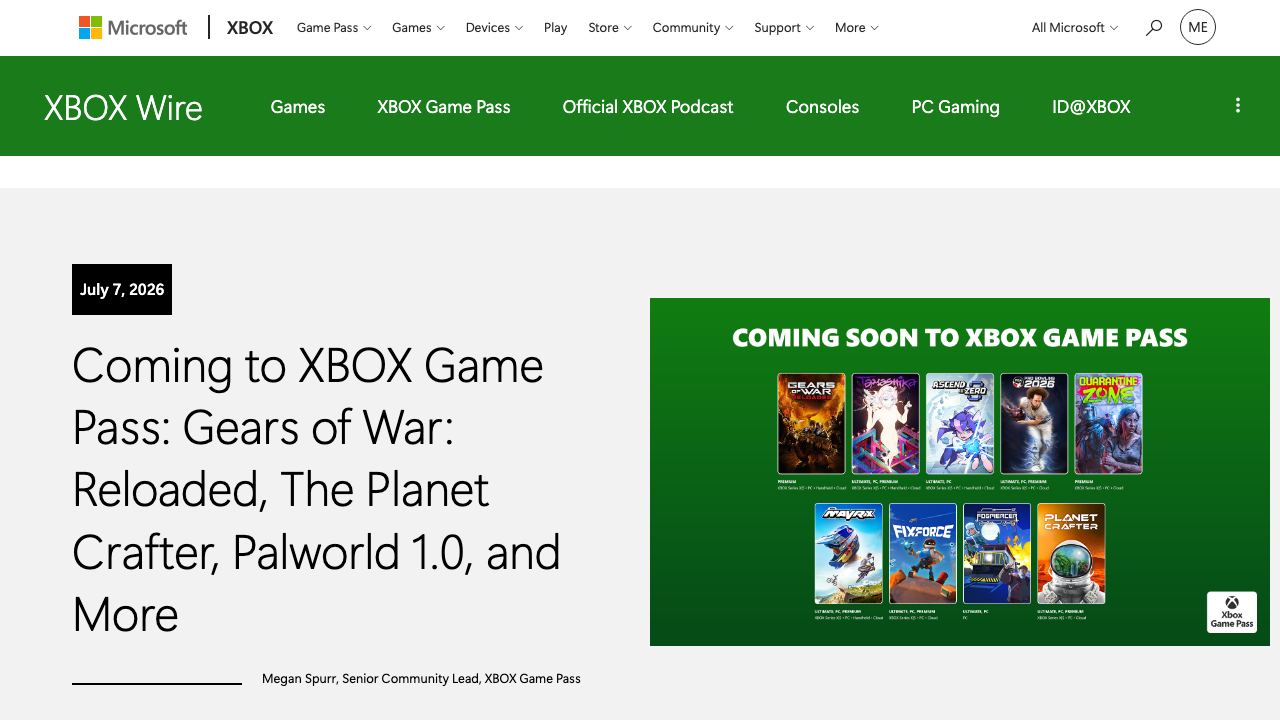
FixForce and Fogpiercer arrive on Game Pass today with two different indie loops
Xbox's July Game Pass lineup adds FixForce across cloud, Xbox Series, handheld, and PC, while Fogpiercer joins PC Game Pass. FixForce is a cooperative extraction platformer in which up to six robot workers salvage parts and build giant junk structures with drill-wrench arms. Fogpiercer takes a more tactical route, combining roguelike deckbuilding with positioning, chain reactions, and an environment hidden by dangerous fog.
The pair offers a useful contrast to today's AI-creation conversation. Neither game is selling the miracle of how quickly it was produced; each is selling a readable play loop that can survive repeated sessions. Subscription placement gives both teams a large discovery moment, but it also puts retention under immediate scrutiny. Players can sample in minutes and leave just as quickly. That makes clear mechanics, onboarding, and multiplayer reliability more important than trailer polish. As generative prototypes multiply, platform catalogs may become an even harsher test of whether an idea is merely visually convincing or genuinely playable with friends.
Today's Catalog Test
- FixForce goes broad — Cloud, console, handheld, and PC maximize reach.
- Six-player identity — Cooperative building creates a strong social hook.
- Fogpiercer stays focused — PC deckbuilding targets a proven strategy audience.
- Sampling is unforgiving — Game Pass removes purchase friction and exposes weak onboarding.
Heave Ho 2 and Moss widen July's case for mechanics with an instantly readable identity
July's release slate gained two distinctly legible games on July 16. Heave Ho 2 expands the original's arm-linked cooperative platforming with online play, eight themed worlds, and more hazards built around the same physical comedy. Moss: The Forgotten Relic reworks the acclaimed VR adventures for conventional screens, opening Quill's puzzle-platforming journey to players who do not own a headset.
Both releases underline a useful design lesson during Kimi K3 week: technical possibility is not the same as a game identity. Heave Ho can be explained through one gesture — grab, swing, and refuse to let your friends fall. Moss is carried by scale, companionship, and the relationship between player and mouse, even after its camera context changes. Generative tools may accelerate level sketches, asset variants, and porting work, but the memorable part remains a compact promise that players can repeat to someone else. In a storefront crowded with impressive screenshots, clarity is still one of the rarest development resources.
Release Lessons
- Heave Ho keeps one verb — Physical cooperation remains the entire pitch.
- Online expands the circle — The sequel no longer depends on one couch.
- Moss leaves VR — A careful adaptation broadens access without discarding identity.
- Clarity beats feature count — Players remember the central feeling, not the production checklist.
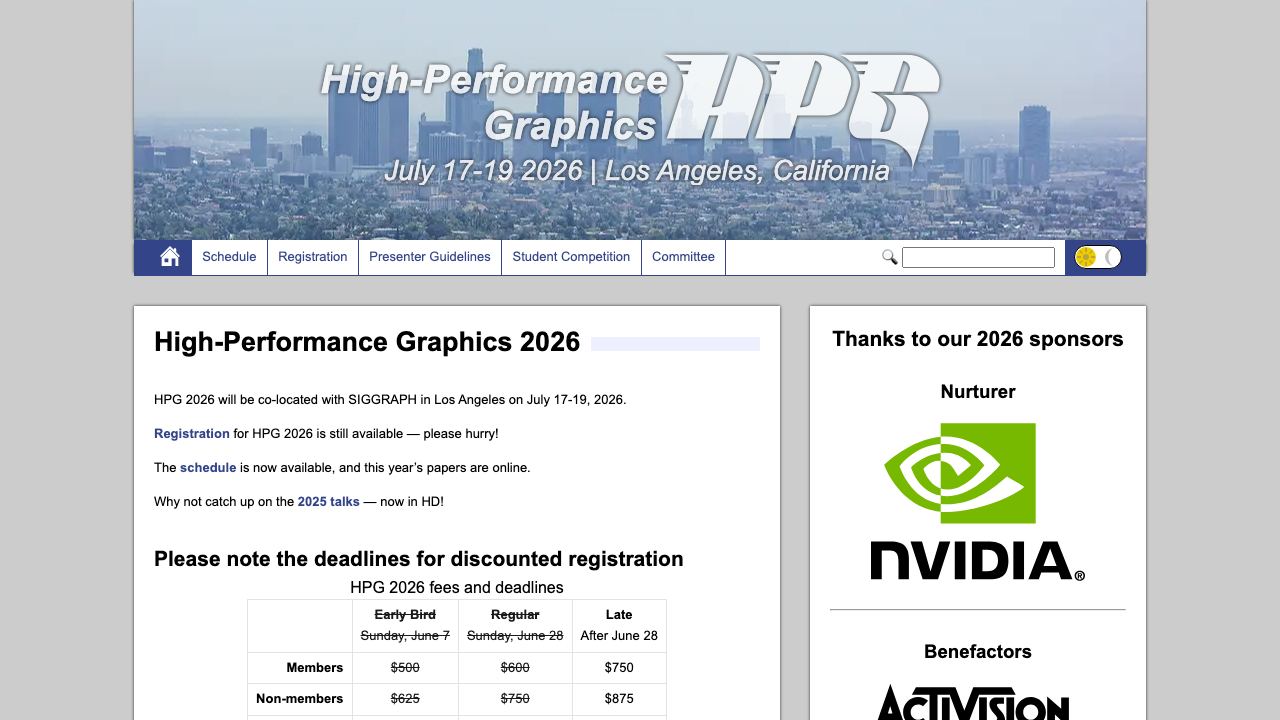
High-Performance Graphics 2026 opens with ray tracing, neural shaders, and real-time denoising
High-Performance Graphics 2026 opens today in Los Angeles and runs through July 19 alongside SIGGRAPH. The first-day schedule includes accelerated ray tracing, massive animated geometry, real-time path tracing and denoising, reliable Android frame profiling, and neural.slang, a standard module for inline neural networks in shaders. The event brings graphics researchers, engine engineers, hardware architects, and production-minded implementers into the same room.
The conference provides a grounded ending to a day of astonishing generated worlds. Kimi K3 can assemble a WebGPU scene, but every smooth forest, animated rider, and dynamic weather effect still depends on years of graphics research, standards work, compilers, drivers, and careful profiling. AI may help developers express an intention faster; it does not repeal memory bandwidth, frame budgets, or device fragmentation. HPG's agenda is where those hard limits are turned into new capabilities. The most important relationship is therefore not “AI replaces graphics expertise.” It is that models may make more people consumers of advanced graphics systems, increasing the value of the engineers who make those systems reliable.
Research Meets Production
- Ray tracing at scale — Massive animated scenes remain a core performance problem.
- Neural shaders mature — Inline networks move closer to standardized graphics workflows.
- Mobile profiling matters — Generated worlds still have to run on real devices.
- SIGGRAPH adjacency — Research can travel quickly into tools and engines.