
When someone tried to file Peak under “the world’s first 100% AI created game,” co-publisher Aggro Crab did not write a policy statement. They wrote: “We might be slop, but we're human-made locally-sourced artisanal slop.”
That line only exists because a hit game still had to prove it was made by people. Steam AI disclosure is the booth where that proof happens. The industry pitch goes the other way. Platform holders talk about removing repetitive work. Executives talk about more content for less money. The implied customer is the small team: limited budget, no art department, a store page that has to look finished by Thursday.
I did not interview a newsroom-sized sample. I read the public record from the last year: the GamesRadar conversations with more than two dozen indie developers, the GDC 2026 survey, Steam and itch disclosure rules, CrazyGames and Kongregate developer docs, and the named fights that actually left a paper trail. Peak. Hardest. Expedition 33. Saber Interactive. The pattern is not “AI is good” or “AI is bad.” It is that Steam AI disclosure asks the people with the least cover first, and web game portals barely ask at all.
Steam AI disclosure is the confession booth
Valve has required Steam AI disclosure since January 2024. In January 2026 it narrowed the form: coding assistants and other internal tools can stay off the store page, but player-facing art, audio, writing, localization, and live generation still have to be declared. The label sits near the bottom of the page, next to the specs. Players who care will find it. Players who want a filter still have to hunt.
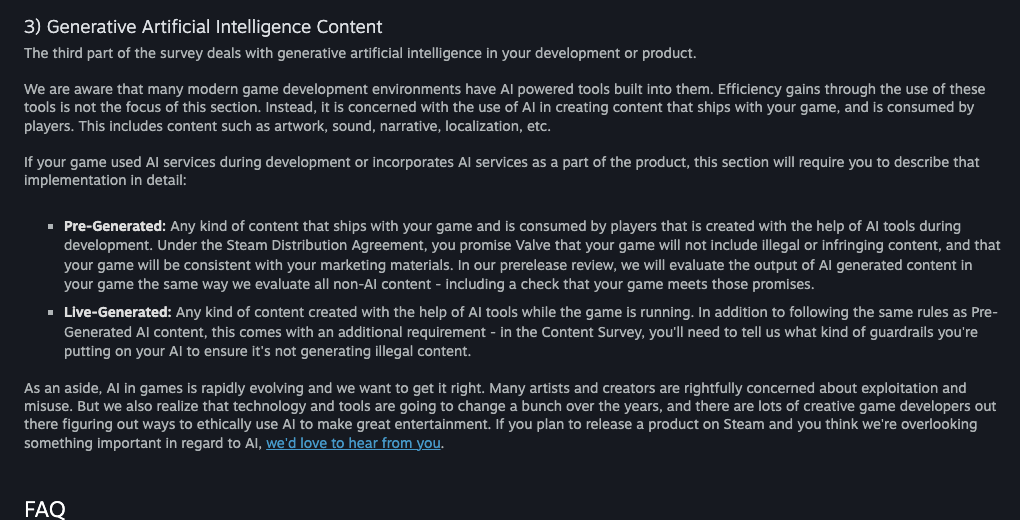
They have a lot to hunt. GamesRadar counted more than 8,600 demos in the June 2026 Steam Next Fest, and nearly 1,700 of them carried an AI disclosure. SteamDB’s tally for the same week was 1,715 of roughly 8,700, about one in five. That is not a fringe tag anymore. It is a weather report.
itch.io is blunter in a different way. Its creator guidelines tell people not to mass-upload AI pages, and they ask every project that ships generative material to use the AI Disclosure field. Tagged games get their own browse lane. The point is not a ban. The point is that the file has a label before a stranger clicks it.
Eero Laine felt that weather and took his game down. In January he posted that Hardest, a free card roguelike he had shipped with AI illustrations, would leave Steam. “The game existing in its current form is a disgrace to all game makers and players,” he wrote. He said he had coded it himself and could remake it with real assets. He deleted it anyway.
Sandfall’s Clair Obscur: Expedition 33 got the prestige version of the same slap. The Indie Game Awards pulled its Game of the Year after leftover AI placeholder textures became public, even though the studio said those assets were not supposed to ship. A solo developer deletes a free game. An awards body retracts a trophy. Both are punishments that only work if someone is looking at a store page, a credits list, or a ceremony.
I would rather not be able to make games anymore than use generative AI.
Colin McInerney, Strange Scaffold / Pedalboard, to GamesRadar+
The people with a PR team arrive later
GDC’s 2026 State of the Game Industry report, based on more than 2,300 professionals, found that 52 percent now think generative AI is bad for the industry. Two years earlier that number was 18 percent. The share who think it is good fell to 7 percent. Use itself barely moved: about a third still say they use the tools at work. The feeling changed faster than the workflow.
PC Gamer’s write-up of that survey also printed the line that keeps showing up in smaller rooms: “I'd rather quit the industry than use generative AI.” Managers, the same report noted, are more likely to use the tools than the people under them.
Then look at who gets to argue in public after the fact. In August, narrative designer Stella Sacco said Saber Interactive replaced her with ChatGPT on Rideshare Stimulator and that the passenger voices were AI too. Saber denied replacing writers and said the campaign was written by people. CEO Matthew Karch, talking to the press, said he would “in retrospect have been happy to replace her with AI.” A few days later the Steam page grew a disclosure: voice generation, some localization, optional free-ride missions, labeled AI radio. The game was not delisted. The argument was about how late the footnote arrived.
Ubisoft can announce Teammates, a generative-AI companion program, as the direction it wants to take. Call of Duty and EA can eat a week of screenshot forensics and keep the release date. Lucas Pope, who made Papers, Please and Return of the Obra Dinn, told a podcast he does not even want to describe his next game, because “it's getting slurped up by AI or people are gonna copy it.” Softmode, shipping Mahou Arms after nine years, felt the need to write that the 1.0 build had “not a single pixel of generated art, audio, narrative, or code.”
The small names pre-empt the accusation. The large names amend the store page when the quote is already circulating.
Web game portals still skip AI disclosure
This is where browser games get interesting, and not in the way the efficiency pitch promised.
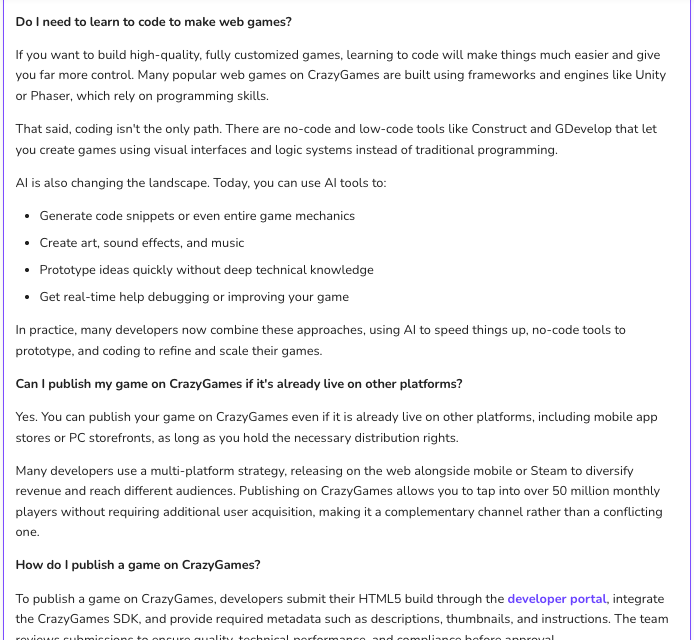
CrazyGames’ developer FAQ is cheerful about the same tools that get a Steam game ratio-bombed. It tells prospective makers they can generate code, art, sound, and music, prototype without deep technical knowledge, and combine that with no-code tools. There is no equivalent of Valve’s public content survey sitting under the play button. The page you land on is a thumbnail, a title, and an iframe.
Kongregate is more careful and still softer than Steam. Its support article says the license does not require a specific AI disclosure. The platform “requests” that the player-facing description mention AI and how it was used. Developers remain responsible for rights and takedowns. Request is not a store-page field. Most players will never read a developer portal article.
Poki, which now talks about 100 million monthly users, is hand-curated. That is a real quality gate. It is also a private one. The public requirements I can read are about SDK integration, no extra ads, no outgoing splash screens, and blocking third-party requests. I could not find a player-facing AI label that follows a game from Poki onto the dozens of sites that later embed the same file.
Once a browser-game build is out, it travels. GameDistribution, iframe copies, “free unblocked” mirrors, a category row on a site like this one. Steam AI disclosure does not travel with it. The clone of last year’s hit can wear a new thumbnail and a new title. If the art was generated, the player has no form to scroll to. They have a loading bar.
That is the double standard that does not show up in the GDC pie charts. Steam is harsher because it built a confession booth. The open web is sloppier because it built a pipe. Indies get punished in the booth. Portal clones slide through the pipe.
Using gen AI to remove the most important human elements, whether it's pre-production or full production, it creates lesser games.
Manda Farough, Strange Scaffold, to GamesRadar+
Handmade only works if someone is watching
The developers Austin Wood talked to for GamesRadar were not confused about the pitch. They had heard it. They still treated generative tools as a reputation risk, a legal risk, a trap for juniors, or a waste of the part of the job they actually like. Mica McFarland and Rafal Zaremba put an anti-AI stance on the Rockbeasts startup screen. Gregorios Kythreotis of Shedworks said automating the “easy” work, like writing barks, deletes the jobs where juniors learn the craft.
Those are Steam-and-festival problems. They assume a credits page, a journalist, a wishlist, a player who might open the about section. A web portal can still reject a game in QA for being thin, janky, or too close to a clone. Some do. That rejection does not produce a public AI tag. It produces silence, or a yes, or a reskin that performs.
I keep a library of instant-play games, and I can tell you what the row looks like on a busy week: a few originals with a sharp hook, then a weather system of near-copies. The copies are not all generated. Plenty are just cheap human labor. The new part is that generated thumbnails and generated UI chrome can now enter that weather without ever passing a disclosure form. The player who would rage at a Steam footnote never sees a footnote.
If you are a solo web-game maker who refuses the tools, you do not get a medal for that on the portal homepage. You get the same tile size as the clone. “Loudly manmade” is a brave boot screen on Steam. In an ad-funded iframe it is mostly a private decision. We already covered the ethics fight in an earlier AI-in-game-development piece. This one is narrower: Steam AI disclosure versus the silence around browser games.

Who Steam AI disclosure is for
The efficiency pitch said small teams would finally punch up. What the last year actually produced is a visibility tax on the people who already have to explain themselves, and a free pass in the channel that still mints most of the anonymous play sessions on the internet.
Steam will make a student confess. An awards show will make a celebrated studio confess after the fact. A mid-size publisher will confess when the former writer is already on Bluesky. A web portal will ask whether the SDK is in, whether the game runs on a phone, and whether it will hold a session long enough to show an ad.
That is not because players of browser games are calmer about slop. It is because web game portals still treat the file as the product, not a store page with a conscience. Until AI disclosure in browser games travels with the build, the harshest room in this argument will keep being the smallest one.
Sources
- GamesRadar: Aggro Crab on Peak as “human-made locally-sourced artisanal slop”
- GamesRadar: Austin Wood’s interviews with indie developers about gen AI
- PC Gamer: GDC 2026 survey, 52% say gen AI is bad for the industry
- GDC: 2026 State of the Game Industry report
- GamesRadar: June 2026 Next Fest, ~1,700 AI disclosures
- PC Gamer: Eero Laine delists Hardest
- GameSpot: Expedition 33 Indie Game Awards revoked
- Polygon: Saber, Stella Sacco, and the late Steam AI disclosure
- The Verge: Saber’s disclosed AI uses in Rideshare Stimulator
- GamesRadar: Lucas Pope on not discussing his next game
- GamesRadar: Softmode on Mahou Arms shipping with no generated pixels
- CrazyGames: developer FAQ on AI for code, art, and audio
- Kongregate: AI disclosure is requested, not required by the license
- itch.io: creator quality guidelines and AI disclosure tags
- Poki: public game requirements
- BestGames: Steam Next Fest 2026 demo guide
- BestGames: AI in game development, the 2026 ethics debate
- BestGames: why browser games came back


Leave a Comment
Share your thoughts with the community