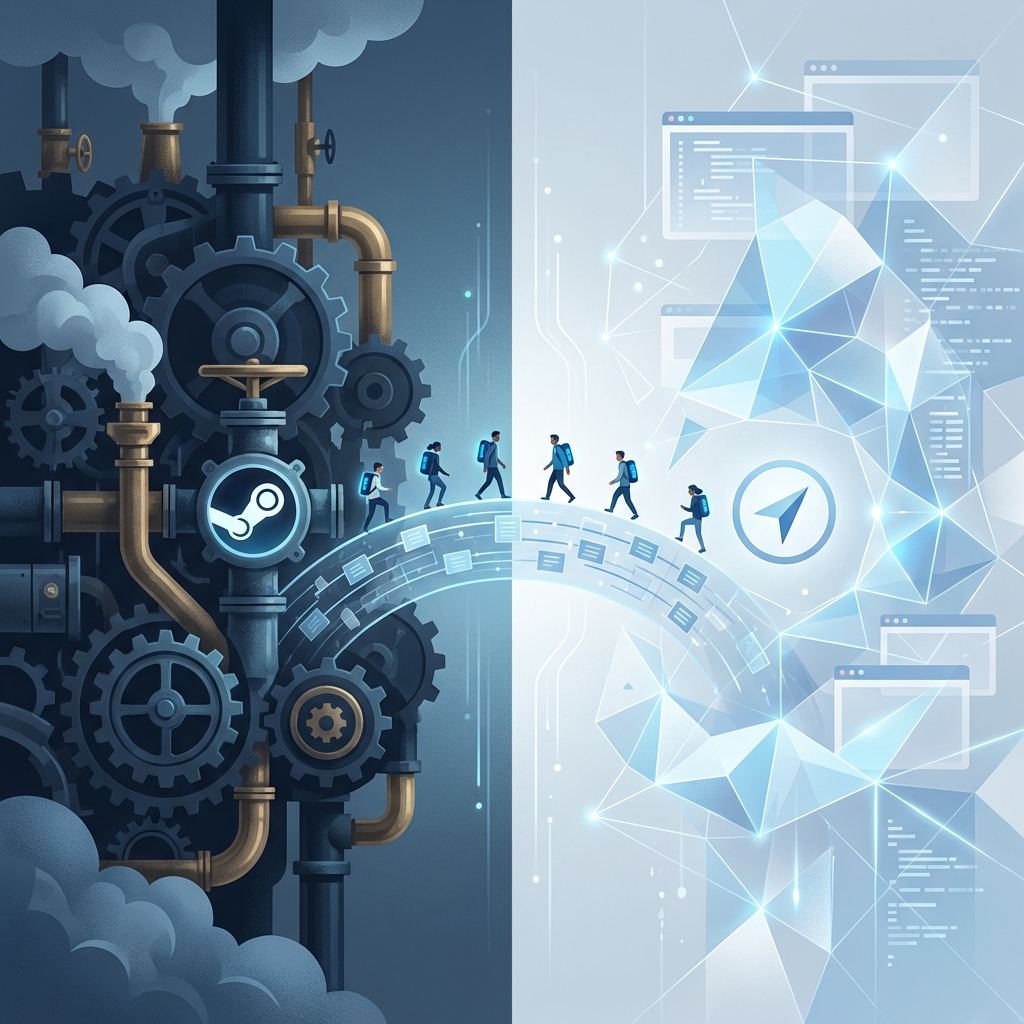
For the past 15 years, the indie game development roadmap has been a monolithic scripture, repeated at every GDC talk and in every Reddit thread: "Build a vertical slice, gather a community on Discord, farm wishlists, and launch on Steam."
In 2016, this was sound advice. In 2020, it was risky but viable. In 2026, for 95% of indie developers, this strategy is financial suicide.
This is not hyperbole; it is a conclusion drawn from cold, hard data. While the gaming press celebrates the outliers—the Balatros and Lethal Companys of the world—the silent majority of developers are drowning in an algorithmic ocean that has become mathematically hostile to small teams.
This comprehensive guide will dissect the current state of the Steam marketplace with brutal honesty, analyze the technological leap of WebGPU that has finally bridged the "fidelity gap," and present a financially viable alternative: The Premium Browser Game Ecosystem.
Part 1: The Mathematics of Failure on Steam
1.1 The Saturation Crisis by the Numbers
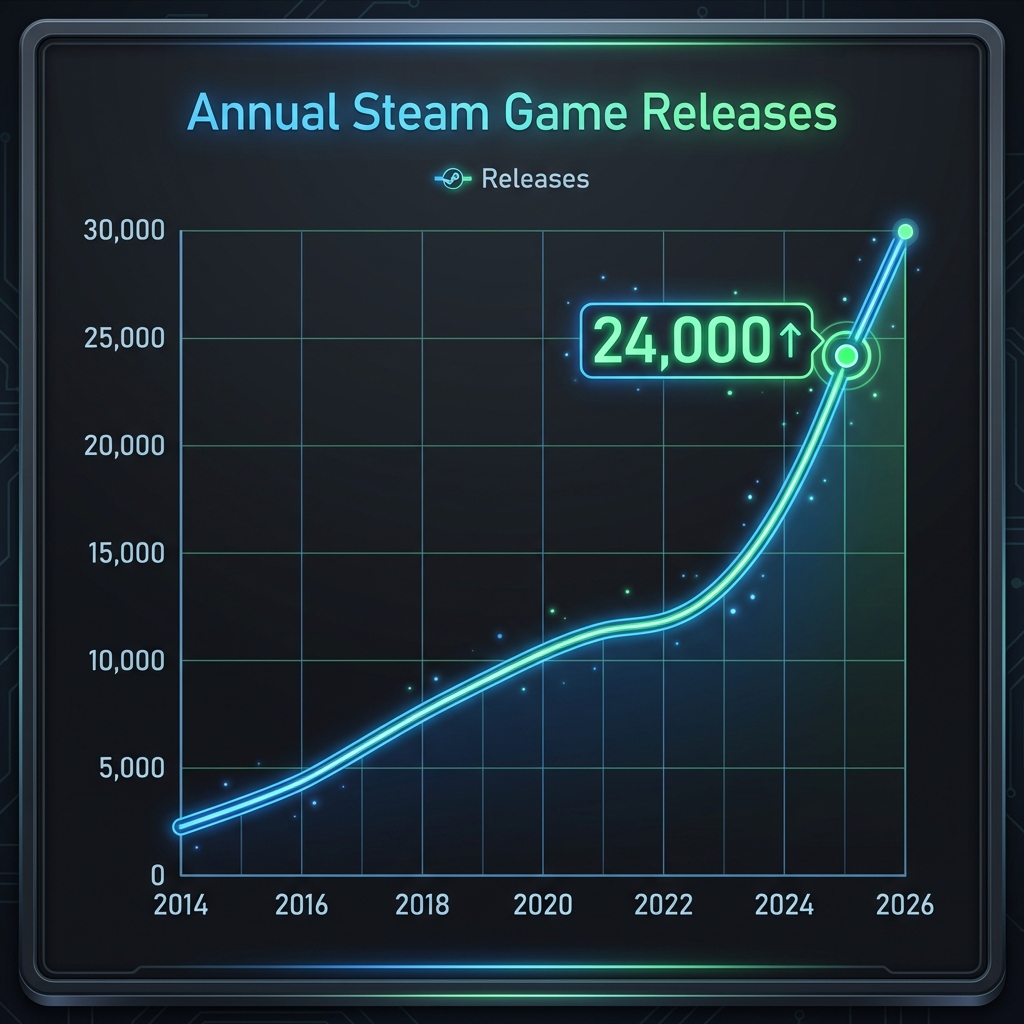
To understand why the "Steam-First" strategy is failing, we must look at the supply-side economics. According to data from VG Insights and Gamalytic, the volume of games released on Steam has not just grown; it has exploded.
- 2023: ~14,000 games released.
- 2024: ~18,500 games released.
- 2025: Over 24,000 games released.
As we settle into 2026, we are averaging nearly 70 new games every single day. This saturation has two devastating effects on the "Visibility Algorithm":
- The "New and Trending" Cliff: Previously, a new game could expect 24-48 hours of visibility in the "New releases" list. Today, that window has shrunk to minutes. Unless you bring your own massive traffic spike, you slide off the front page instantly.
- Wishlist Inflation: In 2020, 10,000 wishlists guaranteed a spot in "Popular Upcoming." Today, due to bot traffic and user fatigue, the threshold for organic visibility is closer to 50,000 wishlists.
1.2 The Median Revenue Trap
The most dangerous metric in game development is the "Average." The average indie game revenue is skewed heavily by mega-hits. The metric you need to look at is the Median.
"In 2025, the median revenue for an indie game on Steam was roughly $500. For games that took over a year to make, that is an hourly wage of pennies."
Think about that. $500 lifetime revenue. After Steam takes its 30% cut, and the IRS takes taxes, you are left with enough to buy a used office chair. This is the reality for the bottom 50% of games on the platform. The "Middle Class" of indie developers—those making $50k-$100k per game—is effectively disappearing, hollowed out by the polarized market.
Part 2: The "Zero-Friction" Revolution of the Open Web
While Steam has become a walled garden of high friction, the open web has evolved into a highway of instant gratification. The core advantage of browser games in 2026 is summarized in one concept: Time-to-Fun (TTF).
2.1 The Friction Funnel Analysis
Let's compare the user acquisition funnel for a Steam game versus a Browser game. In marketing, every additional click or second of waiting reduces your conversion rate by 20-50%.
The Steam Funnel (High Friction)
- 1. User sees TikTok/Tweet (-0%)
- 2. Click link to Steam (-30% drop-off)
- 3. Login / Age Gate (-20% drop-off)
- 4. Click "Download" (5GB+) (-40% drop-off)
- 5. Wait for Install (-10% drop-off)
- 6. User Plays
Total Conversion: < 5%
The Browser Funnel (Zero Friction)
- 1. User sees TikTok/Tweet (-0%)
- 2. Click link (-10% drop-off)
- 3. User Plays (Load time < 3s)
Total Conversion: > 60%
In an era where TikTok has reduced the human attention span to roughly 8 seconds, asking a user to wait 20 minutes to download a 2GB demo is asking too much. Browser games capitalize on impulse.
2.2 The "Chromebook Economy"
There is a massive, underserved demographic that Steam ignores entirely: The Restricted Device User.
- Students: Millions of students use school-issued Chromebooks where installing `.exe` files is blocked.
- Office Workers: Employees on corporate laptops cannot install Steam, but they have access to a browser.
- Shared Devices: Library computers or family tablets.
This "Invisible Market" is hungry for content. When you release on the web, you gain instant access to these millions of users who literally cannot play your game on Steam.
Part 3: The Tech Stack - Why 2026 is Different
Critics often argue: "But browser games look like garbage." In 2020, they were right. In 2026, they are wrong.
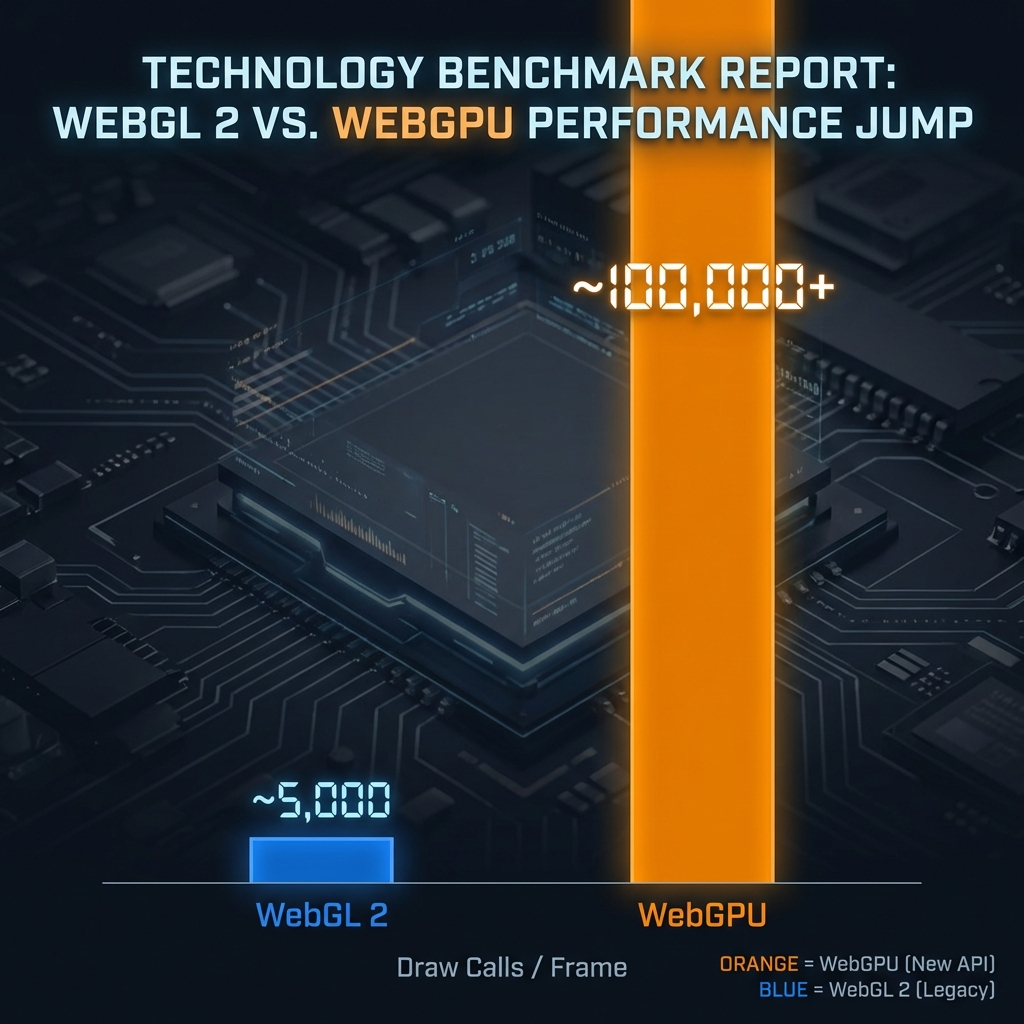
The widespread adoption of WebGPU has fundamentally changed the rendering pipeline of the browser. Unlike the older WebGL 2.0 (based on OpenGL ES 3.0), WebGPU gives developers low-level access to the GPU, similar to DirectX 12 or Vulkan.
3.1 Compute Shaders in the Browser
The game changer is Compute Shaders. This allows the GPU to handle tasks other than just drawing triangles—like physics calculations, crowd simulation, and procedural generation—offloading the CPU (which is notoriously slow in JavaScript).
Major engines have pivoted hard to support this:
- Godot 4.x: Offers a "Web" export preset that is increasingly robust, with multi-threading support improving rapidly.
- Unity 6: The new Web runtime is lighter and faster, specifically targeting mobile browsers with optimized WASM (WebAssembly) builds.
- PlayCanvas & Babylon.js: Native web engines that now support clustered lighting and volumetric effects previously reserved for consoles.
You can now build a game with PBR materials, dynamic lighting, and complex physics that runs at 60 FPS in a Chrome tab.
Part 4: The Economics of Browser Games
How do you actually make money? The "Premium" model ($9.99 upfront) rarely works on the web. Instead, the web ecosystem offers a diversified portfolio of income sources.
4.1 Licensing Deals (The "Golden Handshake")
This is the secret weapon of web game developers. Unlike Steam, where you publish once, the web has hundreds of portals (CrazyGames, Poki, Armorgames, GameDistribution, CoolMathGames).
These portals pay for content. There are two main types of licenses:
- Non-Exclusive License: You allow a portal to host your game. You keep the IP. They pay you a flat fee (e.g., $500 - $2,000). You can sell this license to 10 different portals.
Math: 10 portals x $500 = $5,000 guaranteed revenue. - Exclusive License: A portal pays a premium (e.g., $5,000 - $20,000) to be the only place your game exists for a set period (e.g., 6 months).
For a small indie game that might only make $500 on Steam, a licensing tour can generate $5,000 to $10,000 in its first month with zero marketing spend from the developer.
4.2 Ad Revenue Share (The "Long Tail")
Most portals operate on a 50/50 or 60/40 revenue share model for ads. Video ads (pre-roll and mid-roll) have high CPMs (Cost Per Mille). If your game has high retention (e.g., an idle game or an addictive roguelike), users might watch 5-10 ads per session.
"A hit web game can generate $1,000+ per day in ad revenue purely from organic traffic provided by the portal's own user base."
Part 5: Case Study - The "Hybrid" Strategy
The smartest developers in 2026 aren't choosing "Steam OR Web." They are choosing "Web THEN Steam."
The Vampire Survivors Model
Vampire Survivors started as a free browser game on itch.io. It cost nothing to play. This allowed the developer, Poncle, to:
- Test mechanics rapidly with zero barrier to entry.
- Build a massive, addicted player base.
- Generate word-of-mouth hype because the link was easy to share.
When the game finally launched on Steam, thousands of players bought it immediately to support the developer and get the "Premium" features (achievements, cloud saves). The web version was the marketing funnel for the Steam version.
Strategic Roadmap for 2026
If you are starting a project today, here is your battle plan:
- Prototype on Web: Build your vertical slice targeting WebGL/WebGPU constraints from Day 1.
- Soft Launch on Itch.io/Newgrounds: Gather feedback. Iterate fast. Fix bugs.
- The Portal Tour: Once polished, sell non-exclusive licenses to smaller portals to fund your development. Keep the IP.
- Build the "Steam Wishlist" Funnel: In your web version, add a prominent "Wishlist on Steam" button. Offer an exclusive skin or character in the Steam version.
- The Premium Launch: When you hit 10,000 wishlists (driven by your web players), launch on Steam.
Conclusion: Survival of the Smartest
The "Indiepocalypse" is only real if you insist on playing by the old rules. The Steam marketplace is crowded, yes. But the appetite for play has never been higher.
By shifting your focus to the browser, you trade "Prestige" for "Performance." You trade the ego boost of a Steam page for the bank account boost of licensing deals. You trade the frustration of zero visibility for the joy of seeing 100,000 people actually play your game.
In 2026, the browser isn't just a platform for prototypes. It is the frontier. It is the only place left where a solo developer can still launch a hit from their bedroom without a marketing budget. The gatekeepers are gone. The web is open.
Are you ready to hit publish?
References & Data Sources
- Steam Statistics: SteamDB Annual Release Charts - Verified growth trends.
- Market Analysis: VG Insights: State of Indie Games - Median revenue data.
- Technical: CanIUse.com: WebGPU Adoption Rates - Browser compatibility data.
- Godot Web Export: Godot Engine Official Blog - Web export improvements.
- Revenue Models: GameDeveloper.com - Analysis of HTML5 licensing market.

Leave a Comment
Share your thoughts with the community