Simulation · Editorial analysis
Subway Builder review: real cities, demanding decisions, and reasons to wait
BestGames Editorial · Checked 2026-10-02 · 8 min read
The attraction is rebuilding a city you recognize. The buying decision depends on something less romantic: whether you enjoy diagnosing a network, and how much uncertainty you can accept around its current version.
Game at a glance
- Game type
- Single-player transit planning and management
- Platforms
- Windows, macOS and Linux; no mobile or Chromebook support
- Steam release
- July 17, 2026
- Publisher on Steam
- Borough Studio
- Version examined through notes
- v1.7.2, released September 29, 2026
- Evidence checked
- October 2, 2026; no hands-on session
Facts from the official site, release notes and Steam store.
Our take
A compelling shortlist candidate for transit enthusiasts, with enough documented complexity to reward careful planning. For everyone else, our advice is to watch a current demonstration and verify the version and purchase option before paying. We cannot recommend its performance or polish without testing them.
Best suited to: Players who enjoy studying a map, comparing travel options and improving one system over time.
Keep in mind: Paid desktop download, with an internet connection required for map data. Official pages disagree on some prices and Mac requirements; check the current store and release notes.
What stands out
- A recognizable city gives each proposed connection a concrete purpose.
- Journey and route views offer more to investigate than a decorative map.
- Documented mod support provides ways to extend a favorite city.
Reasons for caution
- Recent fixes make old impressions unreliable; current stability remains untested here.
- Store and website details need checking at purchase time.
- The appeal depends on enjoying analysis and revision, not simply building quickly.
The strongest hook is a city you already care about
If you have ever stared at a transit map and wondered why two neighborhoods are so awkward to connect, Subway Builder has an immediately understandable pitch. The game asks you to build and operate a network in a real place. The official city list currently advertises 54 cities across seven countries, including London, New York, Tokyo, Paris and Auckland. The list also shows the actual playable boundaries, which matters more than simply seeing your city’s name.
Our view is that familiarity changes the character of the puzzle. In an invented city, a new line can be an abstract optimization. In a place you recognize, you bring a hypothesis: this district needs a connection, this transfer seems wasteful, this corridor might work. That is a strong reason to investigate the game, but it is also a reason to check the map boundary before buying. A recognizable city center is less useful to you if the neighborhood you wanted to explore lies outside the playable area.
The sensible expectation is a game about transit decisions. It should not be treated as proof that your proposed real-world railway would work. A simulated result depends on the model, its input data and the things it leaves out.
Evidence: Official playable city list
Why a shorter line is not automatically a better journey
The developer’s simulation explanation describes passengers choosing journeys from the actual timetable. Walking, waiting and transfers affect the choice; transit then competes with driving and walking. Income influences the value assigned to time. These are documented design features, rather than results of our own testing.
Consider a hypothetical choice between a direct but infrequent train and a faster connection that requires a transfer. On a map, the second route might look superior. For a passenger, reaching the first station, waiting twice and walking between platforms can erase the advantage. This example is our reasoning about the design, not a recorded session. It explains why frequency and interchange placement deserve as much attention as the line itself.
That gives Subway Builder an appealing question to ask repeatedly: what makes this service useful to the person taking it? The answer may be a small operational change rather than another long extension. Players who enjoy that distinction are more likely to appreciate the concept. Players who mainly want the satisfaction of rapidly filling an empty map should look closely at a demonstration before assuming this is their kind of builder.
The screenshots reveal a game about reading evidence
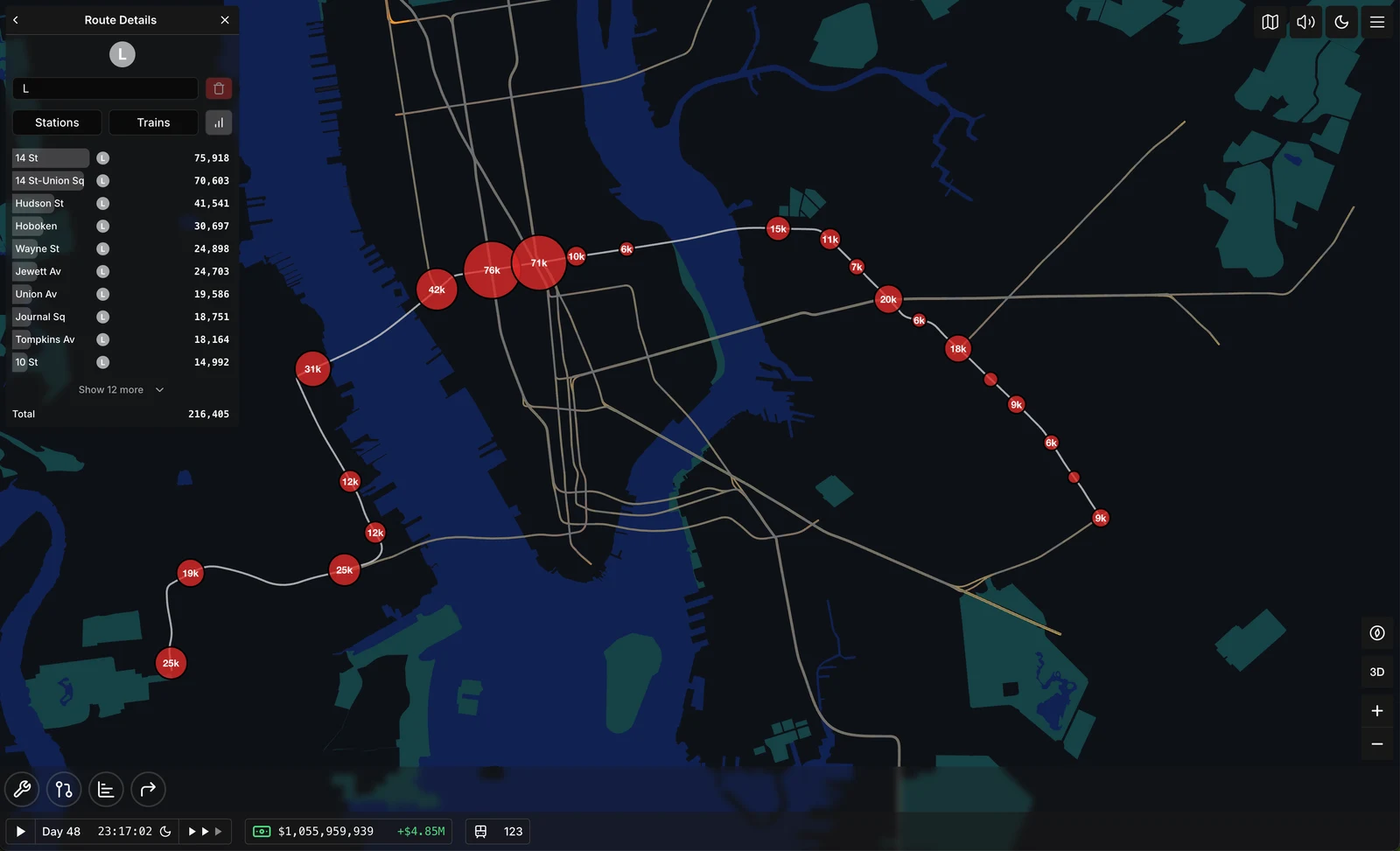
The official route screenshot below shows a list of stations alongside circles of different sizes on the map. It gives you two ways to inspect the same line: a geographic overview and a numerical station list. We can observe that presentation directly. We cannot tell from a still image how quickly the panel opens, whether the numbers are easy to interpret during play or how well the view behaves in a much larger save.
This is where the game’s appeal becomes clearer than a feature list. A planning game needs to show where a problem lives. When information is attached to a station rather than hidden in an overall total, it offers a place to begin asking questions. Is an interchange carrying more work than expected? Is the useful part of a route concentrated in a few stops? Those are possible lines of investigation, not findings about this pictured network.
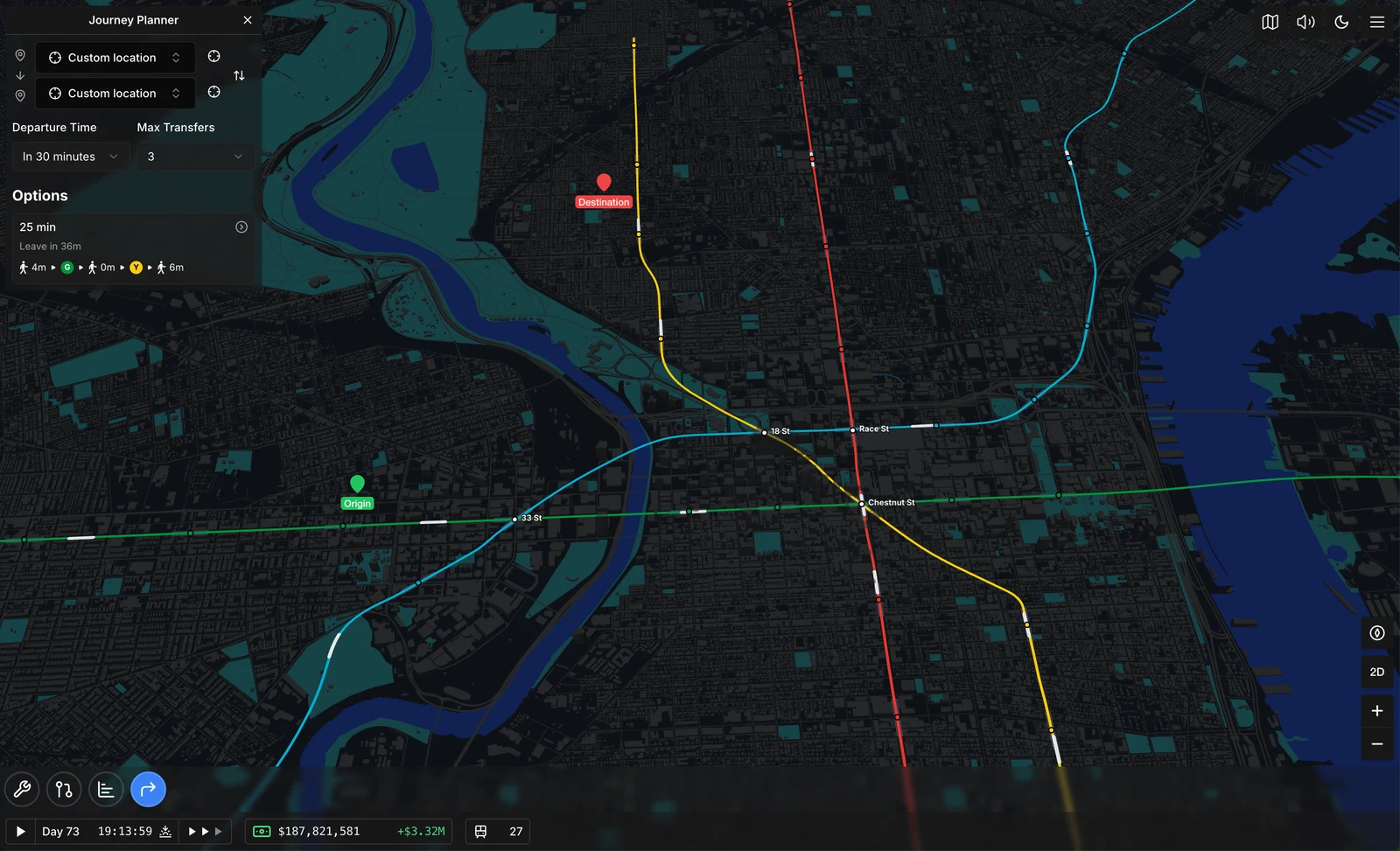
The cover image offers a different view: an origin, a destination and a journey option broken into stages. Together, the two screenshots suggest that the reward is understanding the network you have built. If studying a panel feels like interruption rather than part of the game, take that preference seriously.
Evidence: Official press kit and screenshot license
Construction matters when an elegant route becomes expensive
The official overview describes different construction methods and constraints involving geography, roads and building foundations. It also warns that crowded stations and too many trains can create delays. The design therefore puts two different problems beside one another: building a connection and operating it effectively.
Our interpretation is that this makes restraint potentially more interesting than expansion. A line that looks neat can be a poor use of money if it is difficult to build or adds little useful access. Equally, increasing service is not automatically the right response to every queue. A useful simulation should make those trade-offs legible enough that a failed decision teaches you something.
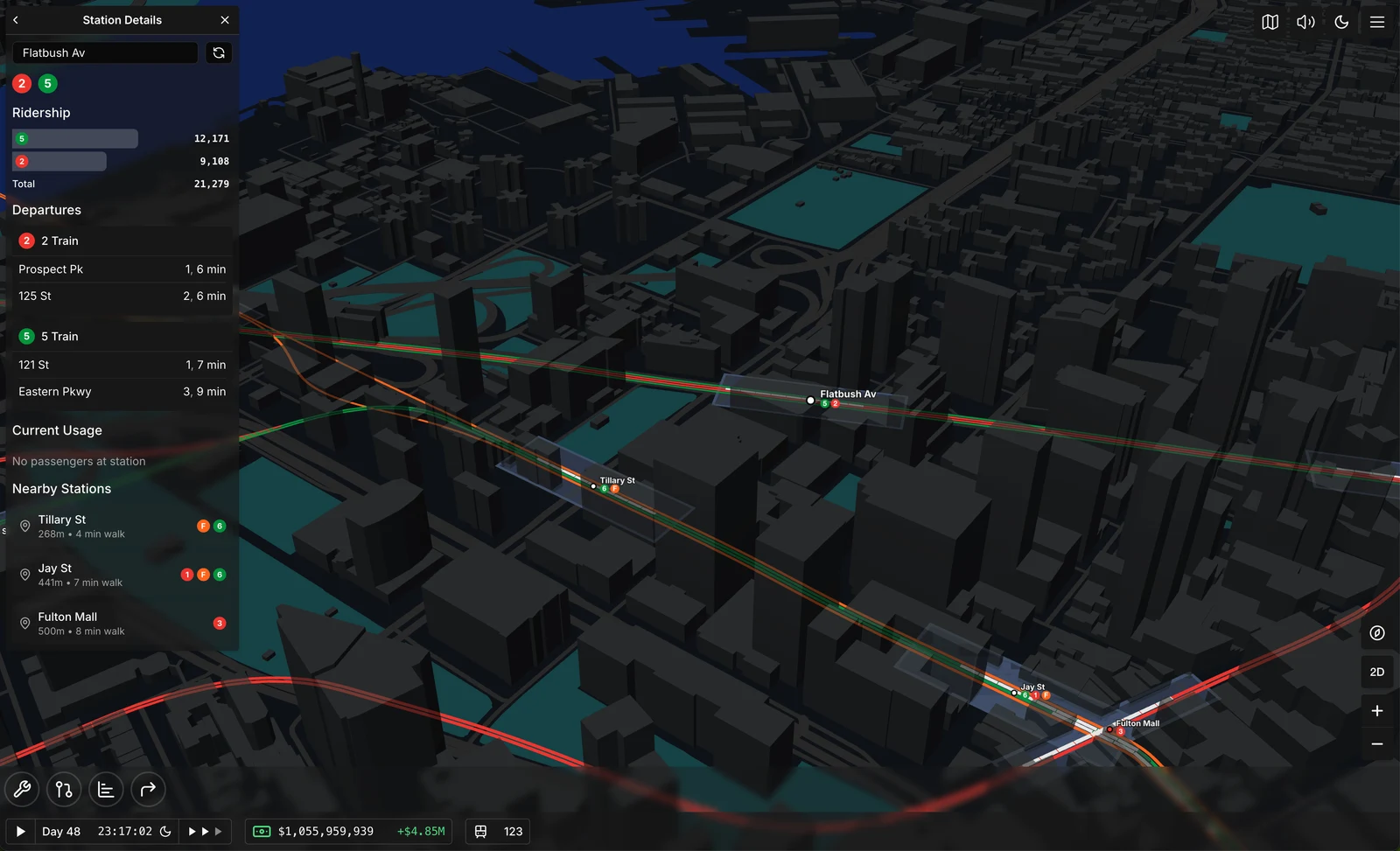
The station screenshot below shows nearby stops, departures and ridership information over a tilted view of buildings and tracks. It supports a narrower observation: the presentation can move between a city-scale plan and the immediate surroundings of a station. It does not prove that construction tools are comfortable to use. The distinction matters because attractive results and an enjoyable editing process are separate qualities.
Evidence: Official overview and FAQ · Official press kit and screenshot license
v1.7.2 changes the questions an older review can answer
The September 29 release adds Auckland, Wellington, Zurich and Geneva, along with a route-reliability tab and clearer capacity warnings. Its notes also describe spreading commuter calculations out to address periodic lag spikes, improving route pathfinding and fixing reliability statistics that did not save. The preceding v1.7.1 notes report a fix for a startup black-screen issue affecting some users.
These details support two conclusions. First, the project is being maintained, and several changes address the information needed to manage a network. Second, stability and performance have been active areas of repair. Neither conclusion tells us whether the latest version now runs well on your machine. A listed fix is evidence of a developer action, not a substitute for repeating the test.
For a buying decision, check which version a video or review covers. An older complaint may have been addressed; an old recommendation may miss a later problem. Our position is to reserve judgment on large-save performance, save recovery and first-session usability until they have been tested. This is also why the article has no numerical score: a confident-looking number would hide the biggest gaps in the evidence.
Mods add possibilities, not a promise of unlimited content
The official modding documentation supports custom cities, interface components, map styles and changes to trains, stations and rules. That gives a transit enthusiast several possible reasons to stay with one place rather than continually starting another map.
The value depends on what you want to change. Someone interested in a missing city may care about map and demand data; someone interested in operating a network may care about a clearer panel. Those needs should guide the search for a mod. The existence of an extension system alone does not tell us whether a particular download is accurate, maintained or compatible with the current release.
Before depending on a mod, read its installation instructions and version requirements. Keep a separate copy of a valued save and establish that the unmodified game works first. This is practical advice for reducing uncertainty, not a claim that we have tested community add-ons.
Evidence: Official modding guide
Before paying, resolve the store details rather than trusting a headline price
On October 2, the official purchase comparison showed $30 for a direct download and $39.99 for Steam. The Steam page showed a temporary $29.99 promotion ending October 8. However, the official homepage FAQ displayed a different sale and Steam list-price description. These figures describe the pages we checked, not a guaranteed offer in every region. Confirm the price and currency at checkout.
The purchase comparison says both versions receive the same game updates, while Steam includes achievements and cloud saves. The homepage FAQ says buying directly does not provide a Steam key. Decide whether the store features matter to you before choosing the lower displayed price. A discount is less useful if it buys a version that does not fit the way you manage your library.
Requirements also need care. Steam lists 4 GB RAM as a Windows minimum and 8 GB as recommended, with broadband required. Its Windows 7 entry sits beside a notice that the Steam client requires Windows 10 or later. The Mac minimum on Steam also differs from the homepage FAQ. We would not use the most permissive line as a compatibility guarantee: verify the current download or store requirements for your system.
This is not one of the free browser games on BestGames. You need a supported desktop computer and a paid download. If you arrived looking for a quick game on your phone, this is a useful point to stop rather than discover the mismatch after paying.
Evidence: Official overview and FAQ · Official purchase comparison · Steam store: release, requirements and player-review summary
Our buying advice: shortlist it for the problem-solving, wait on the polish
Steam’s page, checked on October 2, reported 60% positive across 413 reviews overall and 72% positive across 48 recent reviews. That snapshot suggests a divided response and a more favorable recent sample. It does not explain why each player voted, establish a trend by itself or certify that a specific issue is fixed. We have not audited individual player reports, so we are not turning the percentages into a list of proven faults.
Our editorial judgment is conditional. Put Subway Builder on your shortlist if the exciting part is discovering why a network underperforms, then revising it. Its documented tools and the official images make that interest a much better buying signal than the general label “city builder.” Watch a current session in a city you care about and look at the decisions between the attractive finished maps.
Wait for stronger current evidence if you need a firm promise of smooth performance, a gentle introduction or reliable long-term saves. Those qualities matter enough that we should test them before recommending them. The next meaningful step for this article is a recorded first session, a busy network on a specified computer, and a save reopened after an update. That would add experience; another page of feature descriptions would not.
Evidence: Steam store: release, requirements and player-review summary
How we prepared this article
BestGames Editorial checked the official game site, simulation explanation, city list, v1.7.2 release notes, modding documentation, press kit and Steam store on October 2, 2026. This article combines those facts with our own design analysis and observations of the supplied screenshots. We did not install or play the game, test frame rates, measure the learning curve or verify save reliability. The byline identifies the site’s editorial work, not an invented individual or specialist credential. No score is assigned. Store links below are direct source links.
Screenshot credits
Screenshot © Redistricter, LLC, 2026. All three images come from the official press kit, which releases its screenshots under CC BY 4.0. Images have been resized and compressed for this page; their content has not been altered. They are developer-supplied images and may depict an earlier version.
Sources
- Official overview and FAQ ↗
- Developer explanation of the commuter simulation ↗
- Official playable city list ↗
- Official changelog: v1.7.2 and earlier releases ↗
- Official modding guide ↗
- Official purchase comparison ↗
- Steam store: release, requirements and player-review summary ↗
- Official press kit and screenshot license ↗