Strategy · Editorial analysis
OpenFront review: try the free map war before buying on Steam
BestGames Editorial · Checked 2026-10-03 · 9 min read
OpenFront turns a world map into a contest over borders, resources and trust. Our research-led assessment asks who will enjoy that tension and what the Steam edition adds to a game you can already try free.
Game at a glance
- Core format
- Real-time territorial strategy with multiplayer and single-player options
- Free entry
- Browser game at openfront.io
- Steam release
- September 17, 2026; Early Access
- Developer / publisher
- OpenFront Inc; Evan Pellegrini is also listed as developer
- Update relevant to this article
- Steam 0.2.0 announcement, September 23: 29 achievements
- Assessment scope
- Official sources and supplied screenshots checked October 3, 2026; no completed match
Facts from: Official Steam store: features, purchase information and Early Access statement · Official developer announcements: launch, Steam 0.2.0 and patch notes · Official OpenFrontIO public project repository.
Our take
Start with the free browser version. The documented design is an attractive fit for players who enjoy positional decisions and unpredictable neighbors. Buy the Steam edition if you already like the game and value its client features or want to support development; do not expect a separate, richer combat game.
Best suited to: Players who like map control, carefully timed expansion and the uncertainty of negotiating with other players.
Keep in mind: Steam remains in Early Access. Browser play is free, while the paid client shares the multiplayer pool. We could not complete a playtest because the browser entry was held at a security-verification page.
What stands out
- A territorial map makes the objective easy to recognize without a long fictional setup.
- The browser version lets you investigate the core appeal before paying.
- A shared multiplayer pool keeps the Steam purchase from becoming a separate community.
Reasons for caution
- Readable borders do not mean easy strategic decisions or a forgiving first match.
- Diplomacy and match quality depend on other people; they cannot be guaranteed by the feature list.
- Launch-era feature complaints need checking against later patches, while announced plans still need confirmation.
OpenFront’s appeal starts with a border, not a build order
OpenFront is easiest to understand as a contest over a map rather than a parade of individually commanded soldiers. Its official description centers on expansion, an economy, neighboring powers and escalation. That immediately makes a useful distinction for a prospective player: the important question is where and when to commit, not how elegantly you can shepherd a squad around an obstacle.
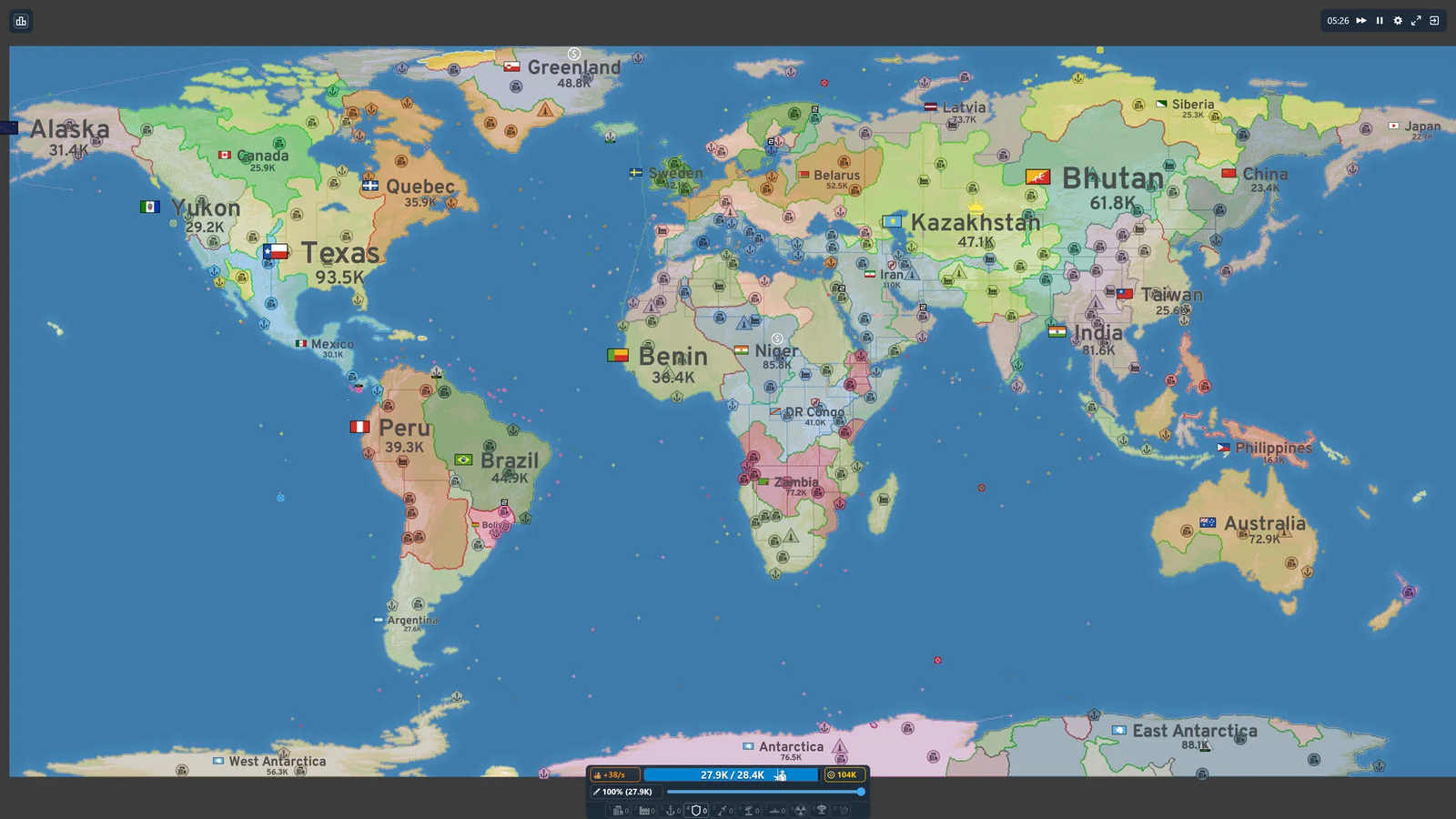
The world-map screenshot gives this proposition a recognizable shape. Colored regions, player labels and water separate the field into positions that matter to one another. You can see the kind of information the game wants you to notice before learning its exact rules. That is a strength of the presentation, although a screenshot cannot establish how comfortably a beginner interprets every icon.
Our central judgment is that OpenFront should appeal to people who like decisions with consequences beyond the immediate fight. Expanding into a gap might bring useful space, but it also changes who can reach you. Winning a border can expose another border. A temporary agreement might buy breathing room without making the other player permanently safe. Those are design implications, not events from a match we played.
The free browser entry makes that judgment inexpensive to investigate. You do not need to begin by deciding whether a promotional screenshot is worth a purchase. You can begin by checking whether the underlying kind of decision interests you. For BestGames readers accustomed to opening a browser game, that is a much more useful starting point than the size of its advertised audience.
Evidence: Official Steam store: features, purchase information and Early Access statement · Official free browser entry
Why taking more land can make your position worse
The community wiki describes a normal domination target of 80 percent of the map’s land and explains that mountain terrain costs more to capture than grassland. This is a community-maintained explanation, linked from the developer’s announcements; modes and balancing changes can alter the details. Treat it as orientation rather than a permanent formula for winning.
The broader point survives a change in the numbers: space is useful only when you can hold it. Imagine two possible advances. One captures a compact neighboring area and leaves a short boundary. The other reaches far into a gap but touches several new opponents. The second move might color more of the map while making the position harder to defend. This hypothetical example explains our interest in the design; it is not a recommended opening we tested.
A troop-commitment decision adds another layer. An attack is also a decision about what you retain. If you spend as though every visible opportunity must be taken immediately, you can leave the next opponent a much easier problem. That creates room for patience to matter, which is promising for players who prefer positioning over constant clicking.
It also describes the likely mismatch for some readers. A player wanting a steady sequence of guaranteed upgrades may find a contested map less reassuring. Another player can interrupt the plan. A sensible local choice can become uncomfortable when the neighborhood changes. OpenFront’s attraction depends on accepting that uncertainty as part of the game, rather than expecting every loss to follow a neat single-player lesson.
Evidence: Community wiki: OpenFront rules and terrain overview
The map is part of the rules, not just the background
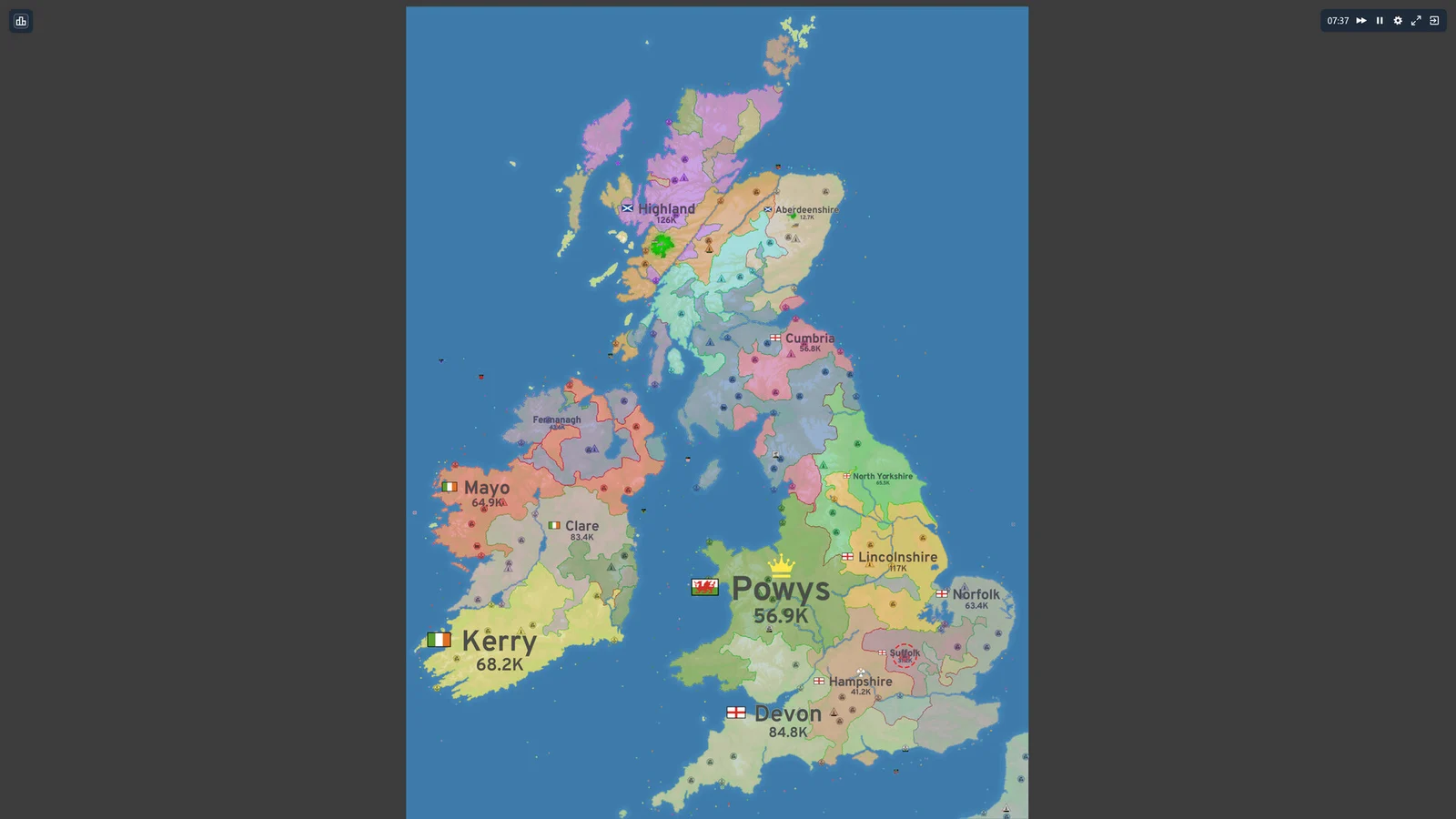
The official Britain-and-Ireland image below is markedly different from the global view at the top. It concentrates attention on a narrower, recognizable region with islands, long coastlines and nearby territories. This is an observation of the supplied image. We cannot infer that one spawn is stronger than another, or that a shown territory is controlled by a human rather than a bot, from the picture alone.
What we can reasonably analyze is the difference in questions such geography invites. On a broad landmass, neighboring borders dominate your attention. On separated islands, the ability to reach another shore becomes more significant. A route around a front may matter as much as pressure through it. Geography gives a positional game variation without requiring every map to introduce a completely different control scheme.
This is why we would choose a recognizable map for a first trial. Recognition reduces the work of understanding where water and land connect. It does not remove the need to learn the economy or combat, but it lets you spend less attention decoding the layout. Then a later map can test whether you understood the decisions or merely memorized a comfortable place.
The screenshots also show substantial variation in how much information can occupy a single view. At a wide zoom, labels, borders and icons compete. Being able to identify the overall situation is different from being able to act precisely on a small target. A desktop view is worth trying before making assumptions about how pleasant this will be on a phone.
Evidence: Official Steam store: features, purchase information and Early Access statement
The interesting uncertainty is what the other player will do
The developer describes ally requests and shared multiplayer matches. That brings a kind of uncertainty that a numerical army comparison cannot resolve. Another participant has an intention, can change that intention and may be responding to pressures you do not see.
Our view is that this is the strongest reason to investigate OpenFront if the map alone looks plain. A border can be quiet because a neighbor is weak, busy, cautious or temporarily cooperative. Those possibilities produce the same empty space on screen while implying very different decisions. Judging the situation is more interesting than simply finding the next region with a smaller number.
It also sets the standard for a proper future playtest. We would need several public matches, not just one fortunate round, to judge whether cooperation is understandable, whether a reversal feels earned and whether the interface makes another player’s actions clear enough to react. A still image cannot settle any of those questions.
If you dislike depending on strangers, begin with the single-player option advertised on the store and check whether you enjoy the basic territorial loop. Then treat public play as a separate experiment. Enjoying map expansion against computer opponents does not automatically mean you will enjoy negotiation, coordination or opportunistic attacks against people.
Evidence: Official Steam store: features, purchase information and Early Access statement
A customizable map still needs to stay readable
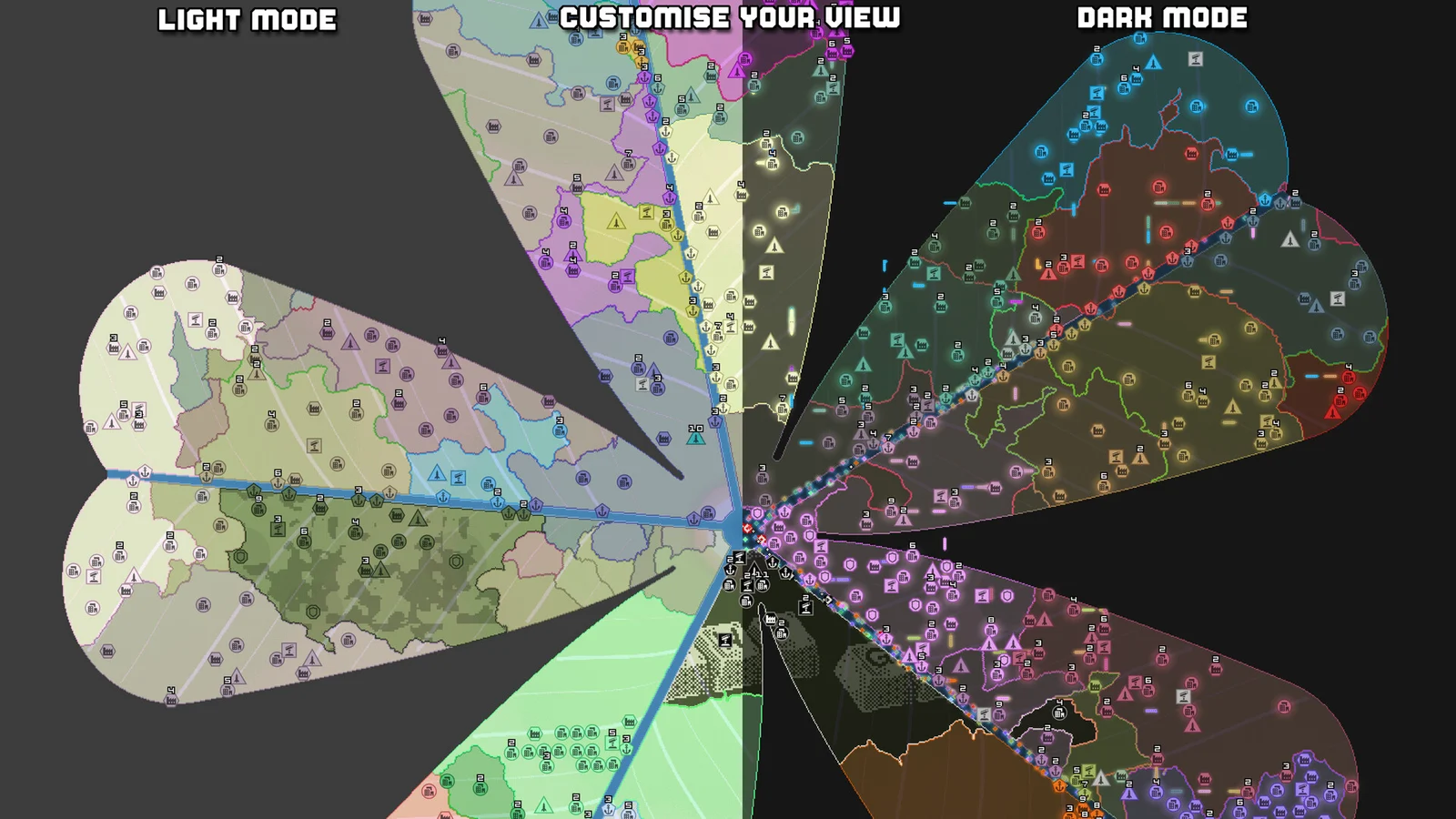
The third official image is a promotional montage showing light mode, dark mode and several map appearances. It should not be mistaken for one unusual-shaped playable map. That distinction is useful because the image is explaining presentation choices, not demonstrating a completed battle.
Changing the appearance of your territory is an appropriate place for personalization in a game where territory is your visible presence. But a strategy interface has another job: helping you read threats. Strong patterns, bright borders and numerous symbols can be attractive while also competing for attention. The best visual choice for you may be the one that makes your own decisions easier, rather than the one that looks busiest in a gallery.
The store describes cosmetics as visual rather than gameplay advantages. We report that as the developer’s stated model, not as the result of an audit of every item or a balance test. For a reader deciding whether to spend, the practical distinction is still clear: choose appearance because you like it or want to support the project, without expecting it to fix an uncomfortable strategic situation.
Before paying for extras, try the basic map presentation through a full match. Check whether you can quickly distinguish your own boundaries, structures and approaching threats. The screenshots show enough to make that a sensible test; they do not let us certify accessibility, color recognition or touch accuracy.
Evidence: Official Steam store: features, purchase information and Early Access statement
OpenFront on Steam: pay for a client you value, not another game
OpenFront entered Steam Early Access on September 17, 2026. The developer says browser and Steam players share the same multiplayer pool, and the launch announcement says the browser version remains free. That keeps the first purchase question unusually simple: do you like the core game enough to want a paid way of accessing and supporting it?
The Steam store displayed a US price of $6.99 when checked on October 3. Earlier developer announcements and fan pages contain different launch prices, so do not use an old figure as a current offer. Regional prices, taxes and promotions can differ; use the store shown to your account before deciding.
The most important feature correction concerns achievements. A highly visible September 17 negative review complained about their absence at launch. The September 23 Steam 0.2.0 announcement subsequently said 29 achievements had been added, with most tracking in public matches. It would be misleading to reproduce the launch complaint as though nothing had changed.
The announcement is evidence of a shipped update, but we have not installed the Steam client and tested an unlock. Likewise, the store mentions offline play and performance benefits; we have not measured either. If one of those features is the reason you want to pay, look for current confirmation of that specific use rather than assuming every future plan is already complete.
Our recommendation is to buy only after the free version has answered the larger question. The Steam edition can make sense for someone who likes a library-based client, achievements, its included extras or funding development. It makes less sense as a speculative purchase intended to turn a game you do not enjoy into a materially different one.
Evidence: Official Steam store: features, purchase information and Early Access statement · Official developer announcements: launch, Steam 0.2.0 and patch notes · Steam player-review sample, including a September 17 purchase comparison
Early Access makes version dates part of the buying decision
The official patch history includes fixes for a Steam-overlay black window on Linux, screenshot capture and an advertisement appearing during older replay viewing. These are specific repaired behaviors, not proof that the entire client is now free of problems. A review written around launch can therefore be useful historical evidence while no longer describing the same feature state.
Multiplayer trust is another ongoing concern. The developer’s anti-cheat blog describes trusted lobbies, analysis of suspicious inputs, public account information and reporting. It also acknowledges that these measures do not end cheating. That acknowledgment is more useful than a promise of perfect fairness, but it does not tell us how consistently real matches are moderated.
For a competitive player, this matters as much as the rules. A territorial game depends on believing that opponents are operating within an understandable framework. If an outcome could reflect coordination outside the intended mode or automation, frustration can displace the appeal of reading the map. We have not observed those problems ourselves; they are reasons to examine the developer’s approach and current player reports.
The public repository gives readers a place to follow development, but a visible project is not a guarantee that a specific request will be completed on time. Judge the game you can access and the features already announced as shipped. Roadmap intentions may explain the direction of travel; they should not carry the whole value of your purchase.
Evidence: Official developer announcements: launch, Steam 0.2.0 and patch notes · Official OpenFrontIO public project repository
Our verdict: the free trial is the clearest recommendation
OpenFront has a coherent proposition: a recognizable map, competing claims on space and decisions whose effects extend to your neighbors. For someone interested in geography, timing and social uncertainty, the documented design deserves a trial. For someone seeking a quiet builder or a predictable progression ladder, its contested positions may be a poor match.
The useful way to test that fit is sequential. First see whether the territorial loop holds your attention. Then try a public match and see whether the presence of other people improves it. Finally, decide whether Steam’s client and extras are worth a purchase. These are three different judgments, and the free browser entry lets you make the largest one before paying.
We reserve a score because we did not reach a match. Our attempted browser visit on October 3 stopped at a security-verification screen, so we cannot claim an easy onboarding session, smooth performance or a dramatic alliance betrayal. The next update to this same article should add recorded matches, the device and browser used, and specific observations of the controls and outcomes.
Until then, the recommendation is concrete but limited: try OpenFront free if its kind of decision appeals to you; buy Steam when you can name the benefit you want. The existence of a paid client is not a reason to skip the free entry, and the free entry is not a reason to dismiss the value of supporting a game you already enjoy.
Evidence: Official Steam store: features, purchase information and Early Access statement · Official free browser entry
How we prepared this article
BestGames Editorial checked the official Steam store and developer announcements, the public project repository, the linked community wiki and a dated player-review sample on October 3, 2026. We also inspected all three official images reproduced here. We attempted to enter openfront.io using Chrome on macOS, but received a security-verification screen and did not reach a lobby or a match. There is no tested playtime, victory record, performance benchmark or Steam-client session behind this article. The argument is our analysis of the published design and visible images. No numerical score is assigned. We have not verified the developer’s audience totals independently, and we do not use them as evidence of a good match. Source and store links are direct links.
Screenshot credits
Game imagery © OpenFront Inc and its contributors. Source: OpenFront’s official Steam store gallery. These three publisher-supplied promotional images are reproduced to illustrate this assessment. They have been resized and compressed, with their content unchanged. They are not captures from a BestGames match; the third image is an official comparison montage rather than one continuous gameplay view.
Sources
- Official Steam store: features, purchase information and Early Access statement ↗
- Official developer announcements: launch, Steam 0.2.0 and patch notes ↗
- Official OpenFrontIO public project repository ↗
- Community wiki: OpenFront rules and terrain overview ↗
- Steam player-review sample, including a September 17 purchase comparison ↗
- Official free browser entry ↗