There's a reason tile match games have become a global obsession. Whether you're killing five minutes in a waiting room or unwinding after a long workday, there's something deeply satisfying about spotting matching tiles, tapping them in sequence, and watching them vanish from the board. It's the gaming equivalent of popping bubble wrap—simple, addictive, and oddly therapeutic.
But if you've been playing tile match games casually and want to actually get good—clear boards faster, beat tougher levels, and understand what makes these puzzles tick—this guide is for you. We'll break down the mechanics, share battle-tested strategies, and explain why your brain loves this stuff so much.

What Is a Tile Match Game?
A tile match game is a puzzle where you clear a board by selecting groups of identical tiles. The concept traces back to the ancient Chinese game of Mahjong Solitaire, but the modern browser version adds fresh twists: a limited collection bar, layered 3D tile stacks, and a match-3 mechanic instead of the traditional pairs.
Here's the basic loop:
- Tap a tile to move it into your collection bar (usually holds 7 tiles).
- Collect three identical tiles and they vanish, freeing up space.
- Clear all tiles from the board to win.
- If the bar fills up without a match? Game over.
Sounds simple. It isn't. The challenge comes from tile stacking—many tiles are hidden beneath others, and you need to plan several moves ahead to avoid locking yourself out.
Key Difference from Classic Mahjong
Traditional Mahjong Solitaire matches pairs (2 tiles). Modern tile match games like Tile Match use a triple mechanic (3 tiles), adding an extra layer of strategy since you must manage partial matches in your collection bar.
How to Play Tile Match: Step-by-Step
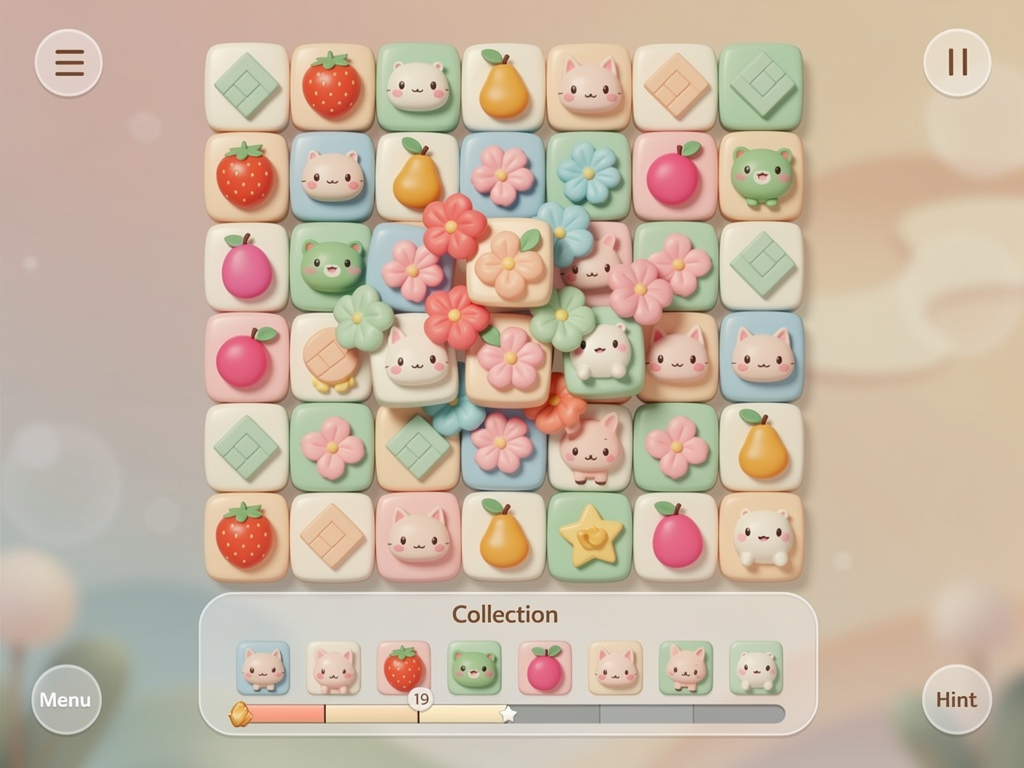
Controls
The controls couldn't be simpler:
- Desktop: Click on any exposed tile to select it.
- Mobile/Tablet: Tap on any exposed tile.
An "exposed" tile is one that isn't covered by another tile on top of it. You can only select tiles that are fully visible and accessible.
The Collection Bar
Think of the collection bar as your workbench. It holds up to 7 tiles at a time. When you place a third matching tile into the bar, all three disappear. The bar is your lifeline and your biggest constraint—if it fills to 7 without any triplet completing, you lose.
Winning a Level
Clear every tile from the board. That's it. Later levels add complications like more tile types, deeper stacks, and tricky arrangements designed to tempt you into bad moves.
Power-Ups
Available Power-Ups
| Power-Up | Effect | When to Use |
|---|---|---|
| 🔄 Undo | Returns the last tile to the board | When you realize a pick was a mistake |
| 🔀 Shuffle | Rearranges all remaining tiles on the board | When no useful moves are visible |
| 💡 Hint | Highlights a recommended set of matching tiles | When you're stuck and can't spot matches |
7 Strategies That Actually Work
Casual players tap randomly and hope for the best. Here's what experienced players do differently:
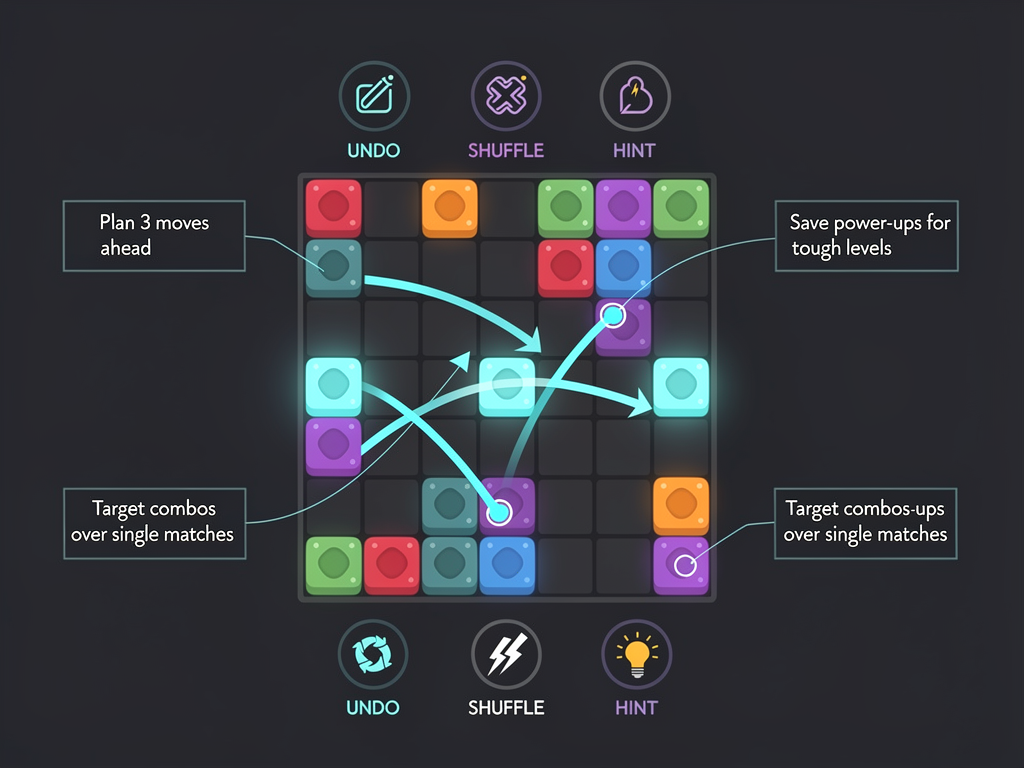
1. Scan Before You Tap
Before making any move, take 5 seconds to scan the entire board. Identify which tiles appear in groups of 3 that are all accessible. Starting with complete triplets keeps your bar clean.
2. Keep the Collection Bar Below 4
This is the golden rule. If your bar reaches 5+ tiles without a match forming, you're in danger. Every time you pick up a tile, ask: "Can I complete this triplet within the next 2 moves?" If not, pick something else.
3. Prioritize Deep Tiles
Tiles buried under multiple layers should be freed first. The top tiles will always be accessible later, but bottom tiles create bottlenecks. Think of it like archaeology—dig down, not across.
4. Match the Most Common Tile Type First
If you see 6 strawberry tiles and only 3 flower tiles, tackle the strawberries first. Having more of one type gives you more flexibility and reduces the chance of getting stuck.
5. Use the "Edge Sweep" Technique
Work from the edges of the pile inward. Edge tiles are less likely to be blocking other tiles beneath them. By clearing edges first, you expose more tiles in the center without creating dead-end situations.
6. Save Power-Ups for Emergencies
Don't waste your Undo or Shuffle on the first five moves. Save them for when your bar hits 5-6 tiles and you're one bad pick from losing. That Shuffle can turn an impossible board into a solvable one.
7. Look for "Chains"
A chain is when clearing one triplet exposes tiles that immediately form another triplet. Spotting chains lets you clear 6+ tiles in rapid succession, which is both efficient and extremely satisfying.
Common Mistake
Tapping tiles of the same type when you can only see 2 of them accessible. This fills your bar with incomplete matches. Always confirm you can access the third tile before committing.
Why Your Brain Loves Tile Match Games

It's not just entertainment. Research on puzzle games consistently shows cognitive benefits:
Pattern Recognition
Your brain is constantly scanning for matches among dozens of tile types. This exercises your visual cortex and improves your ability to spot patterns in everyday life—from reading data spreadsheets to noticing details in your environment.
Working Memory
You need to remember what's in your collection bar, what tiles are hidden beneath others, and what you'll need next. This engages working memory, which is critical for tasks like following conversations, remembering instructions, and problem-solving at work.
Strategic Planning
Every tile you select affects future options. Planning 3-4 moves ahead exercises executive function—the same mental skill you use for project management, budgeting, and decision-making.
Stress Reduction
The gentle, self-paced nature of tile match games creates a meditative state. Studies on casual gaming have found that short puzzle sessions (10-20 minutes) can reduce cortisol levels and improve mood. The beautiful tile designs and calming backgrounds amplify this effect.
Flow State
Tile match games hit the sweet spot between "too easy" and "too hard." This creates what psychologist Mihaly Csikszentmihalyi calls "flow"—a state of complete absorption where time seems to disappear. Flow is associated with happiness, creativity, and peak performance.
Tile Match vs. Other Puzzle Games
How does Tile Match stack up against other popular browser puzzle games?
Advanced Tips for Higher Levels
Once you've mastered the basics, these advanced techniques will help you tackle the really hard stages:
The "Two-Deep" Rule
Before selecting any tile, check what's directly beneath it. If removing the top tile exposes a tile you need for a different match, that's a bonus. If it exposes something useless and blocks future access, skip it.
Color Grouping
Mentally group tiles by color or theme. Instead of scanning the whole board, train your eyes to focus on one tile type at a time. This reduces visual noise and helps you spot triplets faster.
The "Emergency Exit" Strategy
Always keep one easy triplet in reserve—three accessible tiles of the same type that you deliberately don't collect yet. If your bar gets dangerously full, you can grab them to free up 3 slots instantly.
Counting Tiles
In harder levels, count how many of each tile type exist. If there are exactly 3 (one triplet), they're priority targets. If there are 6 or 9, you have more flexibility and can use them strategically to manage your bar.
FAQ: Tile Match Questions Answered
Q: Is Tile Match free to play?
A: Yes! You can play Tile Match for free directly in your browser at best-games.io. No download, no installation, no account required. Just click and play.
Q: Can I play tile match games on my phone?
A: Absolutely. The browser version works perfectly on mobile devices—both iOS and Android. The touch controls are intuitive: just tap the tiles you want to select.
Q: What's the best strategy for beginners?
A: Focus on keeping your collection bar as empty as possible. Only pick up a tile if you're confident you can complete the triplet within 1-2 moves. And always scan for buried tiles that need to be freed early.
Q: How many levels does Tile Match have?
A: Tile Match features over 1,000 levels with gradually increasing difficulty. New levels introduce more tile types, deeper stacks, and more complex arrangements.
Q: Are tile match games good for your brain?
A: Yes. Puzzle games like Tile Match exercise pattern recognition, working memory, and strategic planning. Research shows regular puzzle play can help maintain cognitive sharpness and reduce stress.
Q: What's the difference between tile match and Mahjong?
A: Traditional Mahjong Solitaire matches pairs (2 identical tiles). Tile match games use a triple mechanic (3 identical tiles) and add a collection bar constraint, making the strategy more complex.
Q: I keep running out of space in the collection bar. Any tips?
A: The #1 rule is: never pick up a tile unless you can see at least 2 more of the same type accessible on the board. If you can only see 1 or 0 others, leave that tile alone and look for a better move.
Ready to Play?
Tile Match is one of those games that's easy to learn but genuinely rewarding to master. Whether you're after a quick mental break or want to challenge yourself with the harder stages, it delivers.
The best part? It runs right in your browser. No downloads. No sign-ups. No ads interrupting your flow. Just you, the tiles, and that satisfying pop when a triplet clears.
Start Playing Tile Match Now
Put your puzzle skills to the test. Can you clear the board?
PLAY TILE MATCH FREE



Leave a Comment
Share your thoughts with the community