Steam Summer Sale 2026 starts today, June 25, and runs through July 9. This is the point in the PC gaming calendar where a lot of players stop choosing and start collecting. The store gets loud. The wishlist lights up. A game you ignored for six months suddenly looks like a responsible purchase because it has a big green discount tag.
I do not think the smart move is to buy more. The smart move is to buy with less confusion. A sale should help you make a decision you were already close to making. If it turns a random scroll into a cart full of "maybe someday" games, the sale won and you did not.
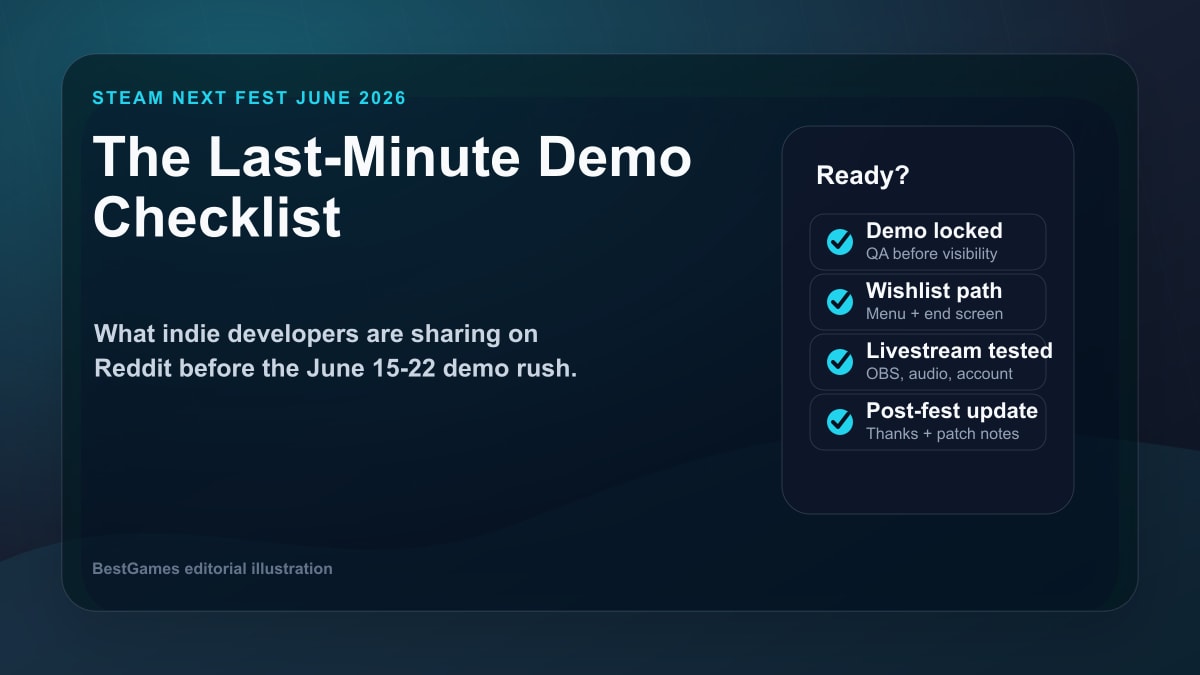
That is especially true this week because the sale lands right after Steam Next Fest. The June Next Fest ran from June 15 to June 22, which means many players have fresh demo memories. That is useful. A demo tells you how a game feels in your hands. A discount only tells you how it looks in your cart.
The Short Answer
Buy games you already wanted, games you tested during Next Fest, and games with healthy recent player feedback. Wait on games you only noticed because the discount is huge, Early Access projects that sell a dream more than a current game, and bundles where most of the value is padding.
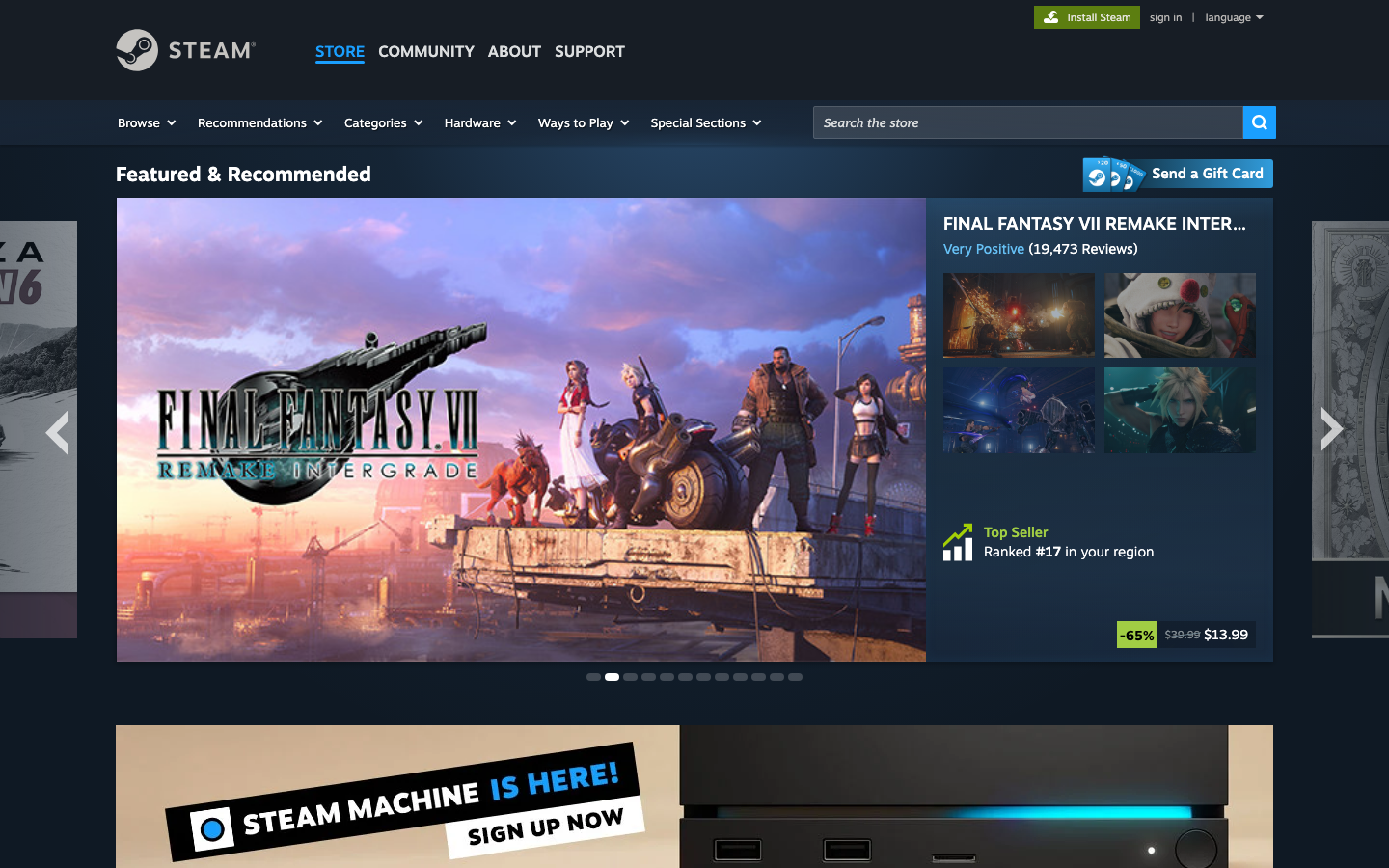
PC Gamer lists the 2026 Steam Summer Sale window as June 25 to July 9. GamesRadar also points out the useful timing: the June Steam Next Fest ended on June 22, just before the Summer Sale. That makes this a rare moment where you can connect two signals: what you actually enjoyed playing last week, and what is discounted now.
1. Start With The Game You Came For
My first rule for a big sale is boring, which is why it works: start with the game you came for.
Not the homepage carousel. Not the "because you played" strip. Not the bundle that looks mathematically impressive. Start with the title that was already on your mind before the sale started. If you cannot name one, that is already an answer. You are browsing for a reason to spend, not checking whether a real want became cheaper.
Open your wishlist and sort it into three piles:
- Already wanted: games you were likely to buy even without the sale.
- Demo-proven: games you tried during Next Fest and still remember clearly.
- Discount-created: games that only became interesting after you saw the price.
The first pile is the safe zone. The second pile is the interesting zone. The third pile is where most regret lives.
2. Use The Next Fest Memory Test
If you played demos last week, do not start by reopening every store page. First, write down the demos you still remember without looking. This is a better test than it sounds.
A good demo leaves residue. You remember the movement, the camera, the first clever puzzle, the combat timing, the way a weapon sounded, or the moment you thought, "I want to see the full version of this." A weak demo leaves a capsule image and a genre label. When a game disappears from memory in three days, a 30% discount probably should not rescue it.
This is also why I do not like buying only from trailer energy. Trailers are edited to remove boredom. Demos cannot hide quite as much. If the demo made you impatient, confused, or tired, do not let the sale make you sentimental.
3. Read Recent Reviews Like Patch Notes
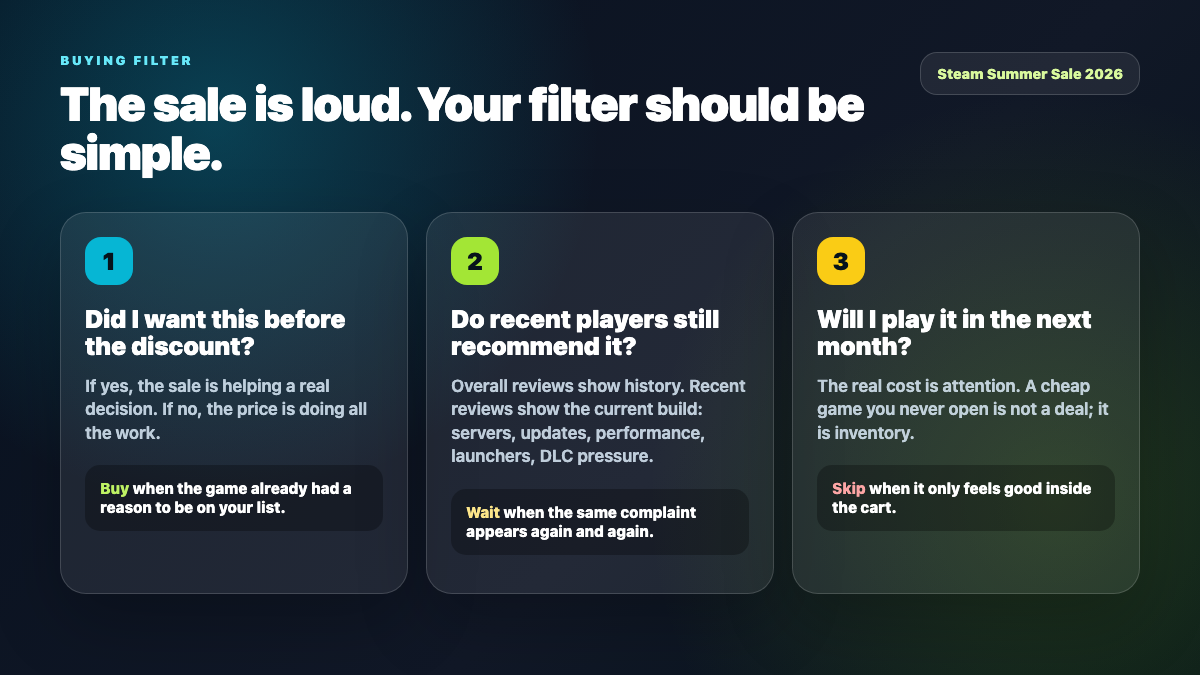
Overall reviews tell you what a game has been. Recent reviews tell you what you are actually buying today.
This matters for almost every category that causes buyer's remorse: live-service games, multiplayer games, Early Access projects, old PC ports, games with launcher drama, and games that depend on DLC to feel complete. A game can have a great reputation and still be in a bad current state. It can also have a messy launch and be much better now.
Do not read reviews like a courtroom. Read them like weather. You are looking for patterns. If five recent players mention bad server population, believe the weather. If people keep mentioning stutters after the latest update, believe the weather. If the negative reviews mostly say "not my genre," that is less useful.
Here is the quick scan I use:
- Performance: are players with normal hardware complaining about stutter, crashes, or broken saves?
- Population: if it is multiplayer, are matches easy to find?
- DLC pressure: does the base game feel complete, or is the sale price only the entry fee?
- Update direction: are recent patches making players happier or more annoyed?
4. Be Suspicious Of The Giant Discount
A 90% discount is not automatically a trap. Some older single-player games, puzzle games, roguelikes, strategy games, and complete editions are perfect deep-discount buys. The problem is that a giant discount can make you stop asking whether you want the game.
The question is not "is this cheap?" The question is "will I install this before the next Steam sale?"
If the honest answer is no, leave it. The game will probably be discounted again. Steam sales are not rare miracles anymore; they are a rhythm. Missing one discount on a game you are not ready to play is not a loss.
My Cart Rule
If I would not start the game this month, I do not buy it this month. That one rule kills most fake urgency.
5. Bundles Are Where Math Starts Lying
Bundles feel rational because they show you a bigger number crossed out. But the bundle is only a deal if you want the extra games.
When a bundle tempts you, ignore the total savings for a moment. Price the one game you actually came for. Then ask: would I pay the difference for the rest if they were sitting on a normal shelf without the bundle label?
If yes, good. If no, you are not saving money. You are buying clutter with a discount certificate attached.
6. Early Access Needs A Colder Eye
Early Access can be the best part of a Steam sale because unfinished does not always mean weak. Some Early Access games already have a strong core loop and an active developer rhythm. Buying those can feel good because you are supporting something alive.
But do not buy the imagined version. Buy the version that exists today.
Look for current proof: readable update notes, a demo that already works, recent players describing the game as fun now, and developers who communicate in specifics. Be careful with store pages that mostly sell future scope: more biomes, more classes, more systems, more everything. "More later" is not a feature today.
7. Make A Small Budget Before You Browse
Steam sales are built out of small prices. That is why they work. A $4.99 game does not feel like a decision. Six of them do.
Give yourself a shape before you browse. One bigger game and two smaller games. Or one game from your wishlist, one Next Fest follow-up, and one wild card. The exact rule does not matter. The point is to stop the sale from turning every cheap thing into a yes.
I like rules that leave room for fun but prevent sleepwalking. A sale should feel like choosing dinner, not stocking a bunker.
8. When The Right Choice Is Not Buying
There is another option that people forget during sale week: do not buy anything today.
If you want to play now, the fastest path is not always Steam. It is a browser tab. No install, no client update, no storage check, no "I should really finish this because I paid for it" feeling. Just open a game and see if it catches.
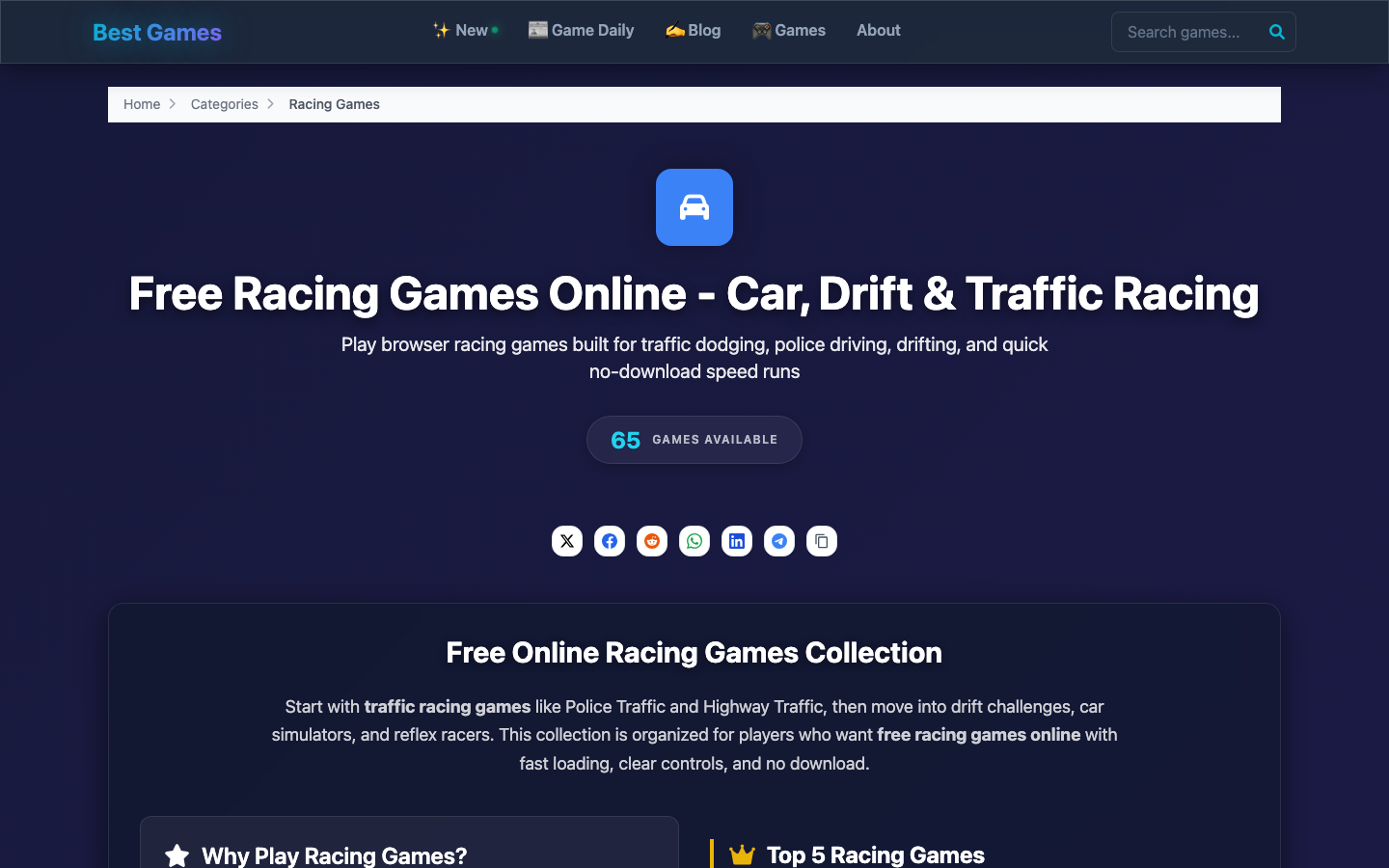
On BestGames, start with Arcade Games if you want fast restarts, Puzzle Games if you want slower decisions, or Racing Games if the sale has you looking at speed and driving games. If you want a direct shortlist, our no-download racing games guide is built for that exact mood.
And if you missed the demo window, read our Steam Next Fest 2026 demo guide. The same filtering habit still works during the sale: do not ask "is this available?" Ask "do I actually want to play this?"
FAQ
Q: When is Steam Summer Sale 2026?
A: The 2026 Steam Summer Sale runs from June 25 to July 9.
Q: Should I buy games on the first day of the Steam Summer Sale?
A: It is fine to buy on day one if the game was already on your wishlist and the discount is strong. Steam seasonal sales no longer rely on old-style flash deals, so you can also take time to compare.
Q: How should I use Next Fest demos during the Summer Sale?
A: Buy the games whose demos you still remember clearly. If a demo was forgettable, confusing, or only looked good in screenshots, wait for more reviews.
Q: Are the biggest discounts always the best deals?
A: No. The best deal is a game you will actually play. Deep discounts are useful, but they can also turn into backlog if the game does not match your taste right now.
Q: What can I play instead of buying a Steam game?
A: Try free browser games. BestGames has no-download arcade, puzzle, and racing games that start in the browser.
Bottom Line
Steam Summer Sale 2026 is a good buying window, but it is also a good filtering test. Start with your wishlist, trust the demos you remember, read recent reviews, watch for bundle padding, and buy for the next game you will actually play.
If nothing earns that confidence today, skip the cart and play something free. The sale lasts until July 9. Your backlog can wait.


Leave a Comment
Share your thoughts with the community