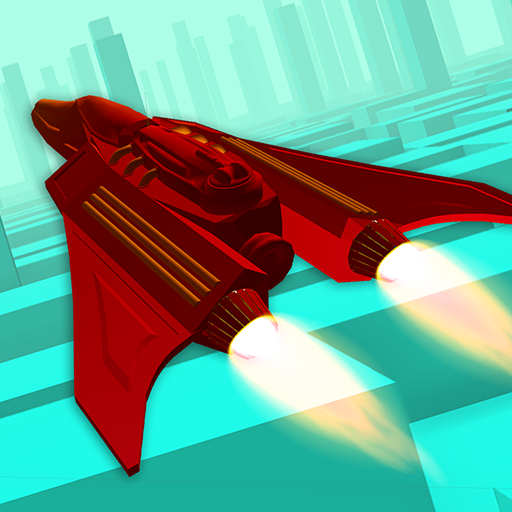
Jet Rush looks simple from the outside: a fast jet, a futuristic track, and a stream of obstacles that close the road in front of you. The hard part is not understanding the goal. The hard part is staying calm when the tunnel starts moving faster than your hands want to.
This guide is written for players who already know how to start the game but keep losing runs to the same mistakes: chasing a coin into a bad lane, oversteering after a narrow save, or staring at the obstacle instead of the gap. If you enjoy quick racing games and reflex challenges, Jet Rush rewards the same habit every good browser racer teaches: read early, move less, and give yourself an exit.
Start with the center line
The safest place in Jet Rush is not always the middle, but the middle is the best place to begin a decision. When you drift too far left or right after every obstacle, you shorten the time available for the next move. A good run often feels quieter than a lucky one because the jet returns to a neutral lane before the next gate appears.
Use the first few seconds of each run to train that reset. Dodge, then come back toward center. Dodge again, then stop correcting. The habit matters more than one flashy save. Games like GT Traffic Racer and Highway Traffic teach a similar lesson: the player who keeps a clean lane has more choices than the player who is always recovering from the last move.
Look at the gap, not the wall
The most common beginner mistake is visual. Players look at the barrier that scares them, then steer straight into it. Train your eyes to search for the empty lane instead. The earlier you recognize the open space, the smaller your input can be.
A useful exercise is to name the safe lane before you move: left, center, right, or hold. Do it for ten runs without caring about score. You will notice that many crashes happen because you moved before the answer was clear. Waiting half a beat can feel dangerous, but it often reveals the real opening.
Do not let coins choose your route
Collectibles are useful only when they sit on a safe line. If a coin asks you to cross two lanes, clip a moving obstacle, or enter a corner late, it is bait. The better rule is simple: take coins you can collect without changing your planned escape route. Leave the rest behind.
That choice gets harder after a weak start. You want to make the run feel worthwhile, so the risky coin looks tempting. Resist it. In Jet Rush, one longer run teaches more than five greedy restarts. The same patience applies to other quick-play recommendations in our no-download racing games list: speed only helps when the next decision is still readable.
Use small inputs at high speed
Big steering corrections feel heroic, but they usually create the next crash. At higher speed, tap or feather your movement instead of holding a direction until the jet reaches the edge. Think in small corrections: move into the opening, release, then prepare the next move.
If you keep dying after a successful dodge, the problem is probably the recovery, not the dodge. You escaped the obstacle, but you carried too much sideways motion into the next pattern. Practice ending each move earlier than feels natural. Clean exits matter more than dramatic entries.
Build a three-run practice loop
Instead of grinding mindlessly, give each set of runs a job:
- Run one: Ignore coins and focus only on returning to center after every dodge.
- Run two: Call out the safe lane before moving. If you cannot name it, wait.
- Run three: Play normally, but skip any coin that pulls you away from the safest lane.
This rhythm turns Jet Rush from a reaction test into a learning loop. You are not just asking, "How far did I go?" You are asking, "Which mistake ended the run?" Over time, that is how high-score games become less random.
Fix the boring technical problems
Browser games depend on clean input. Before blaming yourself for every crash, remove the obvious friction:
- Close heavy tabs: video pages, downloads, and background games can cause stutter.
- Use full screen: it reduces visual clutter and makes the tunnel easier to read.
- Check hardware acceleration: if the game feels choppy, your browser may not be using the GPU well.
- Use a stable keyboard: wireless delay or key ghosting can make small corrections feel late.
These fixes are not glamorous, but they matter. A fast obstacle game with a stuttery frame rate is not a fair test of skill. If you also like handling-heavy games, compare the feel with something slower like Drift King. When the input feels predictable there but not in Jet Rush, performance is likely part of the problem.
What a good Jet Rush run feels like
A strong run rarely feels frantic the whole time. It has a rhythm: hold center, read the next opening, move once, recover, repeat. The crashes that teach the most are not the unfair ones. They are the ones where you can say exactly what happened: I chased the coin, I held the turn too long, I looked at the wall, I restarted angry.
Once you can name the mistake, the next run has a purpose. That is the real appeal of Jet Rush. It is fast enough to punish hesitation, but short enough that improvement shows up quickly.
Related on BestGames
For more fast browser picks, try GT Traffic Racer, Highway Traffic, or our guide to racing games you can play without downloading.
Ready to test a cleaner line?
Play Jet Rush



Leave a Comment
Share your thoughts with the community