While the mainstream gaming industry has been fixated on metaverse hype cycles, overpriced VR headsets, and the ballooning file sizes of AAA titles, a quiet but violent revolution has been brewing in the place everyone already visits daily: the web browser.
Welcome to 2026. Here, browser games are no longer the "flashy" distractions for bored office workers they once were. They are a burgeoning market projected to maintain a CAGR of 11.89% through 2035. For indie developers tired of the "Steam Abyss"—the algorithmic graveyard where thousands of games launch into oblivion every month—the open web is becoming the new frontier.
This is not just an update; it is a fundamental shift in how games are built, distributed, and consumed. In this survival manifesto, we will dissect why the "Web-First" strategy is the smartest move an indie developer can make in 2026.
Part 1: The Silicon Bridge — WebGPU and the Death of the "Web Limitation"
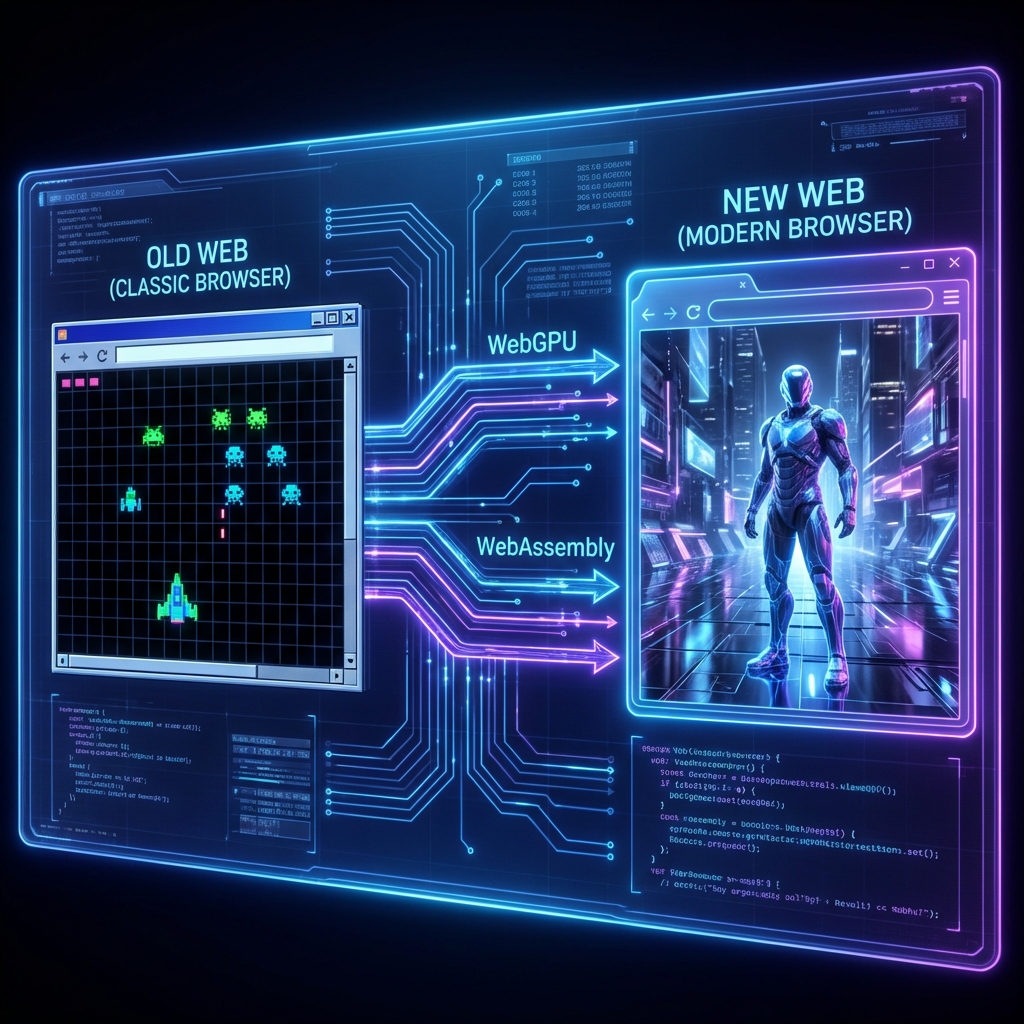
For decades, the "browser game" label was synonymous with "low performance." That era ended in early 2025. By 2026, the technical gap between native and web has narrowed to the point of irrelevance for 95% of use cases.
1. WebGPU: The Browser's "Vulkan" Moment
WebGPU has achieved universal browser maturity. Unlike its predecessor, WebGL, which was built on an aging OpenGL model, WebGPU provides direct access to modern GPU features. This means:
- Real-Time Ray Tracing: Yes, browsers can now handle hardware-accelerated ray tracing. Games like the 2026 edition of Polytrack utilize WebGPU to render dynamic reflections and soft shadows that rival native desktop builds.
- Compute Shaders: Complex physics, massive particle systems, and live AI inference have moved from the CPU to the GPU. This offloads the heavy lifting, allowing browsers to remain responsive even during intense gameplay.
- WGPU Abstraction: Developers using Rust or Godot can write code once and have it run across Vulkan, Metal, and DirectX via the browser's abstraction layer with negligible overhead.
2. The Industrialization of WebAssembly (Wasm)
WebAssembly is no longer just a "cool experiment." In 2026, compilers for Godot, Unity 6, and Bevy produce Wasm code that runs at over 90% of native speed. The days of rewriting your C++ or Rust engine in JavaScript are over. You can now compile your high-performance native logic directly to the web, turning the browser into a universal, high-speed operating system for games.
Part 2: The Psychology of Breakout — Why "Zero Friction" Wins the Market
In an attention economy where Customer Acquisition Cost (CAC) has skyrocketed, every second of friction is a lost player. In 2026, the "Install" is the ultimate friction.
1. The "100GB Barrier" vs. The Instant Click
Native Gaming Flow: Buy → Download → Wait for Install → Update → Log In → Play (Avg. Time: 45 minutes).
Web Gaming Flow: Click Link → Play (Avg. Time: 3 seconds).
This "Instant Access" is the driving force behind the explosion of the Hyper-Casual and Hybrid-Casual genres. The 2026 mobile player, raised on TikTok-style instant gratification, refuses to wait for a 2GB download for a game they haven't tried yet. If you can provide a high-fidelity experience in 3 seconds, your conversion rate will be 10x higher than any app store listing.
2. The Viral Power of the URL
The web's greatest superpower is its atomic structure: the URL. A player having a spectacular moment in your game can copy the address bar, paste it into Discord, and their friend is playing that exact same game state in seconds. This level of viral potential cannot be replicated by closed ecosystems like "Invite Links" that require an app download first.
Part 3: Case Studies of the Avant-Garde — Success in the Open Wild
1. PokeRogue: The Legend of Frictionless Growth
PokeRogue demonstrated that you don't need million-dollar marketing if your gameplay loop is tight and your accessibility is universal. By stripping away everything except the core combat and roguelike progression, it created a loop that was perfect for "just one more run" during a lunch break. Its success was not built on ads, but on the organic sharing of URLs within communities like Reddit and Discord.
2. Polytrack: UGC as the Ultimate Retention Tool
Polytrack's minimalist aesthetic was a Trojan horse for a deep User-Generated Content (UGC) system. By allowing players to build, play, and share their own tracks instantly via short URLs, the developers created an infinite content machine. In 2026, the most successful web games are often those that function more like "Creative Platforms" than static products.

Part 4: The Developer’s Arsenal — Choosing Your Engine for 2026
1. Godot 4 & 5: The Open Source King
By 2026, Godot has become the de-facto standard for small to mid-sized web projects. Its web export is virtually seamless, supported by Wasm SIMD and multi-threading. For indies, the lack of licensing fees and the engine's 30MB editor size make it the leanest weapon in the arsenal.
2. Unity 6: The WebGPU Powerhouse
Unity 6 has leaned heavily into WebGPU to justify its subscription model. If you need high-end URP features like volumetric lighting and advanced VFX on the web, Unity's established pipeline is still the fastest route for teams moving from native projects to web distribution.
3. Bevy & Rust: The Hardcore Edge
For developers who demand absolute performance and tiny bundle sizes, the Bevy engine compiled to Wasm is the choice. We are seeing "1MB miracles"—games with deep mechanics that load faster than a standard JPEG.
Part 5: Monetization 2.0 — Beyond the "AdSense Cemetery"
The old model of "banner ads and hope" is dead. In 2026, web games monetize like world-class mobile apps:
- The TON/Telegram Ecosystem: The integration of the TON blockchain into Telegram has created a frictionless micro-payment layer for 1 billion users. In-App Purchases (IAP) on the web are now easier than on iOS.
- Platform Funds: Portals like Best-Games.io, Poki, and CrazyGames now offer "Performance-Based Grants" for top developers, providing stable income for games with high retention.
- Rewarded Play: Instead of forced pop-ups, modern web games use voluntary rewards (e.g., watch a 15s clip for an extra life). In 2026, CPMs for high-quality web traffic have stabilized and are now competitive with mobile app ads.
Part 6: AI: The Asset-Slaying Edge
In 2026, the smartest indies aren't building "static" content. They are using Runtime AI Orchestration.
By shipping 20MB of "Seed Code" and utilizing the user's local WebGPU power to run light LLMs or diffusion models, games can generate infinite worlds, dialogues, and quests on the fly. This solves the "Weight Problem"—how to provide a 100-hour RPG experience without a 10GB download.
Conclusion: Build for the Click, Stay for the Community
The "Steam-First" strategy is a gamble against an algorithm you don't control. The "App Store" is a hostage situation with 30% ransoms. The Web, however, remains the largest, freest, and most transparent platform on the planet.
In 2026, the browser isn't where you put your "lite" version. It's where you put your best version. It's where you capture the player in the one second they have between scrolling and working. Build for the click, and you build for a global audience that is just one URL away.
Are you ready to join the Revolution?
Check out our curated HTML5 collection to see the power of the 2026 web in action.
EXPLORE HTML5 GAMES NOW


Leave a Comment
Share your thoughts with the community