
Mahjong Solitaire, also known as Shanghai Solitaire or simply Mahjong, has captivated puzzle enthusiasts for decades. While the rules are deceptively simple—match identical tiles to remove them from the board—achieving consistent victories requires strategic thinking, pattern recognition, and careful planning. This comprehensive guide will transform you from a casual player into a Mahjong master.
1. Understanding Mahjong Solitaire: The Foundation
Before diving into advanced strategies, let's establish a solid understanding of the game's mechanics and rules.
The Basic Rules
Mahjong Solitaire is a single-player matching game where the objective is to clear all tiles from the board by matching identical pairs. However, there are important constraints:
- Free Tiles Only: A tile is only playable if it has at least one free side (left or right) and nothing directly on top of it.
- Matching Pairs: Only identical tiles can be matched, with the exception of flower and season tiles which can match any tile within their category.
- No Shuffling: Unlike card games, you cannot reshuffle the board (though some versions offer hints or shuffles as power-ups).
Understanding the Tile Set
A standard Mahjong set contains 144 tiles divided into several categories:
Tile Categories
| Category | Types | Count |
|---|---|---|
| Suits (Dots, Bamboo, Characters) | 1-9 in each suit | 108 tiles (4 of each) |
| Winds | East, South, West, North | 16 tiles (4 of each) |
| Dragons | Red, Green, White | 12 tiles (4 of each) |
| Flowers | Plum, Orchid, Chrysanthemum, Bamboo | 4 tiles (match any flower) |
| Seasons | Spring, Summer, Autumn, Winter | 4 tiles (match any season) |
Why Some Games Are Unsolvable
An important reality of Mahjong Solitaire: not every game is winnable. Depending on the initial tile arrangement, approximately 3-5% of standard layouts are mathematically impossible to complete. This means that even perfect play cannot guarantee victory every time. Knowing this helps prevent frustration when you encounter a genuinely unsolvable puzzle.
2. Core Strategic Principles
Success in Mahjong Solitaire comes from applying consistent strategic principles throughout the game.
The Golden Rule: Long-Term Thinking
Every match you make opens new possibilities while closing others. The amateur removes tiles as soon as they spot a match; the master considers how each match affects future moves. Before clicking, ask yourself:
- What new tiles will this match expose?
- Will this match free tiles on multiple sides?
- Am I about to waste a match that could be more valuable later?
Pro Tip: The Patient Approach
Scan the entire board before making your first move. Often, the obvious match isn't the best match. Spend 30 seconds analyzing the layout before playing—this small investment dramatically improves your win rate.
Prioritize the Center and Top
Tiles in the center and on upper layers block the most other tiles. Removing them first maximizes your available options:
- Top Layer Priority: Upper tiles block everything beneath them. Clear the peaks first.
- Center Focus: Center tiles typically block more tiles than edge tiles. Work from the inside out.
- Avoid Edge Obsession: While exposed edges are tempting, focusing too heavily on them can leave you stuck with an inaccessible center.
Balance Your Sides
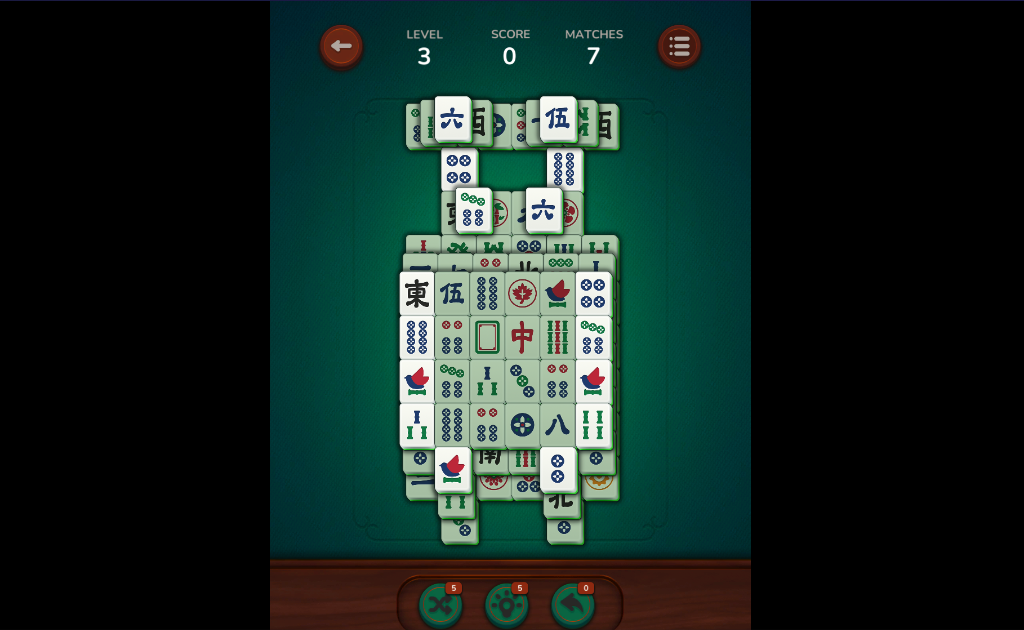
Many layouts (especially the classic turtle/pyramid) have a left-right symmetry. Try to remove tiles evenly from both sides to maintain maximum flexibility. If you clear one side completely while the other remains stacked, you'll have fewer options as the game progresses.
3. Tile Recognition and Pattern Memory
Fast, accurate tile recognition accelerates your play and improves decision-making.
Learning the Suits
The Dot Suit (Circles)
Progresses from 1-9 with increasing circle patterns. The key identifiers:
- 1 Dot: Single large circle (often with decorative design inside)
- 5 Dots: Center circle with 4 corners (cross pattern)
- 9 Dots: 3×3 grid of circles
The Bamboo Suit (Sticks)
Features bamboo stick imagery:
- 1 Bamboo: Often depicted as a bird (sparrow) rather than a single stick
- 2-4 Bamboo: Vertical sticks in their respective quantities
- 5-9 Bamboo: Sticks often in alternating colors
The Character Suit (Wan)
Chinese numerals with the "wan" character:
- Look for the common element (萬) on all character tiles
- The top portion changes to represent numbers 1-9
Quick Identification Tricks
- Flowers and Seasons: These special tiles often have distinctive borders or backgrounds. Learn to spot them instantly as they match flexibly.
- Winds: Usually feature a single large character. East (東), South (南), West (西), North (北).
- Dragons: Red features 中, Green features 發, White is typically blank or has a border frame.
4. Advanced Strategies for Higher Win Rates
Once you've mastered the basics, these advanced techniques will elevate your game:
The Pair Counting Method
Before committing to matches, count how many of each tile type remain visible. Since each tile appears four times in the deck:
- 4 Visible: Safe to match freely—you have all copies available.
- 3 Visible: Still flexible, but the fourth is buried. Don't match all three immediately.
- 2 Visible: Critical pairing situation. If you can't match now, ensure both remain accessible.
- 1 Visible: Potential problem tile. Its pair(s) are buried. Avoid covering access to this tile.
- 0 Visible: All four copies are buried. This often indicates trouble if they're deep in the stack.
The Exclusion Strategy
When you have multiple matching options for a tile, use exclusion logic:
- Identify all possible matches for a given tile
- Consider what each match would expose
- Choose the match that exposes the most useful tiles (ideally, tiles you've identified as "problem tiles")
Maintaining Flexibility
Flexibility is your lifeline in Mahjong Solitaire. Preserve it by:
- Keeping Multiple Options: When you can see all 4 copies of a tile, don't match them immediately unless necessary. Reserve these "safe" matches for moments when you're stuck.
- Avoiding Chain Reactions: Sequential matches that seem efficient can leave you with no good options. Pause between chains to reassess.
- Saving Special Tiles: Flowers and seasons are wildcards within their categories. Keep them available for emergencies.
The End-Game Approach
As the board thins out, strategy shifts:
- Count Remaining Pairs: Mentally track unmatched tile types
- Identify Blockers: Which tiles are preventing access to others?
- Plan Ahead: With fewer tiles, plan 5-6 moves ahead rather than 2-3
Warning: The Endgame Trap
Many games are lost in the final 20 tiles due to rushed play. Slow down dramatically in the endgame—each decision matters exponentially more.
5. Layout-Specific Tactics
Different Mahjong layouts require adapted strategies:
The Classic Turtle (Dragon)
The most common layout, shaped like a turtle or dragon:
- Focus: Clear the head and tail tips first to access center tiles
- Danger Zones: The multi-layer body center can hide critical tiles
- Approach: Work from extremities toward middle, maintaining symmetry
The Pyramid
A triangular stack with tiles layered like a pyramid:
- Focus: Top layers absolutely must be cleared first
- Danger Zone: Bottom corners often trap essential tiles
- Approach: Spiral downward from the peak, layer by layer
The Tower
Vertical stacking emphasis:
- Focus: Height is the enemy—prioritize unstacking
- Danger Zone: Base tiles supporting tall columns
- Approach: Reduce height before spreading out
Wide/Flat Layouts
Spread horizontally with minimal stacking:
- Focus: Opening both sidelines for maximum tile accessibility
- Danger Zone: Long horizontal rows where tiles block each other
- Approach: Create "gaps" in horizontal rows to free blocked tiles
6. Mental Techniques and Focus
Mahjong Solitaire is as much a mental game as a strategic one:
Zone Management
Divide the board into mental zones (left, right, center, top). Regularly scan each zone to avoid tunnel vision on a single area. Many losses occur because players become fixated on one section while ignoring brewing problems elsewhere.
Pause Points
Establish moments to pause and evaluate:
- After clearing each layer
- When you notice a tile appearing only once
- When you've made 5-6 quick matches in succession
- Whenever you feel uncertain about the next move
Handling Frustration
Mahjong can be frustrating, especially with unsolvable layouts. Maintain composure by:
- Accepting that some games are unwinnable
- Taking breaks between failed attempts
- Celebrating partial progress on difficult boards
- Using "undo" features sparingly to learn from mistakes rather than as a crutch
7. Speed Play vs. Strategic Play
Different contexts call for different approaches:
Casual Play (Strategy Focus)
When accuracy matters more than speed:
- Take unlimited time analyzing
- Count all visible tiles of each type
- Plan multiple moves ahead
- Use undo/hint features when stuck
Timed Challenges (Speed Focus)
When the clock is ticking:
- Match obvious pairs immediately (4 visible copies)
- Don't overthink—act on instinct for peripheral tiles
- Reserve analysis for center/top tiles only
- Accept that some speed games will be lost to bad luck
Competitive/Score Attack
When maximizing points matters:
- Speed bonuses often outweigh perfect play
- Plan chain reactions for combo multipliers
- Learn to recognize "safe" speed matches versus risky ones
- Practice specific layouts to improve pattern recognition
8. Common Mistakes and How to Avoid Them
Mistake #1: Matching Everything Immediately
The Problem: Clicking on every match you see without considering consequences
The Solution: Force yourself to identify at least 3 possible moves before making any. Then choose the best one.
Mistake #2: Edge Fixation
The Problem: Constantly clearing edge tiles while the center remains stacked
The Solution: After every 3 edge matches, force yourself to make at least 1 center-focused match.
Mistake #3: Ignoring Asymmetry
The Problem: Clearing one side completely while the other remains blocked
The Solution: Alternate sides regularly, especially in symmetric layouts.
Mistake #4: Panic Matching in Endgame
The Problem: Rushing to finish when tiles get low, leading to dead-ends
The Solution: Consciously slow down when fewer than 30 tiles remain.
Mistake #5: Not Tracking Problem Tiles
The Problem: Suddenly realizing a tile type is hopelessly buried
The Solution: Whenever you see only 1-2 copies of a tile, mentally flag it and prioritize accessing the others.
9. Practice Drills for Improvement
Structured practice accelerates skill development:
Drill 1: The Analysis Game
Play 3 games where you spend at least 10 seconds analyzing before every single move. Time-consuming but builds analytical habits.
Drill 2: One-Side Focus
Deliberately try to clear the left or right side completely. This teaches you about asymmetry consequences.
Drill 3: Top-Only
Only match tiles from upper layers until the top is flat. Develops height-priority instincts.
Drill 4: Speed Runs
Try to complete boards as fast as possible. Builds pattern recognition and instinctive matching.
Drill 5: No Undo Challenge
Complete 10 games without using undo or hint features. Teaches self-reliance and careful decision-making.
10. Online Variants and Scoring Systems
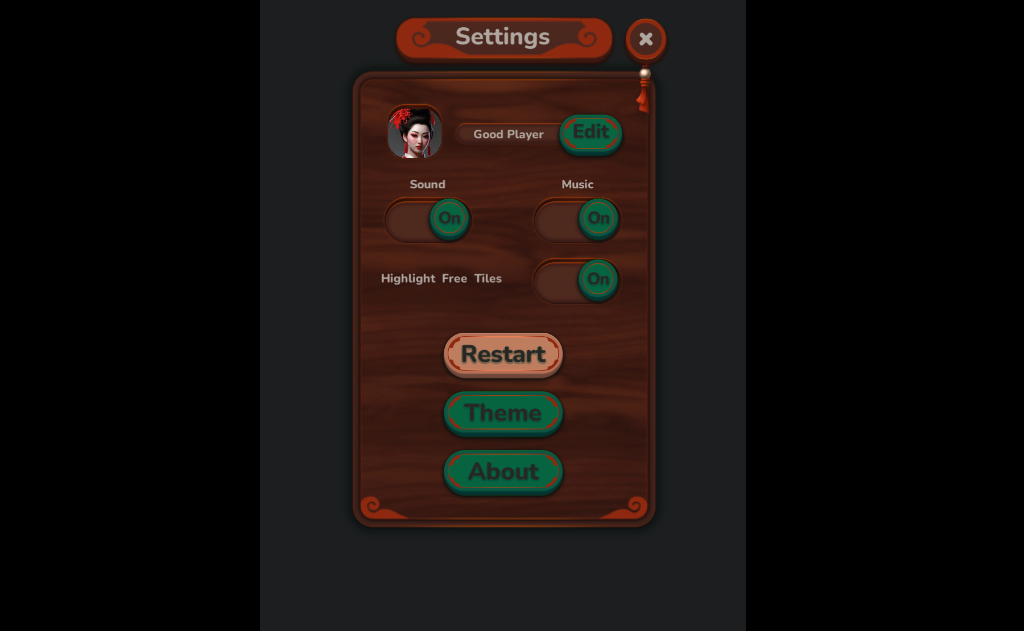
Different versions of online Mahjong Solitaire offer various features that affect gameplay:
Scoring Variations
- Time-Based Scoring: Faster completion earns more points. Rewards quick pattern recognition.
- Move-Based Scoring: Fewer moves = higher score. Rewards efficient matching.
- Combo Systems: Matching tiles in rapid succession multiplies points.
- Difficulty Multipliers: Harder layouts offer higher potential scores.
Power-Ups and Helpers
Many online versions include assistive features:
- Hints: Highlight available matches (usually limited or with score penalty)
- Shuffle: Rearrange remaining tiles (can make unsolvable games solvable)
- Undo: Reverse previous matches to try different paths
- Magnifier: Zoom in on tiles for easier identification
Daily Challenges
Many Mahjong sites feature daily puzzles:
- Same layout for all players worldwide
- Compete for fastest completion time
- Build streaks by completing consecutive days
- Earn achievements and unlock cosmetic rewards
11. FAQ: Common Questions Answered
Q: Is every Mahjong Solitaire game solvable?
A: No. Approximately 3-5% of randomly generated layouts are mathematically impossible to solve due to tile placement. If you've analyzed carefully and still cannot progress, the layout may simply be unsolvable.
Q: What's the difference between Mahjong and Mahjong Solitaire?
A: Traditional Mahjong is a 4-player competitive game with complex scoring rules, similar to card games like Rummy. Mahjong Solitaire is a single-player puzzle game using the same tile set but completely different rules and objectives.
Q: Should I use hints when stuck?
A: For learning, yes—hints teach you what matches you're missing. For building skill, limit hint usage. For competitive play, hints typically carry score penalties, so use them sparingly.
Q: How do flowers and seasons work?
A: Unlike regular tiles that must match exactly (e.g., 5-dot with 5-dot), flowers can match any other flower tile, and seasons can match any other season tile. There are 4 flowers and 4 seasons, each appearing once.
Q: What's the best strategy for beginners?
A: Focus on three principles: 1) Always scan the entire board before matching, 2) Prioritize upper-layer and center tiles, 3) Don't make a match immediately just because it's available—consider what it exposes first.

11. Conclusion: The Path to Mastery
Mahjong Solitaire rewards patience, observation, and strategic thinking. Unlike games of pure luck, every decision you make influences the outcome. The satisfying "click" of a perfect match, the tension of endgame tile counting, the triumph of clearing a difficult layout—these experiences keep players coming back for decades.
Remember that mastery is a journey. You'll lose games to bad layouts, make mistakes on boards you could have won, and sometimes miss obvious matches. Each game, win or lose, teaches you something new about tile relationships and strategic planning.
Start with the fundamentals: scan before matching, prioritize the center and top, and maintain balance. As these habits become automatic, layer in advanced techniques like pair counting and exclusion logic. Before long, boards that once seemed impossible will fall to your strategic prowess.
The tiles are waiting. Your journey to Mahjong mastery begins now.
Ready to Test Your Strategy?
Put these techniques into practice with our classic Mahjong Solitaire game.
PLAY MAHJONG NOW



Leave a Comment
Share your thoughts with the community