
Geometry Dash has become a cultural phenomenon in the gaming world, blending rhythm-based gameplay with precision platforming in ways that challenge even the most skilled players. What appears simple—a cube jumping over obstacles to music—reveals itself as a deep and demanding experience that rewards patience, practice, and persistence. This comprehensive guide will help you progress from struggling with early levels to conquering the game's most challenging content.

1. Understanding Geometry Dash: The Core Philosophy
Before diving into techniques, it's essential to understand what makes Geometry Dash tick. This isn't just a platformer—it's a rhythm game disguised as one.
The Rhythm Connection
Every obstacle in Geometry Dash is synchronized to the music. This isn't decoration; it's fundamental to how the game works. Obstacles appear, spike patterns emerge, and portals trigger in time with beats and melodies. Understanding this connection is the first step to mastery:
- Listen Before Playing: On a new level, let the music sink in. Notice the rhythm, the drops, the build-ups.
- Tap to the Beat: Your jumps should feel like part of the music, not reactions to visuals alone.
- Anticipate with Audio: Audio cues often telegraph what's coming before you can visually process it.
The Game Modes
Geometry Dash features multiple gameplay forms, each with unique physics:
Cube Mode (Default)
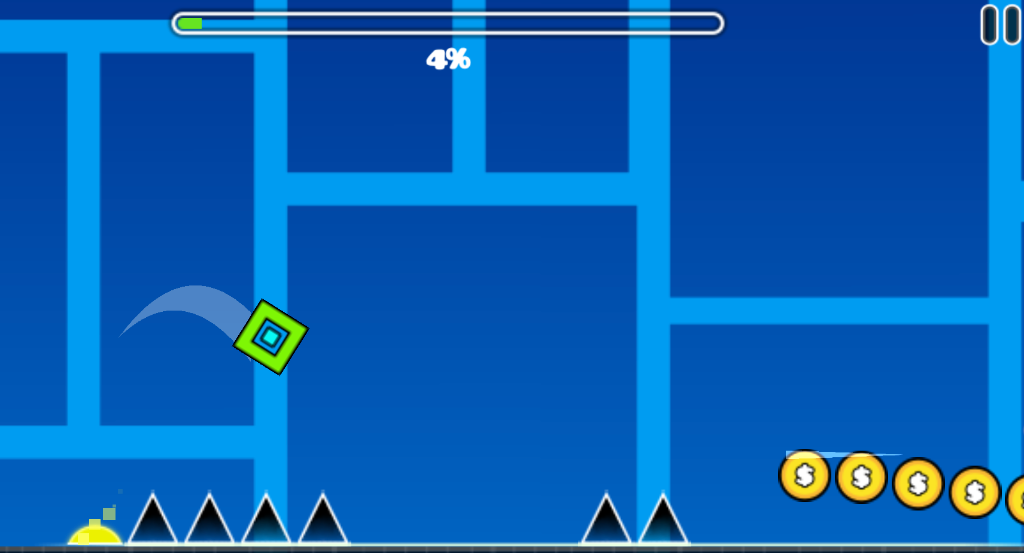
The standard jumping icon. Tap to jump, hold for nothing. Gravity affects you normally. Master this first—it's the foundation of everything else.
Ship Mode
Flying gameplay. Hold to rise, release to descend. Maintaining stable flight paths while navigating through tight corridors is challenging but essential.
Ball Mode
Tap to switch gravity direction. Unlike cube, you don't jump—you flip to the ceiling or floor. Timing changes fundamentally.
UFO Mode
Each tap provides a small boost upward. Requires repeated tapping to maintain altitude. A hybrid of cube and ship mechanics.
Wave Mode
Continuous diagonal movement. Hold to go up-right, release to go down-right. Requires precise cornering skills.
Robot Mode
Similar to cube but jump height varies based on tap duration. Short taps = short hops; long holds = high jumps.
Spider Mode
Teleports between surfaces rather than gradual gravity changes. Tap to instantly switch to the opposite surface.
Pro Tip: Mode Transitions
Mode transitions are where most players fail. When you see a portal ahead, prepare mentally for the new physics before you enter. The moment of transition is not the time to figure things out.
2. Essential Techniques for Every Player
These fundamental skills apply across all modes and difficulty levels:
The Muscle Memory Approach
Geometry Dash, especially at higher difficulties, is too fast for conscious reaction. Instead, you build muscle memory through repetition. Each attempt trains your fingers to act automatically at specific moments. This means:
- Repetition is Key: You will die. A lot. Each death teaches your muscles something.
- Consistent Timing: Try to tap at the same points in the music each time.
- Don't Overthink: If you start analyzing mid-level, you'll hesitate and fail.
The 80% Rule
When approaching a difficult level, don't expect to beat it until you can reach the 80% mark consistently. The final 20% of levels often contains the hardest sections, and reaching it with shaky fundamentals means you won't have the focus to complete it. Mastery of early sections must be automatic before tackling late-game challenges.
Sight Reading vs. Memorization
Early levels can be "sight read"—you react to obstacles in real-time. This becomes impossible in harder levels: obstacles appear faster than human reaction time allows. The distinction is important:
- Easy-Normal Levels: Sight reading is possible and encouraged
- Hard-Insane Levels: Blend of reaction and memorized patterns
- Demon Levels: Almost entirely muscle memory and memorization
Jump Combinations
Many obstacles require specific jump patterns:
- Single Jumps: Tap and release. Clear low spikes.
- Double Jumps (with orbs): Jump, hit orb, jump again. Extends air time.
- Held Jumps (Robot mode): Hold for maximum height, release for short hops.
- Spam Tapping: Rapid continuous tapping for certain orb sequences or UFO sections.
3. Practice Mode: Your Most Powerful Tool
Practice Mode is how skilled players learn difficult levels. Using it effectively accelerates your improvement dramatically.
How Practice Mode Works
In Practice Mode, you place checkpoints. When you die, you respawn at the last checkpoint instead of returning to the start. This allows you to:
- Isolate difficult sections for focused practice
- Learn level layouts without frustration
- Build muscle memory for specific segments
- Identify which sections need the most work
Effective Checkpoint Placement
Where you place checkpoints matters:
- Before Difficult Sections: Allow instant retry of challenging parts
- At Mode Transitions: Practice entering new forms smoothly
- After Safe Zones: Not in the middle of obstacle sequences
- Rhythm-Aligned: Place checkpoints at musical phrase beginnings for timing consistency
The "Clean Run" Approach
A common mistake is leaving Practice Mode too early. Before attempting Normal Mode, you should be able to complete Practice Mode "clean"—meaning you pass through your checkpoints without dying, even though they're there. If you can't complete a section cleanly in Practice, you're not ready to attempt it in Normal.
Section-by-Section Learning
- Use Practice Mode to reach the end once, placing many checkpoints
- Identify your weak sections (where you died repeatedly)
- Isolate each weak section, practicing until you can pass it 5 times consecutively
- Increase section length: practice from two checkpoints back, then three
- Attempt clean Practice Mode run
- Only then attempt Normal Mode
4. Difficulty Progression: Level by Level
Geometry Dash difficulty labels are helpful guidelines:
Easy Levels
Characteristics: Slow speeds, simple patterns, forgiving timing
Approach: Sight reading works. Focus on enjoying the music and learning controls.
Examples: Stereo Madness, Back on Track
Normal Levels
Characteristics: Moderate speeds, introduces more modes, timing becomes important
Approach: Start paying attention to rhythm. Notice how obstacles sync to music.
Examples: Polargeist, Dry Out
Hard Levels
Characteristics: Faster speeds, complex mode combinations, less forgiving
Approach: Practice Mode becomes necessary. Memorization starts to matter.
Examples: Base After Base, Cant Let Go
Harder Levels
Characteristics: Speed increases again, tight timings, memory-heavy sections
Approach: Committed practice required. Multiple sessions needed for completion.
Examples: Jumper, Time Machine
Insane Levels
Characteristics: Very fast, complex patterns, demands consistency
Approach: Clean Practice Mode completion required before Normal attempts.
Examples: Cycles, xStep, Clutterfunk
Demon Levels
Characteristics: Extreme difficulty, frame-perfect timing, extensive memorization
Approach: Dedicate significant time. Break into tiny sections. Accept many deaths.
Examples: The Nightmare (Easy Demon), Clubstep (Medium Demon)
Difficulty Tip
Don't skip difficulties. Playing levels at your current skill ceiling teaches you more than attempting levels far above your ability. Consistent completion of "Hard" levels means you're ready to attempt "Harder"—not Demons.
5. Specific Level Strategies
Here are strategies for some of the most-played official levels:
Stereo Madness (Easy)
The first level and tutorial for cube physics. Key sections:
- Opening Triple Jumps: Three quick taps in rhythm with the intro
- First Drop: The music intensifies; so do the obstacles. Stay calm.
- Final Stretch: Longer gaps between spikes. Don't panic-jump.
Clubstep (Medium Demon)
A major milestone for players. Infamous difficulty spikes:
- Opening UFO: Precise altitude control required. Don't over-tap.
- The "Dual Parts": Control two icons simultaneously. Practice until automatic.
- Final Ship Corridor: Tight flying section near the end. Muscle memory is essential.
- The Very End: Don't relax too early—several players fail at 90%+ from complacency.
Theory of Everything 2 (Demon)
Complex mode transitions and timing:
- Ball Section at 30%: Perfectly timed gravity switches. Memorize the pattern.
- Wave Sections: Multiple wave corridors that punish sloppy movement.
- Memory-Heavy Middle: The 40-60% range requires near-perfect memorization.
6. Common Mistakes and How to Fix Them
Mistake #1: Panic Clicking
The Problem: When obstacles approach rapidly, beginners spam the click button
The Fix: Take a breath. Listen to the music. Obstacles are rhythmic—match your clicks to beats, not to fear.
Mistake #2: Watching the Icon
The Problem: Focusing on your icon rather than upcoming obstacles
The Fix: Shift your visual focus forward in the level. Your peripheral vision tracks your icon; your central focus should be on what's coming.
Mistake #3: Ignoring Practice Mode
The Problem: Stubbornly replaying from the start each time
The Fix: Embrace Practice Mode. There's no shame in using it—even top players do.
Mistake #4: Playing Tired
The Problem: Attempting precision gameplay while fatigued
The Fix: Your reaction time and precision drop significantly when tired. Fresh sessions beat marathon sessions.
Mistake #5: Volume Too Low
The Problem: Not hearing the music clearly enough to rhythm-sync
The Fix: Turn up the music. Geometry Dash is a rhythm game—audio is half the game.
7. Speed Settings and Speed Portals
Speed changes are crucial to level design and difficulty:
Speed Levels
- -1x (Slow): Easier timing, but often appears in unexpected places
- 1x (Normal): Default speed, comfortable for learning
- 2x (Fast): Significant reaction time reduction required
- 3x (Very Fast): Near-memorization required for most players
- 4x (Extreme): Pure memorization; sight reading is impossible
Handling Speed Changes
Speed portals can dramatically shift difficulty mid-level:
- When speed increases, previous comfortable timing becomes tight
- Anticipate speed changes—the portal's position warns you
- Slow-down sections are often more dangerous than they appear; complacency kills
8. Jump Orbs and Special Mechanics
Jump orbs allow mid-air jumps, dramatically expanding movement options:
Orb Types
Yellow Orb: Standard mid-air jump. Tap when touching it.
Blue Orb: Reverses gravity when activated.
Pink Orb: Smaller boost than yellow. Common in tight sequences.
Red Orb: Powerful jump. Often launches you to new areas.
Green Orb: Changes gravity without requiring a tap (automatic).
Black Orb: Reverses direction of gravity pull.
Orb Timing
Orbs must be activated precisely when you touch them—not before, not after. This timing becomes critical in orb-heavy sections where multiple orbs appear in rapid succession. The key is rhythm: orbs usually appear on musical beats.
9. Building Consistency
Completing a level once is satisfying; completing it consistently is mastery.
The Warm-Up Routine
- Start sessions with easier levels
- Play through Practice Mode on your target level once
- Make 2-3 attempts before taking micro-breaks
- End sessions before frustration peaks
Tracking Progress
- Note your best% attempt each session
- Identify recurring failure points
- Celebrate improvement, even if you haven't completed the level
The Plateau Problem
Sometimes progress stalls. Solutions:
- Take a day off and return fresh
- Watch successful runs by other players
- Try a different level and return later
- Work on a different section if a specific part is blocking you
10. Custom Levels and Community Content
Beyond official levels, the Geometry Dash community creates millions of custom levels ranging from easy courses to "Extreme Demons" that make official content look simple.
Finding Custom Levels
- Featured Tab: Curated quality levels selected by RobTop or moderators
- Top Lists: Community-maintained rankings of the hardest and most creative levels
- Creator Following: Follow prolific creators to discover new content
- Collaborative Projects: "Megacollabs" where multiple creators each build sections
Level Editor Basics
The built-in level editor lets you create your own challenges:
- Start Simple: Create short, easy levels to learn the tools
- Sync to Music: Use the grid system to align obstacles with beat drops
- Test Frequently: Playtest constantly during creation to catch impossible sections
- Decoration vs Gameplay: Focus on gameplay flow first; add visual polish later
Creating Fun vs Creating Hard
The best custom levels balance challenge with enjoyment:
- Fair Difficulty: Every death should feel like player error, not cheap level design
- Visual Clarity: Players should always know what's dangerous and what's decoration
- Rhythm Flow: Gameplay that naturally follows the music feels better than arbitrary obstacle placement
- Pacing: Vary intensity throughout the level; constant maximum difficulty exhausts players
11. Resource Management Beyond Practice Mode
Some versions of Geometry Dash include additional features to help progression:
Coins and Collectibles
- User Coins: Hidden in custom levels, require specific detours to collect
- Secret Coins: Official level collectibles unlock rewards
- Orbs and Diamonds: Currency earned through gameplay for cosmetic unlocks
Character Customization
While purely cosmetic, custom icons can boost motivation:
- Unlock new shapes by completing achievements
- Color combinations help you stand out
- Death effects add personality to your failures
- Trails visualize your movement path
12. FAQ: Common Questions Answered
Q: How long does it take to beat Clubstep?
A: For most players, Clubstep takes between 500-3000 attempts spread across multiple sessions over days or weeks. It's a significant milestone—don't expect to beat it quickly.
Q: Is playing on mobile harder than PC?
A: Different, not necessarily harder. Mobile has touch latency but offers portability. PC has precise clicks but requires sitting at a computer. Many top players use PC, but mobile has its own successful community.
Q: What's the hardest official level?
A: Of the main levels, "Deadlocked" is generally considered the hardest. Among Demon-rated official levels, difficulty opinions vary by player.
Q: Should I use a controller?
A: Controllers can work but offer no particular advantage. Keyboard/mouse or touchscreen are most common. Use what feels comfortable.
Q: Why can't I beat levels I was completing yesterday?
A: Muscle memory can degrade overnight. Warm up with easier content before tackling your ceiling levels. Fatigue and mental state also affect performance significantly.
11. Conclusion: The Journey of a Thousand Deaths
Geometry Dash is a game about persistence. Every player—from casual beginners to the record-setting elite—started at zero and improved through countless deaths. Each failure is data, teaching your muscles something new about timing and rhythm.
Embrace the challenge. Celebrate small victories: reaching a new percentage, finally mastering a troublesome section, completing a level you thought impossible. The satisfaction of conquering content you once considered unbeatable is what keeps players returning.
Listen to the music. Feel the rhythm. Trust your practice. And when you finally see that 100% flash across your screen, you'll understand why millions of players keep coming back to this deceptively simple game about a jumping cube.
Now get back in there and get those stars.
Ready to Put Your Skills to the Test?
Apply everything you've learned and start conquering those levels.
PLAY GEOMETRY DASH NOW



Leave a Comment
Share your thoughts with the community